
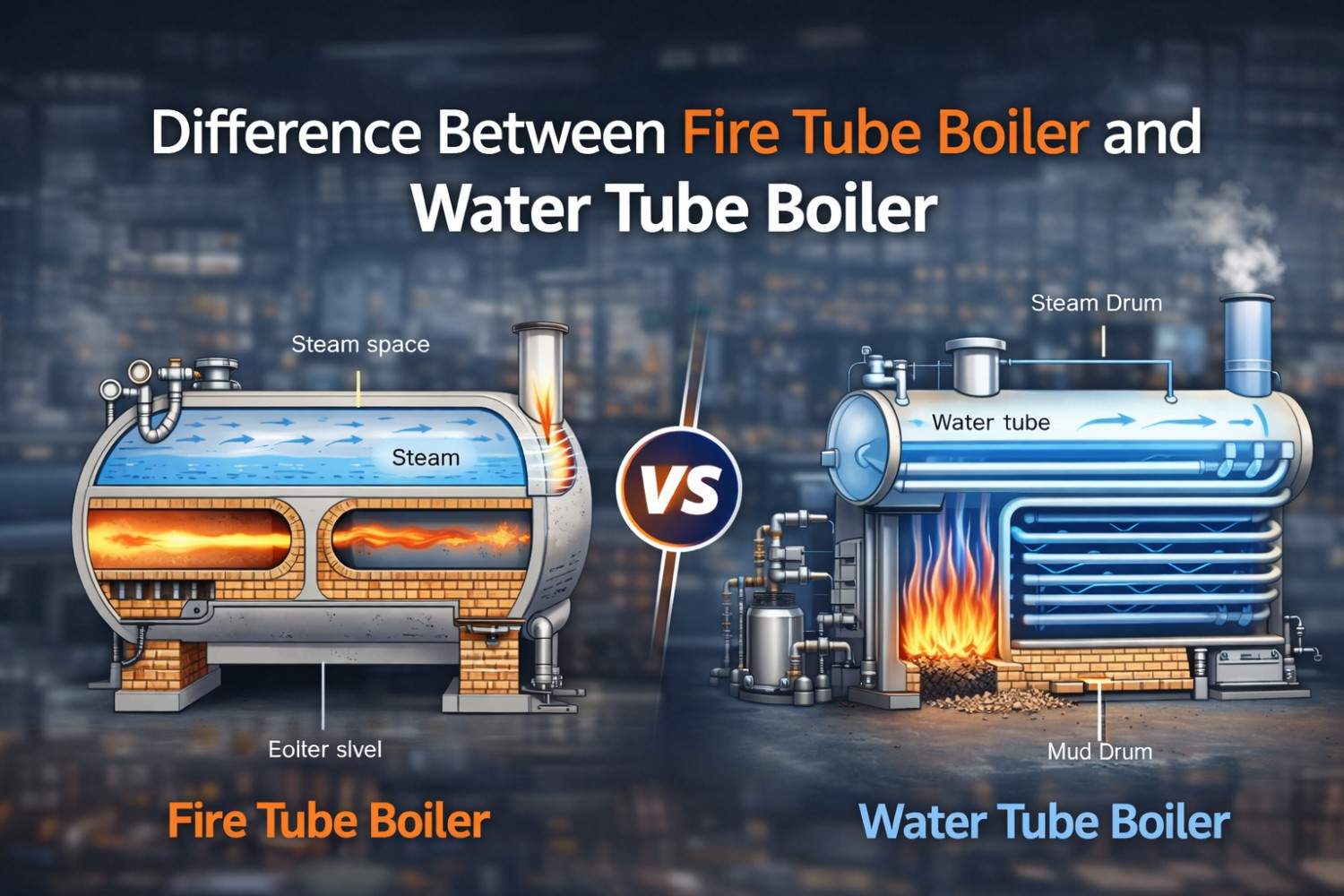
Boilers are the backbone of steam generation in industries such as power plants, manufacturing, refineries, food processing, and chemical production. Among the various designs available, fire tube boilers and water tube boilers are the two most widely used types. Although both serve the same purpose, producing steam, their construction, working principle, operating pressure, efficiency, and industrial applications are fundamentally different.
Understanding the difference between fire tube boiler and water tube boiler is essential for engineers, plant managers, and students because the choice directly affects safety, efficiency, space requirement, operating cost, and scalability. In small industries, a compact and economical boiler may be ideal, while large power plants demand high-pressure, high-capacity steam generation. This guide clearly explains how fire tube and water tube boilers differ, where each type is best used, and why selecting the right boiler matters in real-world engineering systems.
What Is a Fire Tube Boiler?
A fire tube boiler is a boiler in which hot flue gases flow inside the tubes, and water surrounds these tubes. Heat from the flue gases is transferred through the tube walls to the surrounding water, producing steam.
Key Characteristics of Fire Tube Boilers
- Hot gases pass through tubes; water remains outside
- Operates at low pressure (up to ~25 bar)
- Low steam generation rate (around 9 tonnes/hour)
- Requires more floor area for the same power output
- Simple construction and operation
- Lower initial and operating cost
Fire tube boilers are commonly used in small power plants, workshops, textile units, and process industries where steam demand is limited and relatively steady.
Fire tube boilers are commonly used for low-pressure and small-capacity steam applications. Typical examples include:
- Cochran Boiler – Vertical, multi-tubular boiler used in small industries
- Lancashire Boiler – Horizontal boiler with two large fire tubes
- Cornish Boiler – Horizontal boiler with a single large fire tube
- Scotch Marine Boiler – Widely used in ships and marine applications
- Locomotive Boiler – Used in steam locomotives for rapid steam generation
What Is a Water Tube Boiler?
A water tube boiler is a boiler in which water flows inside the tubes, and hot flue gases surround the tubes. Steam is generated inside the tubes as water absorbs heat from the gases.
Key Characteristics of Water Tube Boilers
- Water flows inside tubes; hot gases remain outside
- Operates at very high pressure (up to ~165 bar or more)
- Very high steam generation rate (up to 450 tonnes/hour)
- Requires less floor area for the same power output
- Higher efficiency (up to 90% with economizer)
- Suitable for fluctuating and continuous heavy loads
Water tube boilers are widely used in thermal power plants, large industrial plants, and modern power generation systems.
Water tube boilers are designed for high-pressure, high-capacity steam generation, especially in power plants. Common examples are:
- Babcock and Wilcox Boiler – Widely used in thermal power plants
- Stirling Boiler – Multiple-drum water tube boiler
- Benson Boiler – Supercritical, once-through boiler
- Loeffler Boiler – Uses superheated steam for evaporation
- Lamont Boiler – Forced circulation high-pressure boiler
Also Read:
- Lancashire Boiler Construction, Working with Diagram
- Cochran Boiler – Main Parts, Working, Advantages and Disadvantages
- What is a Boiler? Different Types of Boiler
Difference Between Fire Tube Boiler and Water Tube Boiler (Tabular Comparison)
| S.No | Fire Tube Boiler | Water Tube Boiler |
| 1 | Hot flue gases flow inside the tubes | Water flows inside the tubes |
| 2 | Low-pressure boiler (~25 bar) | High-pressure boiler (~165 bar) |
| 3 | Low steam generation rate (~9 TPH) | Very high steam generation (~450 TPH) |
| 4 | Requires more floor area (~8 m²/TPH) | Requires less floor area (~5 m²/TPH) |
| 5 | Transportation and erection are difficult | Transportation and erection are easier |
| 6 | Efficiency up to ~75% | Efficiency up to ~90% with economizer |
| 7 | Handles fluctuating loads for short periods | Handles fluctuating loads continuously |
| 8 | Water circulation path not well defined | Water circulation path is well defined |
| 9 | Low operating cost | High operating cost |
| 10 | Lower bursting chances | Higher bursting chances due to pressure |
| 11 | Bursting causes major boiler damage | Bursting causes limited overall damage |
| 12 | Can be operated by less skilled personnel | Requires skilled operators |
| 13 | Low maintenance cost | High maintenance cost |
| 14 | Lighter construction | Heavier construction |
| 15 | Suitable for small power plants | Suitable for large power plants |
How Fire Tube Boiler Differs from Water Tube Boiler in Practice
Pressure and Capacity
Fire tube boilers are ideal where low-pressure steam is sufficient, while water tube boilers are designed for high-pressure, high-capacity steam generation.
Safety and Risk
Although fire tube boilers operate at lower pressure, a tube failure can damage the entire shell. In water tube boilers, tube failure usually causes localized damage, making them safer for high-pressure operations.
Efficiency and Performance
Water tube boilers offer higher efficiency and faster steam raising, making them suitable for power generation and large industrial loads.
Space and Scalability
Water tube boilers occupy less floor space for the same output and can be scaled easily for large plants, whereas fire tube boilers are bulkier for equivalent power.
Conclusion
Fire tube boilers and water tube boilers differ significantly in construction, pressure handling, efficiency, and application. Fire tube boilers are simple, economical, and ideal for small-scale, low-pressure steam requirements. In contrast, water tube boilers are engineered for high-pressure, high-capacity operations, making them indispensable in modern power plants and large industries. Choosing the right boiler depends on steam demand, operating pressure, safety requirements, space availability, and long-term operating costs. By understanding these differences clearly, engineers and decision-makers can select the most efficient and reliable boiler system for their specific industrial needs. For deeper understanding, explore boiler mountings, accessories, and real-world industrial boiler applications.
FAQs
Fire tube boilers carry hot gases inside tubes, while water tube boilers carry water inside tubes.
Water tube boilers are safer and more suitable for high-pressure applications.
Water tube boilers have higher efficiency, especially with economizers.
They are simpler, cheaper, and adequate for low steam demand.
Water tube boilers require less floor area for the same steam output.
Only for short durations; water tube boilers handle fluctuations better.
Water tube boilers have a much higher steam generation rate.
Due to high pressure, complex controls, and safety requirements.
Fire tube boilers generally have lower maintenance costs.
Water tube boilers are used in thermal power plants.
Fire Tube vs Water Tube Boiler – Knowledge Check
Please select an option before continuing.