
The Cochran boiler is a compact, vertical, multi-tubular fire-tube boiler designed for low-pressure steam generation. It is widely used in small industries where space is limited and steam demand is moderate. What makes the Cochran boiler unique is its hemispherical furnace, which provides better strength and improved heat transfer compared to older vertical boilers.
This boiler operates on natural circulation and natural draught, making it simple to operate and reliable for continuous use. Due to its improved efficiency over simple vertical boilers, the Cochran boiler has played an important role in early industrial steam applications and is still relevant today for small-scale power and process requirements.
What Is a Cochran Boiler?
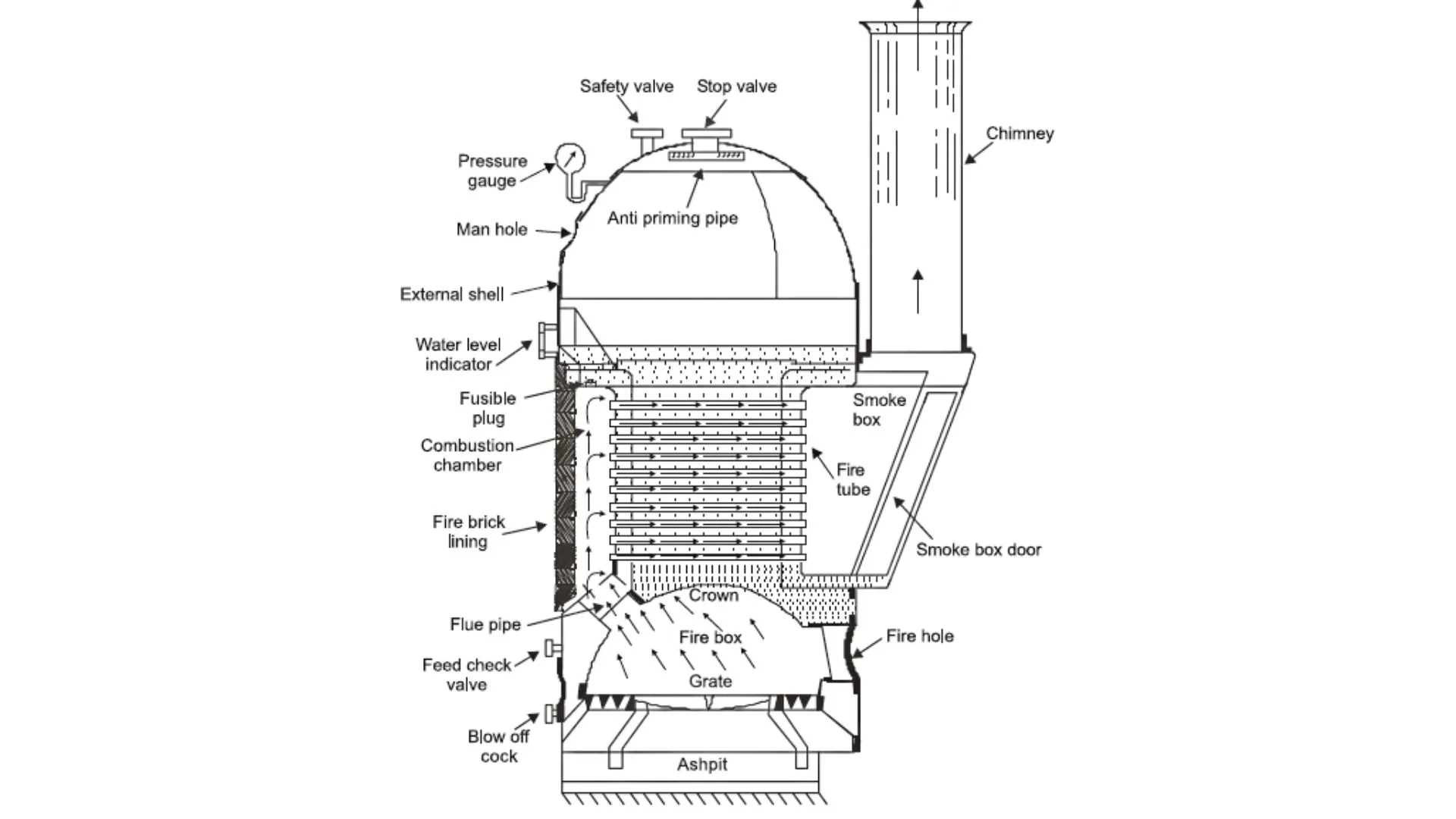
A Cochran boiler is a vertical, internally fired, fire-tube boiler in which hot flue gases pass through horizontal fire tubes surrounded by water. The boiler is mainly used for producing steam at low pressure for industrial and utility purposes.
Key characteristics:
- Vertical drum axis
- Natural circulation and natural draught
- Multi-tubular fire-tube design
- Solid fuel, oil, or gas fired
- Low-pressure steam generation
Construction of Cochran Boiler
The main parts of a Cochran boiler and their functions are explained below.
1. Boiler Shell
The shell is a vertical cylindrical drum with a hemispherical dome at the top. The hemispherical shape helps the boiler withstand internal pressure safely and efficiently.
2. Grate
The grate is the platform where solid fuel is placed and burned. It supports the fuel while allowing air to pass from below for combustion.
3. Furnace
The furnace is located at the bottom of the boiler. This is where the fuel burns and generates hot flue gases.
4. Combustion Chamber
The combustion chamber is positioned above the furnace. It allows complete combustion of fuel before the gases enter the fire tubes.
5. Fire Tubes
Cochran boiler uses multiple horizontal fire tubes. Hot flue gases pass through these tubes, transferring heat to the surrounding water.
6. Fire Hole
The fire hole is provided to insert fuel into the furnace and ignite it.
7. Flue Pipe
The flue pipe connects the firebox to the combustion chamber and guides hot gases upward.
8. Chimney
The chimney is attached to the smokebox and discharges exhaust gases into the atmosphere. Its height is relatively small compared to large industrial boilers.
9. Fire Brick Lining
Fire bricks line the combustion chamber to withstand high temperatures and improve combustion efficiency.
10. Manhole
A manhole is provided for internal inspection, cleaning, and maintenance of the boiler.
Boiler Mountings and Accessories
To ensure safe and efficient operation, the following mountings are used:
- Pressure Gauge – Measures steam pressure inside the boiler
- Safety Valve – Releases excess steam to prevent over-pressure
- Water Level Indicator – Shows the water level inside the shell
- Steam Stop Valve – Controls steam flow to the application
- Blow-off Valve – Removes mud, sediments, and impurities
- Fusible Plug – Protects the boiler from overheating by extinguishing the fire
Also Read:
- Babcock and Wilcox Boiler – Construction, Working, Application, Advantages and Disadvantages
- Locomotive Boiler – Construction Working and Application with Diagram
- Benson Boiler – Construction, Working Principle and Advantages with Diagram
Working Principle of Cochran Boiler
The working of the Cochran boiler follows a simple and effective heat-transfer process:
- Fuel is fed through the fire hole and burned on the grate inside the furnace.
- Hot flue gases produced during combustion rise through the flue pipe into the combustion chamber.
- From the combustion chamber, the gases flow through horizontal fire tubes.
- Heat from the flue gases is transferred to the surrounding water, raising its temperature.
- Water converts into steam, which rises and collects in the hemispherical dome at the top.
- An anti-priming pipe separates moisture from steam to supply dry steam.
- Steam is delivered through the steam stop valve to the required application.
- Exhaust gases exit through the smokebox and chimney.
- Ash falls into the ash pit, and impurities are removed using the blow-off valve.
If overheating occurs, the fusible plug melts, allowing water to quench the fire and prevent damage.
Advantages of Cochran Boiler
- Low initial installation cost
- Requires less floor space
- Simple construction and easy operation
- Safe and reliable for low-pressure use
- Can use different types of fuel
- Easy transportation and installation
Disadvantages of Cochran Boiler
- Low rate of steam generation
- Not suitable for high-pressure applications
- Inspection and maintenance can be difficult
- Requires high headroom due to vertical design
- Limited capacity compared to modern boilers
Applications of Cochran Boiler
Cochran boilers are commonly used in:
- Small manufacturing units
- Food processing plants
- Textile industries
- Chemical laboratories
- Workshops and utility services
Conclusion
The Cochran boiler is a dependable solution for low-pressure steam generation where simplicity, safety, and compact design are essential. Its hemispherical furnace, vertical configuration, and multi-tubular fire-tube arrangement provide better efficiency than older vertical boilers while keeping operational costs low. Although it is unsuitable for high-pressure or large-capacity applications, the Cochran boiler remains an important learning model and a practical choice for small industrial steam needs.
Frequently Asked Questions (FAQs)
Cochran boiler is a fire-tube boiler.
The hemispherical shape provides higher strength and better heat transfer.
It operates at low pressure.
Natural circulation is used.
It can produce steam, but it is not suitable for large-scale power generation.
Solid fuel, oil, or gas can be used.
It prevents overheating and boiler damage.
No, it is internally fired.
Due to improved furnace design and multiple fire tubes.
Yes, for small-scale and low-pressure steam applications.
Cochran Boiler – Knowledge Check
Please select an option before continuing.