
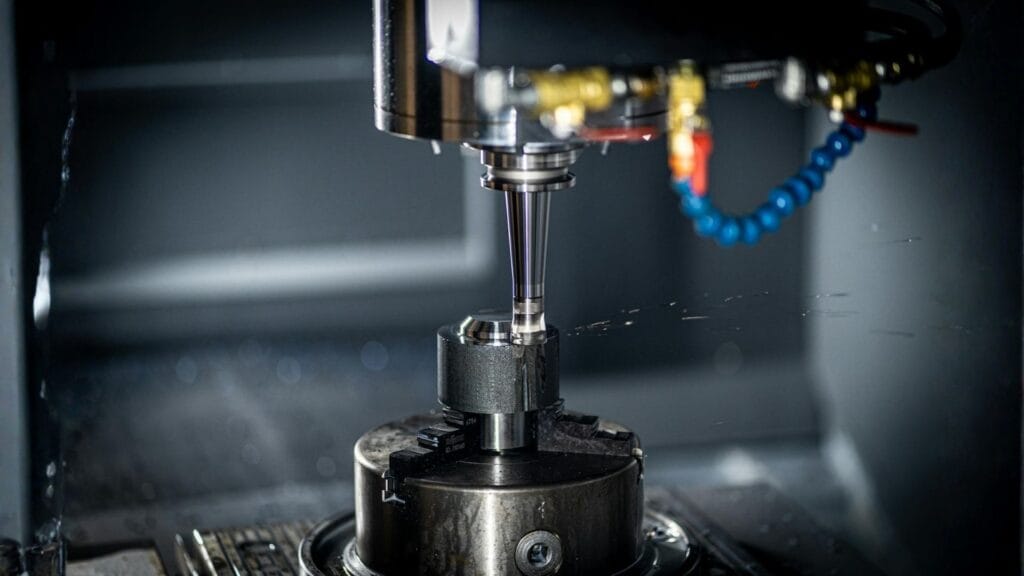
Modern manufacturing industries require high precision, efficiency, and reliability when producing mechanical components. Over the past few decades, one technology that has significantly transformed the manufacturing sector is Computer Numerical Control (CNC) machining.
CNC machining allows manufacturers to produce complex parts with high accuracy using automated machine tools controlled by computers. Compared with traditional manual machining, CNC machining offers better consistency, repeatability, and efficiency.
Today, CNC machining is widely used in industries such as aerospace, automotive, robotics, electronics, and medical device manufacturing. It plays a vital role in both prototype development and large-scale production.
In this article, we will discuss the definition of CNC machining, its working principle, different types of machining operations, advantages of the process, and its major industrial applications.
What is CNC Machining?
CNC machining is a subtractive manufacturing process in which material is removed from a solid block using computer-controlled cutting tools.
The process begins with a digital design of the component created using CAD (Computer-Aided Design) software. This digital model is then converted into machine instructions using CAM (Computer-Aided Manufacturing) software.
These instructions guide the CNC machine to perform precise cutting operations. The machine automatically controls the movement of cutting tools and the workpiece based on programmed commands.
Because CNC machines follow digital instructions, they can produce parts with extremely high accuracy and repeatability.
Modern CNC machines may operate on multiple axes, including:
- 3-axis machining
- 4-axis machining
- 5-axis machining
Multi-axis machining allows tools to approach the workpiece from different angles, enabling the production of complex geometries that would be difficult to achieve using conventional machining methods.
Working Principle of CNC Machining
The CNC machining process involves several important steps that ensure accurate manufacturing.
1. CAD Design
The first step is creating a 3D digital model of the component using CAD software such as SolidWorks, Fusion 360, or AutoCAD. This model defines the geometry, dimensions, and structural features of the part.
2. CAM Programming
The CAD design is imported into CAM software, which generates toolpaths and converts the design into machine-readable instructions known as G-code.
This program determines parameters such as:
- cutting speed
- feed rate
- tool selection
- machining sequence
3. Machine Setup
Before machining begins, the workpiece material is mounted securely on the machine table. Cutting tools are installed in the spindle and the machine is calibrated.
Proper setup ensures that the machining process is accurate and stable.
4. Machining Operation
Once the program is executed, the CNC machine removes material from the workpiece using rotating cutting tools. The process continues until the desired shape and dimensions are achieved.
Because the process is computer controlled, CNC machines can produce identical parts repeatedly with minimal variation.
Types of CNC Machining Operations
Different machining operations are used depending on the geometry and design of the component.
CNC Milling
CNC milling is one of the most widely used machining processes. In milling operations, rotating cutting tools remove material from a stationary workpiece.
CNC milling machines are capable of producing features such as:
- slots
- pockets
- contours
- grooves
- threaded holes
Advanced 5-axis milling machines allow manufacturers to machine complex surfaces and intricate geometries in a single setup.
CNC Turning
CNC turning is commonly used for cylindrical parts. In this process, the workpiece rotates while a stationary cutting tool removes material.
Typical turned components include:
- shafts
- bushings
- threaded connectors
- cylindrical housings
Turning operations are usually performed using CNC lathes.
CNC Drilling
CNC drilling machines are used to create holes with high precision. Multiple holes can be drilled automatically according to the programmed coordinates.
Drilling is often combined with milling operations when manufacturing mechanical assemblies.
Advantages of CNC Machining
CNC machining offers several advantages that make it one of the most widely used manufacturing processes.
High Precision
Modern CNC machines can achieve extremely tight tolerances, often within ±0.01 mm. This level of accuracy is essential in industries where precise dimensions are required.
Excellent Repeatability
Once a machining program is created, the same part can be produced repeatedly with consistent quality.
Ability to Produce Complex Shapes
Multi-axis CNC machines allow engineers to manufacture parts with complex geometries and curved surfaces.
Wide Range of Materials
CNC machining can process many different materials, including:
- aluminum alloys
- stainless steel
- titanium
- brass
- engineering plastics
This flexibility allows manufacturers to choose materials based on performance requirements.
Industrial Applications of CNC Machining
CNC machining is widely used across many industries because of its ability to produce precise and reliable components.
Aerospace Industry
Aircraft components must meet extremely strict quality standards. CNC machining is used to produce structural brackets, housings, and engine components that require high strength and precision.
Automotive Industry
Automotive manufacturers rely on CNC machining to produce engine components, transmission parts, and prototype components during vehicle development.
Robotics and Automation
Robotics systems require high precision mechanical components such as joint housings, motor mounts, and sensor brackets. During the development stage, engineers often work with providers offering precision CNC machining services to manufacture prototype components and small production batches.
These components allow engineers to test mechanical performance and optimize the design before moving to full production.
Product Development and Prototyping
CNC machining is also widely used in product development because it allows engineers to quickly produce functional prototypes.
Many companies rely on specialized prototype manufacturing solutions to create early-stage product models for testing, design verification, and engineering validation.
This rapid iteration process significantly reduces development time and helps bring new products to market more efficiently.
Medical Device Manufacturing
Medical devices and surgical instruments require extremely high precision and reliability. CNC machining is commonly used to produce components that meet strict regulatory and quality standards.
Design Considerations for CNC Machined Parts
When designing components for CNC machining, engineers should consider several important factors.
Avoid Deep Cavities
Very deep pockets require long cutting tools, which may reduce machining stability. Designers should try to minimize pocket depth whenever possible.
Use Standard Hole Sizes
Standard drill sizes simplify the machining process and reduce manufacturing costs.
Apply Tolerances Carefully
Not every feature requires extremely tight tolerances. Over-specifying tolerances can increase machining time and production costs.
Choose Materials Wisely
Material selection plays an important role in part performance and machinability.
Conclusion
CNC machining is one of the most important manufacturing technologies used in modern engineering. By combining digital design tools with automated machining equipment, manufacturers can produce complex components with high precision and consistency.
Because of its versatility, accuracy, and efficiency, CNC machining is widely used in industries such as aerospace, automotive, robotics, and medical device manufacturing.
As product designs continue to evolve and become more sophisticated, CNC machining will remain a fundamental process for transforming digital designs into reliable mechanical components.