
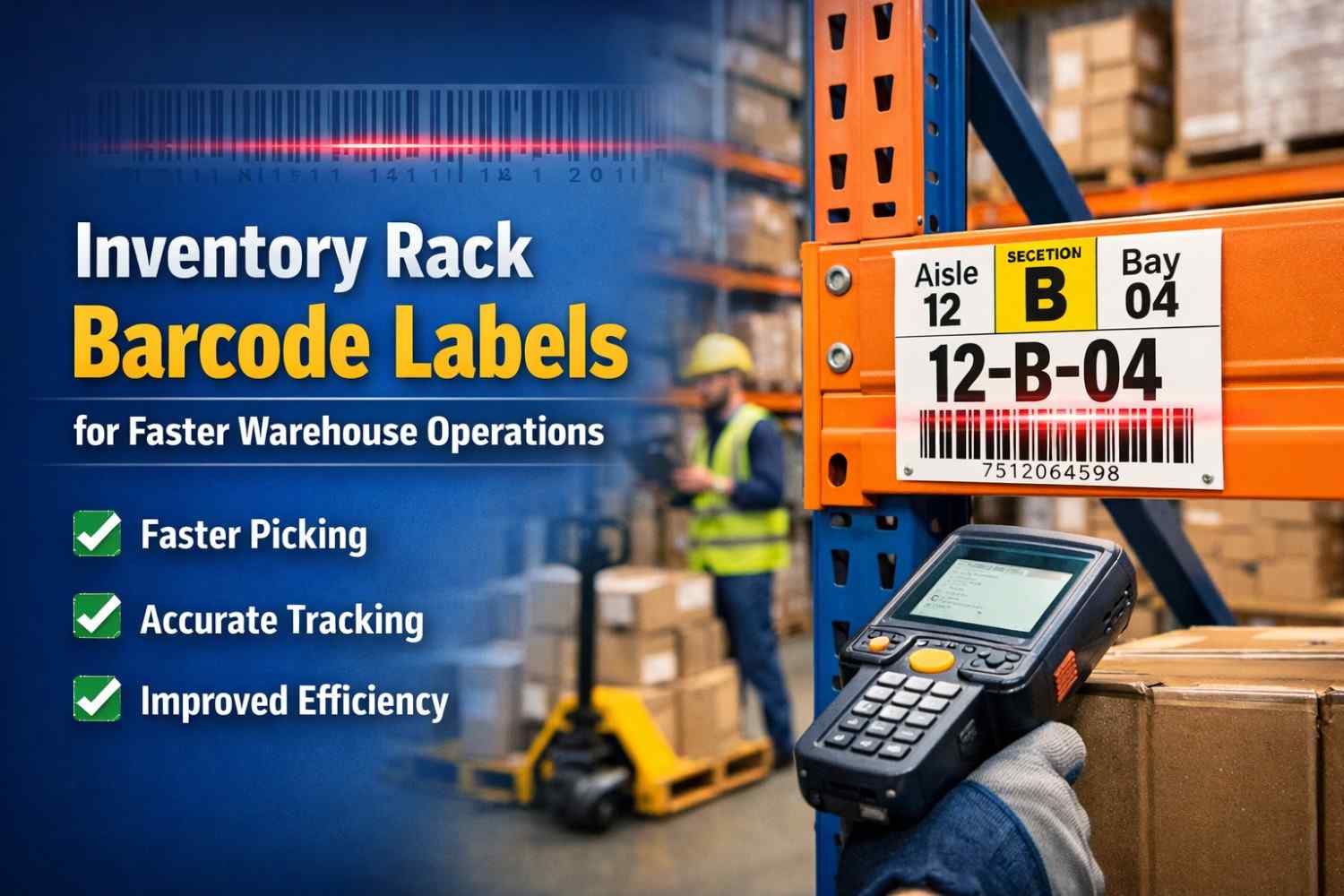
In the high-speed logistics and warehousing industry, speed and accuracy are key factors in success. Inventory rack barcode labels are among the most effective and efficient methods. Unlike any previous method of inventory rack identification, an inventory rack barcode label bridges the gap between physical inventory and digital recordkeeping. Assigning unique numbers to inventory racks and using barcode labels prevents confusion and human error and maximizes visibility in inventory recording and management. Given its efficiency and effectiveness, an inventory rack barcode label remains an integral tool for any warehouse or production facility aiming to maximize speed and efficiency at every step.
Enhancing Traceability and Real-Time Control
Barcode technology drove a paradigm shift in warehouse inventory management, replacing manual processes with instant, automated one. Barcode labeling on storage racks enables instant reading by scanners or automated systems, enabling continuous monitoring. When inventory locations are labeled, they provide a virtual inventory layout that enables workers to easily access products for picking and replenishment. Barcode labeling systems not only enable rapid processing but also eliminate duplicate records, lost products, and stock variance issues. Barcodes provide an instantaneous view of warehouse inventory and product turnaround time to the marketplace. Such tracing systems also enhance accountability by enabling easy identification of operational flow problems and allowing operational adjustments accordingly. Barcode labeling systems are essential when accurate automation is required for inventory management.
1. Integrating Barcode Systems for Smarter Warehousing
The use of barcode solutions in contemporary warehouse management systems has changed how organizations tackle logistics. Inventory rack barcodes have enabled companies to link physical locations in warehouses to their computerized inventory systems. Barcode solutions enable organizations to instantly update product information with every scan. There is no need for reconciliation between physical and computerized inventory because barcodes eliminate discrepancies and optimize decision-making. Barcode solutions have also achieved seamless integration with the software applications organizations use for forecasting and shipping. The increasing use of robotics in warehouses means that inventory rack barcodes will play a pivotal role in aligning organizational and technological realities.
2. Durability and Design for Industrial Conditions
Barcode stickers for inventory rack storage are designed to withstand even the harsh conditions commonly found in storage facilities. Conditions such as dust, high temperatures, moisture, and scratches are factors that normal stickers cannot withstand. However, high-quality barcode stickers are made from materials such as polyester, vinyl, or aluminum to ensure readability even in poor conditions. Barcodes made from this material will remain durable even under solvent exposure during cleaning or routine handling. High-quality barcode stickers are printed with high-contrast markings to ensure easy scanning from all directions and at varying distances, reducing search time. Some storage facilities use special reflective barcodes that make them visible even in low light. Similarly, these facilities may use colored barcodes to increase visibility, even when products are stacked high on shelves.
3. Supporting Lean and Automated Inventory Practices
Barcode labeling is fully integrated with lean inventory system principles to increase efficiency and reduce waste. Barcode labeling also reduces the time spent on manual searches, prevents redundant checks, and ensures items are stored at their proper locations. Additionally, in an automated environment, barcodes can be used to connect a control system to physical items. The use of scanners, AGVs, or robotics is also feasible with proper label placement. The entire process provides a seamless environment that requires minimal human intervention while maintaining control. Integrating a warehouse with technology requires systems such as barcodes to keep automation in sync with the real world.
4. Enhancing Safety and Regulatory Compliance
Barcode labels on the inventory rack are critical to ensuring safety and compliance in an industrial setting. Barcode labeling on the inventory rack creates important data points, including weight capacities, product descriptions, and restricted zones, which help prevent hazards from material overload and improper storage. Staying compliant with safety standards, most notably in the food, healthcare, and chemical industries, is important, as is maintaining material traceability in the setting. Barcode solutions help address this problem by keeping all data points accurately digitized and accessible whenever an audit is conducted for compliance. In addition, barcodes on the inventory rack improve safety by enabling employees to quickly locate critical materials, which is essential for responding to safety hazards such as air quality issues, spills, and other threats.
5. Reducing Costs Through Accuracy and Reusability
Operational mistakes can cause substantial financial damage to a storage facility, ranging from lost shipments to late shipments. Barcode labeling eliminates these mistakes by enabling a structured, foolproof tracking system for every product or item entering a facility. This method significantly reduces reliance on manual processes, thereby decreasing time spent and the potential for errors by reducing the hours personnel spend manually entering data into the system. In due course, efficiency will mean fewer orders, better space management, and lower write-offs from lost products. Another cost-saving benefit is the use of replaceable or reusable barcodes, which directly benefits facilities operating on narrow profit margins.
6. Customization and Adaptability for Different Industries
Every industry has its own label requirements, and barcode systems can be adapted accordingly. Large, clearly visible labels are used in the retail and e-commerce sectors for quick order fulfillment, while temperature-resistant materials that maintain adhesion in freezing temperatures are used by cold storage facilities. Many manufacturers use color-coding or dual-layer labels with both visual and scannable information for simplifying complex workflows. Branding and directional markers can also be added to custom designs, thereby enhancing functionality and aesthetic appeal. The ability to customize barcode labels ensures systems remain compatible with the operational requirements of businesses ranging from small component bins to multi-level pallet racks. As explained above, barcode labeling is one of the key reasons it remains an enduring technology in modern inventory systems.
Building Accuracy and Efficiency Through Labeling
The key to a successful warehouse lies in its ability to handle inventory efficiently, and one of the best ways to do so is barcode labeling. The use of inventory rack barcode labels is one of the greatest successes in enabling warehouses to operate in an organized, technology-enabled way. Using inventory rack barcode labels is one of many ways to improve efficiency and accuracy in warehouses. The ease with which it is possible to apply and use them makes it one of the pivotal tools for ensuring that a warehouse is properly organized and that everything is working in a manner that is needed. In a world where logistics are accelerating rapidly and fulfillment is a precision activity, it is no surprise that barcode labeling is the driving force.