
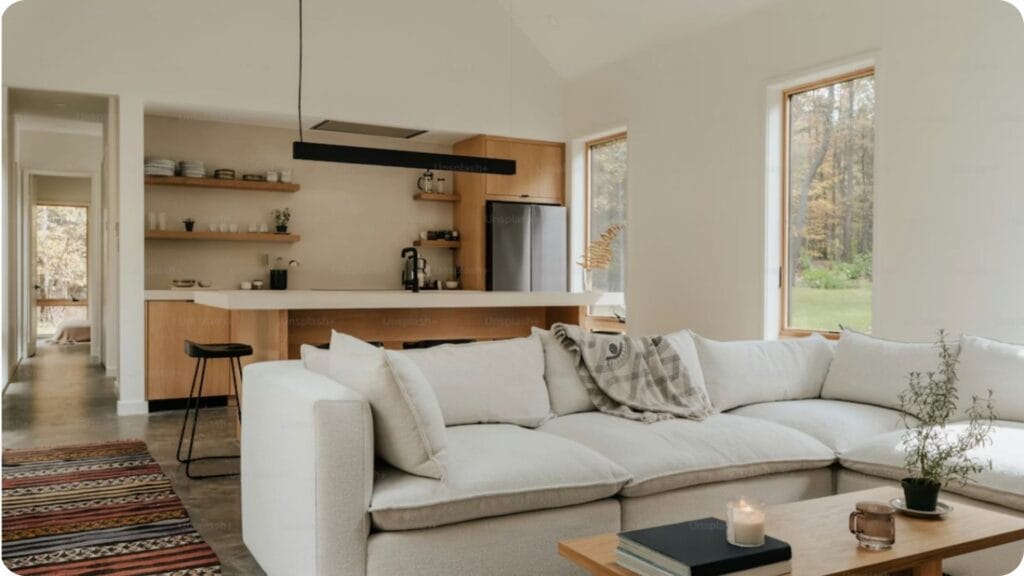
Your couch is doing more work than you think. Seriously, behind every cushion and corner bracket is a stack of calculated decisions most buyers never consider. Modern sectionals have to look great, survive years of real use, and flex with how your life changes.
That’s a tall order. It demands material science, ergonomic modeling, and structural precision that goes far deeper than what shows up on a product tag. According to Gitnux, 65% of design furniture buyers prioritized multifunctional pieces amid hybrid work trends. Shoppers aren’t just browsing anymore, they’re demanding more from their furniture.
When you’re evaluating what to bring into your home, knowing how a sofa is actually built changes your entire decision-making process.
Not just aesthetically, practically. The difference between a sectional that holds up a decade from now and one that squeaks and sags within eighteen months often comes down to engineering choices invisible to the naked eye.
Let’s get into the mechanics.
Core Principles of Sectional Sofa Design from a Mechanical Engineering Standpoint
There’s no such thing as a great sofa that happened by accident. Every well-built sectional reflects intentional choices grounded in physics, ergonomics, and material behavior, all working together quietly underneath the upholstery.
Ergonomics and Human Factors Driving Sectional Sofa Structural Analysis
Proper sectional sofa structural analysis starts with the human body, not a mood board. Engineers rely on anthropometric data representing the 5th through 95th percentile of the population to establish ideal seat depth, lumbar positioning, and cushion firmness.
Sit on a couch that’s too deep, and your lower back loses contact with the backrest within minutes. Too shallow, and it feels like perching on a ledge. Neither extreme is comfortable long-term. Getting this geometry right isn’t artistry, it’s measurement applied strategically to how humans actually sit.
Materials Science: Choosing Components That Hold Up
Understanding how bodies interact with furniture is half the challenge. The other half is selecting materials engineered to support that interaction repeatedly, over years of daily use.
High-density polyurethane foam, kiln-dried hardwood, and advanced synthetic textiles are specified based on quantifiable mechanical properties: compression resistance, fatigue behavior, load distribution.
Engineers run these materials through repeated stress cycles, not to check a box, but to realistically predict lifespan. That process directly shapes modular sectional sofa engineering decisions around both durability and visual longevity.
The Anatomy of a Sectional: What’s Actually Holding You Up
Internal Frame Engineering for Living Room Sectional Sets
Everything starts with the frame. When evaluating living room sectional sets, engineers compare kiln-dried hardwood, engineered wood composites, and steel options using finite element analysis software, tools that simulate load conditions accumulated across years of actual use.
Corner joinery doesn’t get to be an afterthought. Every connection point is a potential failure zone. That’s precisely why modern designs lean on reinforced metal brackets and dado joints that spread stress across a surface area instead of concentrating it at a single point. The frame either holds the whole structure together or quietly becomes its weakest link.
Modular Configuration and Load-Bearing Design
A strong frame is the foundation. But it’s modular configuration and load-bearing innovation that give contemporary sectionals their adaptability and structural resilience.
Connectors, mechanical latch systems, magnetic couplers, interlocking brackets, have to maintain alignment under dynamic, shifting loads. An L-shaped layout distributes weight differently than a U-shape.
Engineers model both configurations to ensure no single section carries a disproportionate share of stress during everyday use. When this is done right, you never notice. When it isn’t, you feel it within months.
Advanced Mechanisms and Smart Features
Reclining Systems, Motion, and Adjustable Headrests
Mechanical engineering sectional sofa designs that incorporate reclining mechanisms face a different category of challenge entirely. Motors, hydraulic pistons, and manual lever assemblies must perform reliably through thousands of actuation cycles while meeting BIFMA and ANSI safety certifications.
Think about that number, thousands of cycles. A mechanism that fails at 5,000 repetitions isn’t fit for a product expected to last a decade. Reliability testing isn’t optional; it’s the whole point.
Embedded Technology in Modern Sectional Sofa Design
Once motion systems are locked in, engineers layer smart technology directly into the structure.
Posture-detecting sensors can trigger automatic lumbar adjustments based on how you’re sitting. Wireless charging pads, USB ports, and integrated speaker systems are now engineered into frame cavities, without sacrificing structural integrity. That integration requires genuine precision, not just clever placement.
User-Centered Customization: Design Your Own Sectional Sofa
Parametric Design Tools and Configuration Platforms
The ability to design your own sectional sofa has expanded dramatically, and it’s changed what consumers expect.
Parametric CAD platforms let users adjust seat depth, module width, fabric type, and leg height in real time, with engineering validation running silently in the background as they configure.
Customization demand rose 34% among U.S. consumers aged 25–34 in 2023 furniture surveys. That’s not a trend quietly fading, it’s a baseline expectation that furniture manufacturers are now designing around.
From Digital Model to Physical Prototype
The configurator is a powerful starting point. But the real test happens when that digital design becomes a physical object.
CNC machining and 3D printing make rapid iteration possible, which means engineering flaws get identified and corrected before mass production begins, not after a product reaches a showroom floor and disappoints early buyers. That sequence matters enormously to quality control.
Sustainability and Lifecycle Analysis in Sectional Sofa Structural Analysis
Eco-Friendly Thinking in Mechanical Engineering Sectional Sofas
Modular design isn’t just a flexibility feature, it’s genuinely sustainable thinking in action. When one section wears out, you replace that section.
The entire sofa doesn’t end up in a landfill. Cradle-to-cradle engineering philosophy pushes designers toward recyclable steel frames, natural fiber cushion fills, and slipcover fabrics that can be responsibly repurposed.
These aren’t marketing claims, they’re design decisions made at the earliest structural stages.
Expert Tips for Getting More from Your Sectional
Structural Stability Over Time
Poorly engineered sectionals announce themselves quickly. Squeaking joints. Cushions that lose shape within a year. Wobbly connectors that shift under load. If any of those show up early, the frame or support system failed before you ever sat down.
Always look for kiln-dried hardwood frames, eight-way hand-tied or sinuous spring systems, and actual BIFMA-certified testing documentation before committing to a purchase.
Engineering Meets Aesthetics
Structural performance and visual appeal aren’t competing priorities, or they shouldn’t be. The best sectional sofa design projects bring mechanical engineers and interior designers into the same room early in the process, resulting in pieces that meet load-bearing requirements while still offering clean, considered silhouettes.
A sectional that holds up perfectly but looks wrong in your space solves only half the problem.
Buying Smarter
Every sectional you’ve ever sat on carries the fingerprints of hundreds of engineering decisions made long before it arrived in a store. Frame joinery, cushion density, connector design, spring selection, mechanical engineering touches every dimension of how comfortable and durable that piece becomes over time.
Understanding these principles doesn’t require an engineering degree. It just requires knowing what to ask and what to look for. A well-engineered sectional isn’t simply a furniture purchase. It’s a long-term commitment to how comfortably and confidently you live inside your own home, and that’s worth getting right.
Frequently Asked Questions
Weak corner joints, low-density foam, and unbraced frames top the list. These failures cause sagging, wobbling, and accelerated wear, typically visible within the first year of regular use.
Modular systems engineer each section to bear loads independently and collectively. Traditional sectionals are often permanently joined, which limits reconfiguration and makes single-section repairs significantly harder.
BIFMA and ANSI certifications confirm the sofa meets standardized structural safety and durability benchmarks through rigorous third-party testing, completed before the product ever reaches a showroom.
Some USB charging modules and speaker systems can be added aftermarket. But structural smart features, posture sensors, for instance, typically require integration during original manufacturing. Retrofitting those usually isn’t practical.