
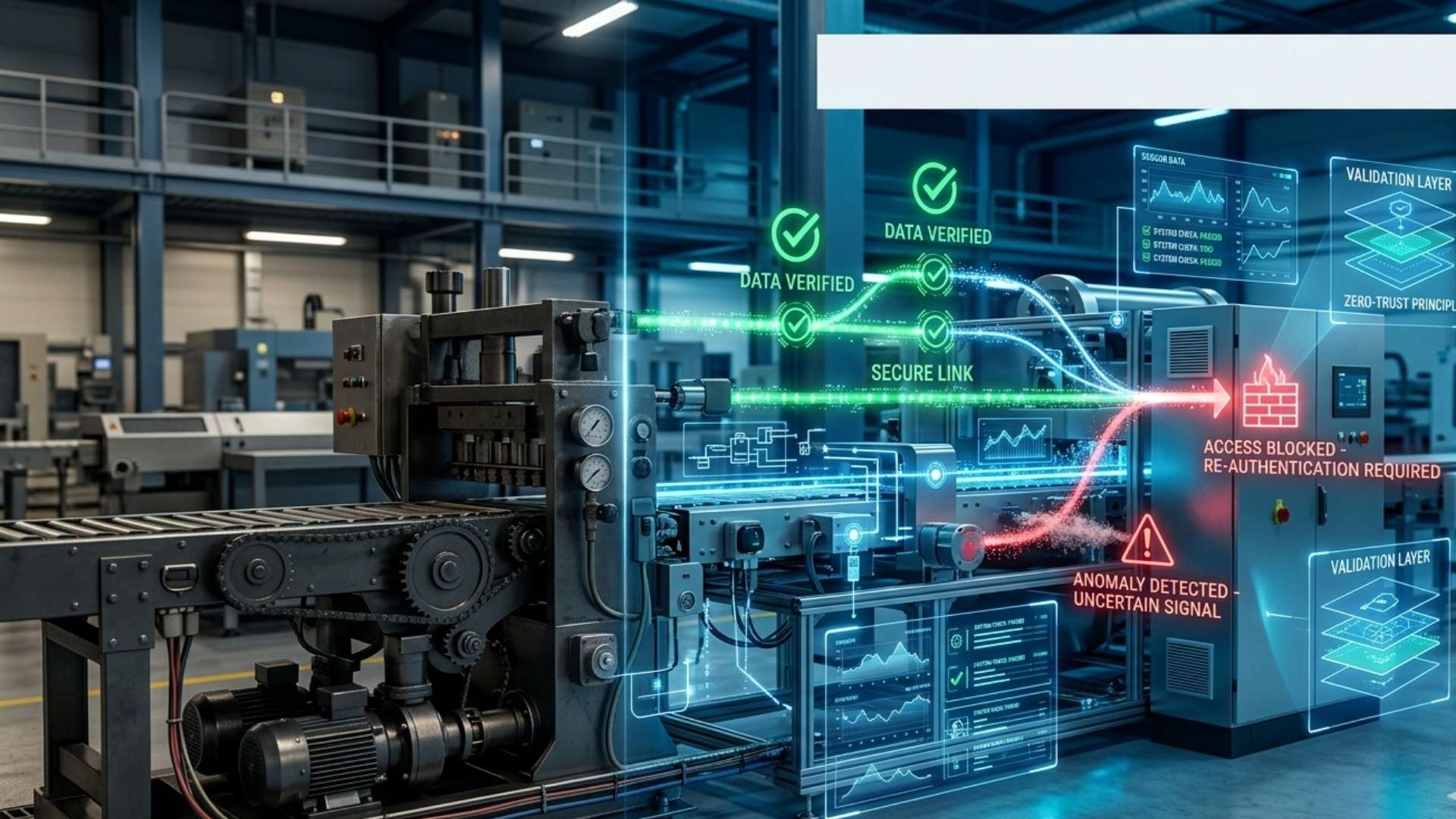
There was a time when machines were far more predictable than they are now. When a system was designed properly, looked after with regular maintenance, and used within its intended limits, it would generally behave exactly the way it was expected to. And there was a certain level of comfort in that; inputs led to clear outputs, and most things followed a steady, understandable pattern. That picture has shifted quite a bit. Modern machines are no longer working in isolation; they’re connected, data-driven systems that depend on sensors, software, and inputs coming from different places. But with that added capability comes a bit more uncertainty. Components don’t always fail in obvious ways, signals can get distorted along the way, and data isn’t always as clean or reliable as it seems at first glance. Sometimes everything looks fine on the surface, but the system is working off something slightly off underneath. This is where zero-trust starts to come into play. It brings in a more grounded way of thinking, one that doesn’t automatically assume everything inside the system is working perfectly, but instead checks and confirms things as they go.
Understanding Zero-Trust in Mechanical Design
Zero-trust might sound like something meant only for IT networks, but the principle translates naturally into engineering. At its core, it means every input, signal, and action must be verified before being accepted. In a mechanical system, that could be as simple as checking whether a sensor reading makes sense before allowing it to influence control decisions. Instead of assuming that a temperature sensor, pressure gauge, or actuator is always correct, the system treats each one as potentially unreliable until proven otherwise.
Breaking Systems into Smaller, Safer Pieces
One of the most practical ways to apply zero-trust thinking is through segmentation. Rather than allowing every part of a machine to interact freely, the system is divided into smaller zones with clearly defined roles. The control system, monitoring layer, and safety mechanisms operate independently, with controlled communication between them. If one section fails or behaves unexpectedly, it doesn’t automatically bring everything else down with it.
Why Verification Matters More Than Ever
Sensors are the eyes and ears of modern machines, but they are not infallible. A faulty reading can trigger incorrect decisions, and in a connected system, that error can spread quickly. Zero-trust design introduces continuous verification, which includes checking whether data is reasonable, comparing it with other sources, and rejecting anything that doesn’t add up. For example, if one sensor reports a sudden spike while others remain stable, the system pauses before acting. This kind of cross-checking creates a buffer between error and action.
The Role of Redundancy in Building Confidence
Redundancy has always been part of good mechanical design, but zero-trust gives it a sharper purpose. Instead of simply adding backups, redundancy becomes a tool for validation. Multiple sensors measuring the same parameter can be compared using voting logic, where the majority determines the correct value. Controllers can operate in parallel, verifying each other’s outputs before commands are executed. Even mechanical safeguards, such as pressure relief valves or interlocks, play a role by providing a final layer of protection when digital systems fail.
Looking Beyond the Machine
Modern machines don’t come together in one place anymore, and that’s not a bad thing, it’s just how engineering works today. Parts are sourced from different suppliers across the world, each bringing in their own design style, firmware, and little quirks. That mix is what makes modern systems powerful and flexible. But it also means not every component arrives with the same level of reliability or protection built in. Sometimes a sensor or controller doesn’t fail outright, it just behaves a little off, and that’s where things can go a bit off.
This is where cybersecurity ties directly into the supply chain. When components are coming from multiple sources, it of course comes down to whether they fit and function, but how trustworthy and consistent they are once they’re part of a larger system. Each piece carries its own data, logic, and communication behavior, and when everything is connected, even small inconsistencies can ripple through the machine. A reading that’s slightly off or a signal that isn’t fully reliable can lead to decisions that don’t quite line up with what’s actually happening.
With so many components talking to each other, small uncertainties are unavoidable. Zero-trust helps systems stay steady through those moments instead of reacting blindly. As connectivity increases, this way of thinking naturally becomes standard practice.