
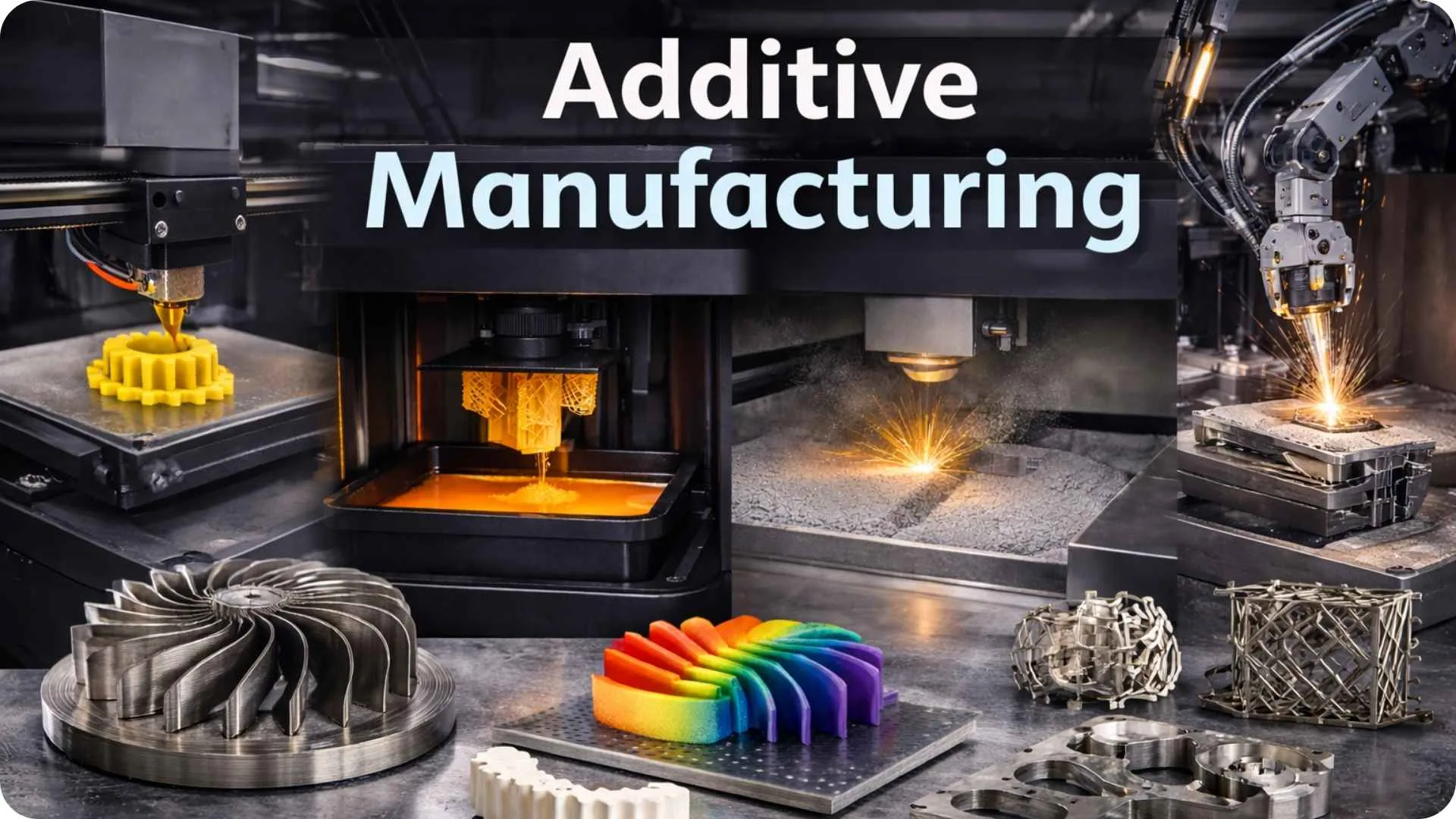
Additive Manufacturing (AM) is an advanced manufacturing process in which three-dimensional components are produced by adding material layer-by-layer directly from digital CAD data.
Unlike traditional manufacturing processes such as turning, milling, casting, or forging-where material is removed (subtractive) or reshaped (formative)—additive manufacturing builds the part from the ground up. This layer-wise fabrication enables:
- Complex internal cavities
- Lattice and cellular structures
- Topology-optimized geometries
- Integrated assemblies (part consolidation)
In industrial and academic contexts, the term additive manufacturing is preferred over “3D printing,” which is more commonly used for consumer-level systems.
Standard Definition
According to international standards developed by ASTM International and ISO:
Additive Manufacturing is a process of joining materials to make objects from 3D model data, usually layer upon layer, as opposed to subtractive manufacturing methodologies.
These standards also classify additive manufacturing into seven major process categories based on the method of material deposition and energy source.
Working Principle of Additive Manufacturing
Although there are multiple AM technologies, the general workflow follows these steps:
1. 3D Modeling
A component is designed using CAD software such as SolidWorks, CATIA, or Fusion 360.
2. File Conversion
The CAD model is converted into STL or AMF format. The file is then sliced into thin layers using slicing software.
3. Machine Setup
Material (filament, powder, resin, or wire) is loaded into the machine.
4. Layer-by-Layer Fabrication
The printer deposits or solidifies material layer-by-layer according to the sliced geometry.
5. Post-Processing
Depending on the process, post-processing may include:
- Support removal
- Heat treatment
- Surface finishing
- Machining
- Sintering
Why Additive Manufacturing Is Important
Additive manufacturing is considered a cornerstone of Industry 4.0 because it integrates digital design with automated production.
Organizations such as NASA use AM to manufacture lightweight rocket components, while companies like Tesla apply it in rapid prototyping and tooling development.
Key Reasons for Its Importance
1. Design Freedom
Engineers can produce geometries that are impossible with conventional machining.
2. Material Efficiency
Since material is added rather than removed, waste is minimized.
3. Rapid Prototyping
Products can be developed and tested quickly, reducing time-to-market.
4. Part Consolidation
Multiple components can be combined into a single printed part, reducing assembly time.
5. Customization
Ideal for medical implants and custom automotive parts.
Types of Additive Manufacturing Processes
According to ASTM classification, additive manufacturing is divided into seven main categories.
1. Material Extrusion (FDM)
Working Principle
A thermoplastic filament is fed through a heated nozzle, melted, and extruded onto a build platform. The material solidifies after deposition.
Engineering Characteristics
- Layer thickness: 0.1–0.4 mm
- Moderate dimensional accuracy
- Anisotropic mechanical properties
Materials Used
- PLA
- ABS
- PETG
- Nylon
- Carbon fiber reinforced polymers
Applications
- Functional prototypes
- Jigs and fixtures
- Educational models
Advantages
- Low cost
- Easy operation
- Widely available
Limitations
- Lower surface finish
- Limited to thermoplastics
2. Vat Photopolymerization (SLA/DLP)
Working Principle
A UV laser or projected light cures liquid resin selectively to form solid layers.
Engineering Characteristics
- High resolution (25–100 microns)
- Excellent surface finish
- Brittle material behavior
Materials
- Photopolymer resins
- Castable resins
- Biocompatible resins
Applications
- Dental aligners
- Jewelry patterns
- Microfluidic components
Advantages
- High dimensional accuracy
- Smooth surface finish
Limitations
- Resin handling hazards
- Limited long-term durability
3. Powder Bed Fusion (PBF)
Working Principle
A thin layer of powder is spread across the build platform. A laser or electron beam selectively fuses the powder according to the design.
Variants
- SLS (Polymers)
- SLM (Metals)
- EBM (Titanium alloys)
Engineering Features
- High mechanical strength
- Good fatigue properties
- Suitable for load-bearing components
Materials
- Stainless steel
- Aluminum alloys
- Titanium alloys
- Inconel
Applications
- Aerospace brackets
- Heat exchangers
- Medical implants
For example, GE Aviation manufactures fuel nozzles using metal powder bed fusion.
Advantages
- Complex geometries
- High structural integrity
Limitations
- Expensive machines
- Powder handling complexity
4. Material Jetting
Working Principle
Droplets of photopolymer material are jetted onto a platform and cured using UV light.
Features
- Multi-material capability
- High color accuracy
- Smooth surface
Applications
- Concept models
- Anatomical models
- Visual prototypes
Limitation
- Limited mechanical strength
5. Binder Jetting
Working Principle
A liquid binder is selectively deposited onto a powder bed, bonding particles together. Post-processing (sintering) is required.
Materials
- Metal powders
- Sand
- Ceramics
Applications
- Sand molds for casting
- Metal structural parts
- Architectural models
Advantages
- Faster printing speed
- Lower thermal stress
Limitations
- Requires post-sintering
- Shrinkage control challenges
6. Directed Energy Deposition (DED)
Working Principle
A focused energy source melts metal wire or powder as it is deposited.
Energy Sources
- Laser
- Plasma arc
- Electron beam
Applications
- Repair of turbine blades
- Large aerospace parts
- Structural reinforcements
Advantages
- Suitable for repair
- Large component capability
Limitations
- Lower surface finish
- Complex control systems
7. Sheet Lamination
Working Principle
Sheets of material are bonded using adhesives or ultrasonic welding and cut to shape layer-by-layer.
Materials
- Paper
- Metal sheets
- Composite sheets
Applications
- Concept models
- Metal prototypes
Limitations
- Limited geometric complexity
Applications of Additive Manufacturing
Aerospace Industry
- Lightweight structural brackets
- Rocket engine components
- Turbine blades
- Heat exchangers
AM reduces weight while maintaining strength, which improves fuel efficiency.
Automotive Industry
Companies such as BMW and Ford Motor Company use AM for:
- Rapid prototyping
- Tooling and fixtures
- Lightweight EV components
- Custom performance parts
Medical Industry
- Patient-specific implants
- Orthopedic prosthetics
- Dental crowns
- Surgical planning models
Customization capability makes AM ideal for biomedical engineering.
Manufacturing & Tooling
- Conformal cooling channels in injection molds
- Rapid tooling inserts
- Production jigs
AM reduces tooling lead time significantly.
Advantages of Additive Manufacturing
- Reduced Material Waste
- Shorter Product Development Cycles
- Lightweight Structures via Topology Optimization
- Reduced Assembly Time
- Digital Inventory (Print-on-demand)
- Cost-effective for Low Volume Production
Limitations of Additive Manufacturing
- Slower Production for High Volume Manufacturing
- High Initial Machine Cost
- Limited Build Size
- Post-Processing Requirements
- Material Property Variability
- Regulatory Challenges in Aerospace/Medical
Additive Manufacturing vs Traditional Manufacturing
| Parameter | Additive Manufacturing | Traditional Manufacturing |
| Material Use | Minimal waste | High waste (machining chips) |
| Design Complexity | Extremely high | Limited |
| Tooling | Not required | Required |
| Setup Time | Low | High |
| Mass Production | Less efficient | Highly efficient |
| Customization | Easy | Difficult |
Future of Additive Manufacturing
The future of additive manufacturing includes:
- Hybrid manufacturing systems (CNC + AM)
- AI-driven generative design
- Advanced metal alloys
- Sustainable materials
- Industry 4.0 integration
The global AM market continues to grow rapidly across aerospace, electric vehicles, and biomedical engineering.
Conclusion
Additive Manufacturing is a revolutionary production technology that enables engineers to manufacture complex, lightweight, and customized components directly from digital designs.
With continuous material advancements and improved machine capabilities, additive manufacturing is becoming an essential part of modern mechanical engineering and industrial production.