
Introduction
In modern manufacturing, efficiency and consistency have become two of the most important factors for companies looking to stay competitive. This is especially true in the packaging industry, where bottles are produced in large quantities and require high-quality decoration for branding, identification, and customer appeal.
Traditional bottle printing methods often depend heavily on manual operations, which can lead to inconsistent results, slower production speeds, and higher labor costs. With the development of industrial automation, automatic screen printing machines have become an effective solution for improving productivity and maintaining stable print quality in bottle manufacturing.
By combining precision mechanical systems, automated control technology, and advanced printing processes, these machines help manufacturers optimize production lines while reducing operational challenges.
Challenges of Traditional Bottle Printing Processes
Bottle decoration is widely used in industries such as cosmetics, beverages, pharmaceuticals, and household products. However, printing on cylindrical containers presents unique challenges compared with flat surfaces.
One major challenge is maintaining accurate positioning during the printing process. Since bottles have curved surfaces, even small positioning errors can affect the final appearance of logos, patterns, and text.
In manual or semi-automatic printing processes, production efficiency may also be limited by human operation speed. When manufacturers need to handle thousands of bottles per day, maintaining the same printing quality for every product becomes increasingly difficult.
Other common challenges include:
- Higher labor requirements
- Longer production cycles
- Inconsistent printing accuracy
- Difficulty managing large-volume orders
- Increased material waste caused by printing errors
These limitations have encouraged manufacturers to adopt automated solutions.
How Automatic Screen Printing Machines Work
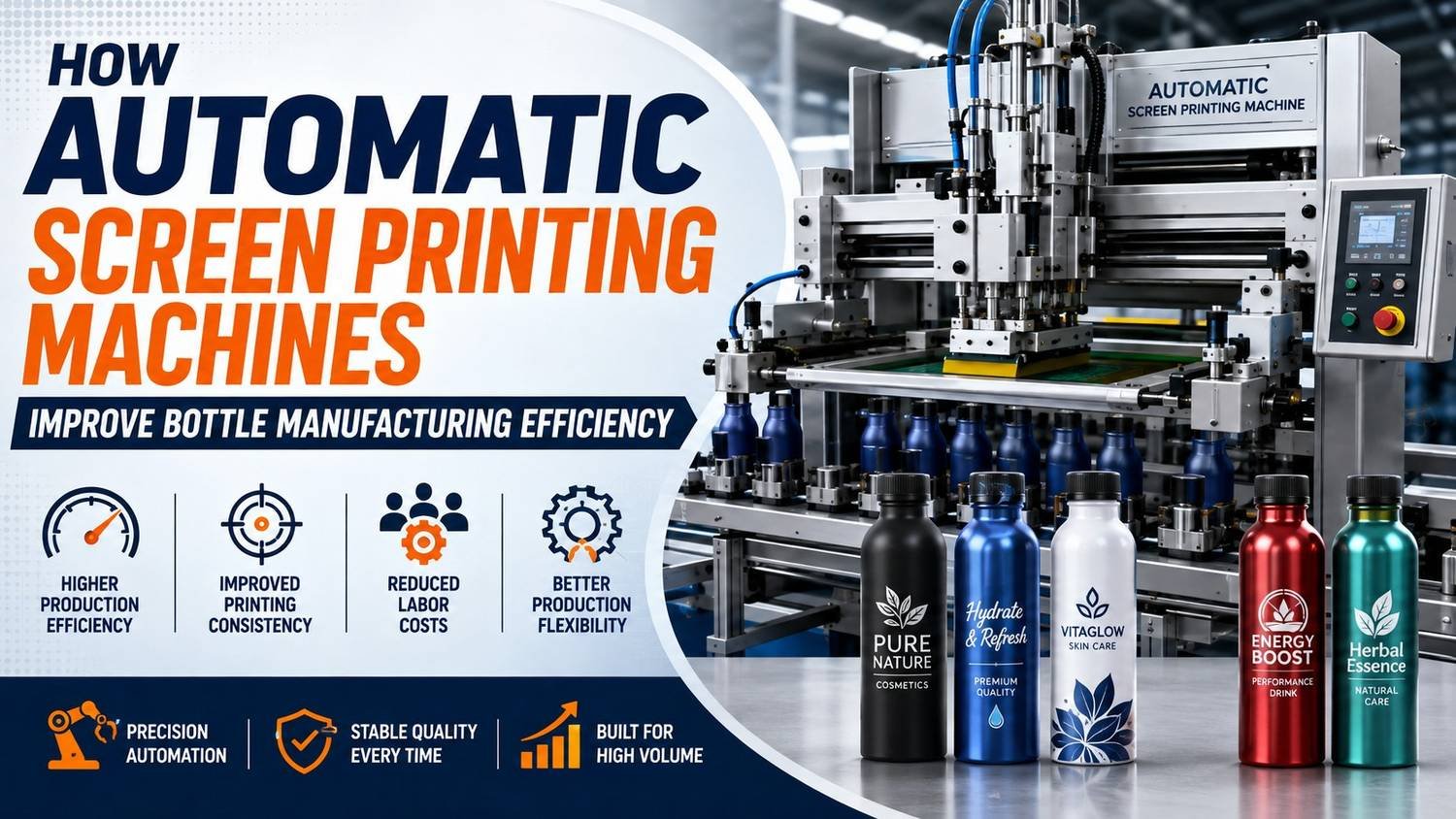
Automatic screen printing machines are designed to complete multiple stages of bottle decoration with minimal manual intervention. Depending on the machine configuration, the process may include automatic loading, bottle positioning, printing, curing, and unloading.
The key components usually include:
1. Automatic Feeding System
An automated feeding mechanism transfers bottles into the printing station efficiently. This reduces manual handling and ensures a continuous production flow.
2. Precision Positioning System
Accurate positioning is essential for cylindrical products. Advanced machines use sensors, servo systems, and mechanical fixtures to ensure bottles remain correctly aligned during printing.
This helps achieve consistent results, especially for multi-color printing applications.
3. Automated Printing Unit
The printing unit controls the movement of screens, squeegees, and bottles with high precision. This allows manufacturers to produce clear and durable patterns while maintaining stable quality throughout long production runs.
4. UV Curing System
Many bottle screen printing machines integrate UV curing technology to quickly dry printed ink. Faster curing improves production speed and helps create stronger adhesion between ink and bottle surfaces.
Benefits of Automatic Screen Printing Machines in Manufacturing
Higher Production Efficiency
Automation significantly improves production speed compared with manual printing methods. Machines can operate continuously with fewer interruptions, making them suitable for large-scale bottle manufacturing.
For companies producing cosmetic containers, beverage bottles, or other cylindrical packaging, automated printing equipment can help increase overall production capacity. Manufacturers such as auromatik.com provide automated bottle decoration solutions designed for high-efficiency production environments.
Improved Printing Consistency
One of the biggest advantages of automation is stable product quality. Since machine movements are controlled precisely, every bottle can receive the same printing position, pressure, and ink coverage.
This is particularly important for brands that require consistent appearance across millions of packaged products.
Reduced Labor Costs
Automatic systems reduce the need for repetitive manual operations. Operators can focus on machine monitoring, quality inspection, and production management instead of performing every printing step manually.
Better Production Flexibility
Modern automatic screen printing machines can be adjusted for different bottle sizes, materials, and printing requirements. This flexibility allows manufacturers to produce various packaging designs without completely changing their production processes.
The Future of Automated Bottle Manufacturing
As manufacturing continues moving toward Industry 4.0, automation will play an increasingly important role in packaging production. Smart sensors, digital control systems, and improved mechanical designs will further enhance printing accuracy and production efficiency.
Future bottle printing systems are expected to offer better integration with factory automation networks, allowing manufacturers to monitor production data, reduce downtime, and improve overall equipment performance.
For companies seeking to improve their bottle decoration processes, investing in automated printing technology can provide long-term benefits through higher productivity, improved quality, and more efficient resource utilization.
Conclusion
Automatic screen printing machines have transformed bottle manufacturing by solving many challenges associated with traditional printing methods. Through precise control systems, automated operations, and improved production capabilities, these machines help manufacturers achieve faster output and more consistent results.
As demand for customized packaging continues to grow, automation will remain a key factor in improving efficiency and competitiveness across the packaging industry.