
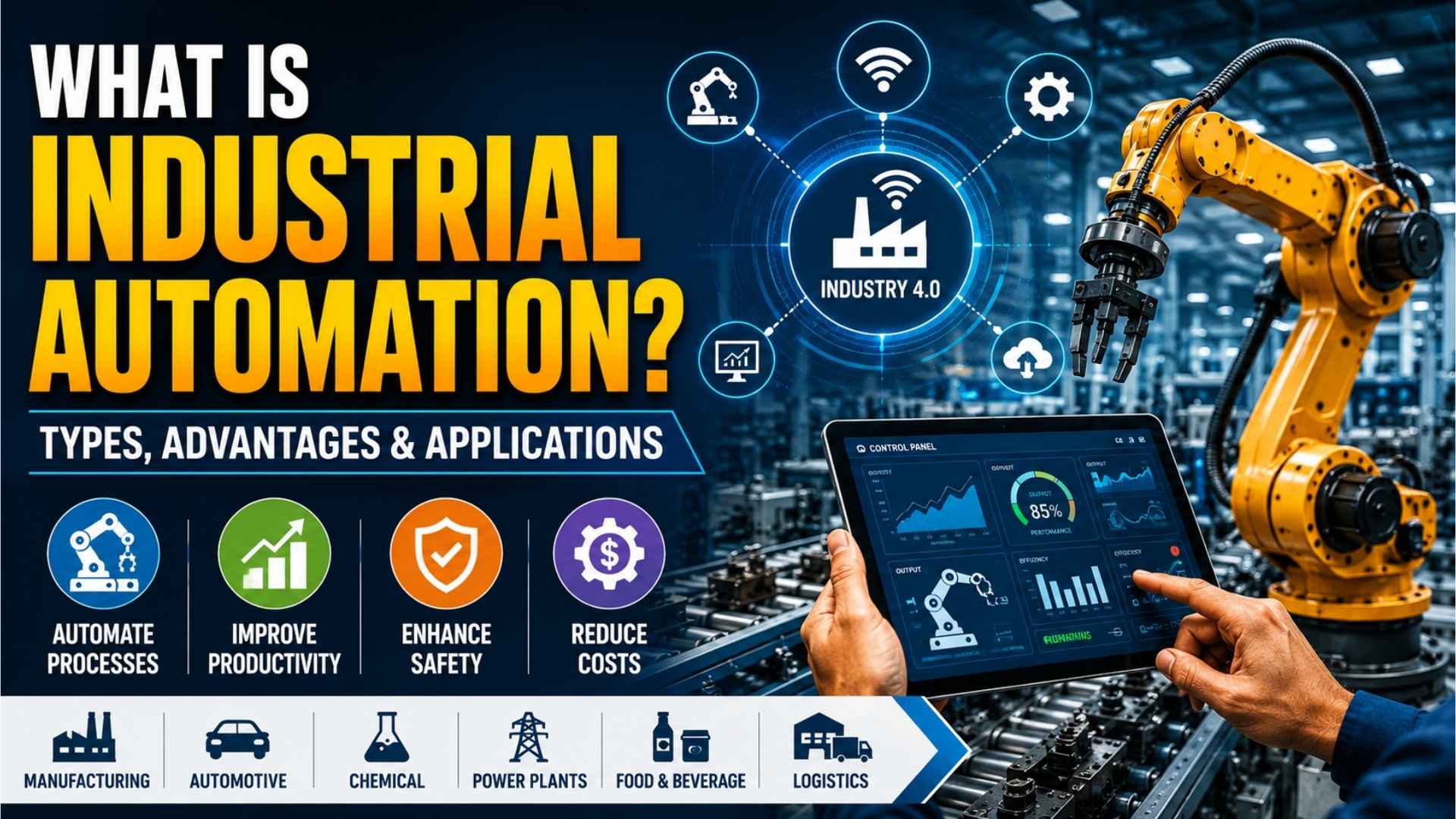
Industrial automation is the use of control systems, machines, software, robotics, and advanced technologies to perform industrial processes with minimal human intervention. It helps industries improve productivity, accuracy, safety, and operational efficiency by automating repetitive or complex tasks.
In modern industries, automation plays a major role in manufacturing plants, power generation facilities, oil refineries, food processing industries, pharmaceutical companies, and logistics systems. Instead of relying entirely on manual labor, businesses use automated systems such as sensors, programmable controllers, robotics, and artificial intelligence to monitor and control operations.
Industrial automation matters because industries today demand faster production, higher quality, lower costs, and improved workplace safety. Whether it is assembling automobiles, packaging food, or monitoring chemical processes, automation has become an essential part of industrial growth and global competitiveness.
What Is Industrial Automation?
Industrial automation refers to the use of machines, control systems, and information technologies to operate industrial processes automatically with little or no human involvement.
The main objective of industrial automation is to improve production efficiency, reduce manual effort, increase accuracy, and minimize operational costs.
Automation systems are commonly designed to perform repetitive tasks consistently without fatigue or human error. These systems can monitor performance in real time, detect faults, and optimize production operations.
Simple Definition of Industrial Automation
Industrial automation is a technology that uses computers, robots, sensors, and control systems to automatically control industrial machines and processes.
For example:
- A robotic arm assembling car parts in an automobile plant
- Automated bottling systems in beverage factories
- Conveyor belts sorting products in warehouses
- Smart temperature control systems in chemical industries
Why Is Industrial Automation Important?
Industrial automation has become essential because industries face increasing demand for high-quality products and faster production cycles.
Without automation, industries may experience:
- Slow production rates
- Higher operational costs
- Increased human errors
- Safety risks
- Inconsistent product quality
Automation solves these challenges by enabling precise and continuous operation.
Some major reasons why automation is important include:
1. Increased Productivity
Machines can work continuously without breaks, improving overall output.
2. Better Product Quality
Automation minimizes defects and ensures consistent product manufacturing.
3. Improved Safety
Dangerous industrial environments can be managed using automated systems instead of direct human involvement.
4. Reduced Costs
Although the initial investment is high, automation lowers labor costs and reduces waste over time.
5. Real-Time Monitoring
Modern systems collect operational data and help industries make faster decisions.
Components of Industrial Automation
Industrial automation systems consist of several components working together.
1. Sensors
Sensors collect information such as temperature, pressure, flow rate, position, and motion.
Examples include:
- Temperature sensors
- Pressure sensors
- Proximity sensors
- Motion sensors
2. Controllers
Controllers process input signals and make decisions.
Common controllers include:
PLC (Programmable Logic Controller)
A PLC is widely used in industries to automate machines and manufacturing processes.
Functions of PLC:
- Controls industrial equipment
- Executes programmed instructions
- Handles repetitive operations
DCS (Distributed Control System)
A DCS controls complex industrial processes through multiple controllers distributed across a plant.
It is commonly used in:
- Chemical plants
- Oil refineries
- Power generation industries
3. Actuators
Actuators convert electrical signals into mechanical movement.
Examples:
- Hydraulic actuators
- Pneumatic actuators
- Electric actuators
4. Human Machine Interface (HMI)
HMI enables operators to interact with machines through visual displays and control panels.
5. SCADA System
SCADA (Supervisory Control and Data Acquisition) systems help monitor and control industrial operations remotely.
Types of Industrial Automation
Industrial automation is generally classified into four major types.
1. Fixed Automation
Fixed automation is designed for repetitive production tasks with predefined sequences.
In this system, equipment is dedicated to a specific process.
Characteristics of Fixed Automation
- High production rate
- Low flexibility
- High initial cost
- Suitable for mass production
Examples of Fixed Automation
- Automobile assembly lines
- Conveyor-based production systems
- Bottling plants
Advantages
- High efficiency
- Faster production
- Lower unit cost
Disadvantages
- Difficult to modify
- Expensive setup
2. Programmable Automation
Programmable automation allows changes in production by modifying machine programs.
It is suitable for batch production.
Characteristics
- Flexible programming
- Moderate production rate
- Suitable for different product designs
Examples
- CNC machines
- Industrial robots
- Batch manufacturing systems
Advantages
- Production flexibility
- Easier modification
Disadvantages
- Slower than fixed automation
- Requires technical programming knowledge
3. Flexible Automation
Flexible automation enables manufacturers to produce different products with minimal manual adjustments.
Machines can automatically switch operations.
Characteristics
- High flexibility
- Quick product changes
- Computer-controlled operations
Examples
- Smart manufacturing systems
- Flexible robotic production lines
Advantages
- Reduced downtime
- High customization capability
Disadvantages
- Higher investment cost
4. Integrated Automation
Integrated automation combines all industrial systems under centralized computer control.
This creates a fully automated production environment.
Characteristics
- Complete system integration
- Data-driven decision-making
- High productivity
Examples
- Smart factories
- Industry 4.0 production systems
Advantages
- Maximum efficiency
- Better resource utilization
Disadvantages
- Very high implementation cost
Advantages of Industrial Automation
Industrial automation offers several benefits to industries.
- Higher Productivity: Automated systems operate continuously and increase production capacity.
- Better Accuracy: Machines produce products with high precision and fewer defects.
- Reduced Human Error: Automation minimizes mistakes caused by fatigue or lack of concentration.
- Improved Worker Safety: Hazardous tasks can be performed using robots and automated machinery.
- Lower Production Costs: Reduced labor requirements and waste help lower operating costs.
- Improved Product Quality: Automation ensures consistency in production standards.
- Real-Time Data Collection: Industries can monitor performance and maintenance needs instantly.
- Faster Production: Machines perform repetitive tasks quickly and efficiently.
Disadvantages of Industrial Automation
Despite many benefits, automation also has some limitations.
- High Initial Cost: Installing automation systems requires major investment.
- Technical Complexity: Automation systems require skilled professionals for operation and maintenance.
- Job Displacement Concerns: Certain repetitive jobs may be replaced by machines.
- Maintenance Costs: Advanced systems require regular servicing and updates.
- Cybersecurity Risks: Connected industrial systems may face cyber threats.
Applications of Industrial Automation
Industrial automation is widely used in many industries.
1. Manufacturing Industry
Automation helps manufacture products faster with greater accuracy.
Applications:
- Assembly lines
- Welding robots
- Packaging systems
2. Automotive Industry
Modern vehicle manufacturing heavily depends on robotics and automation.
Applications:
- Car body assembly
- Paint shops
- Robotic welding
3. Food and Beverage Industry
Automation ensures hygiene and faster production.
Applications:
- Packaging
- Filling machines
- Sorting systems
4. Pharmaceutical Industry
Automation improves precision and quality control.
Applications:
- Medicine packaging
- Tablet manufacturing
- Sterile processing
5. Oil and Gas Industry
Automation helps monitor dangerous operations safely.
Applications:
- Pipeline monitoring
- Pressure control
- Remote operations
6. Power Plants
Automation ensures stable electricity generation.
Applications:
- Turbine monitoring
- Boiler control
- Grid management
7. Logistics and Warehousing
Automation improves inventory handling and delivery systems.
Applications:
- Automated storage systems
- Conveyor systems
- Robotic sorting
Industrial Automation vs Robotics
Many people confuse automation with robotics, but they are different.
| Feature | Industrial Automation | Robotics |
| Meaning | Automated control of processes | Use of programmable robots |
| Scope | Broader concept | Part of automation |
| Examples | PLC systems, sensors | Robotic arms |
In simple terms, robotics is a subset of industrial automation.
Future of Industrial Automation
The future of industrial automation is strongly connected with smart technologies.
Emerging trends include:
- Artificial Intelligence (AI)
- Internet of Things (IoT)
- Machine Learning
- Predictive Maintenance
- Digital Twins
- Smart Factories
- Industry 4.0
These technologies are making industries more intelligent, efficient, and connected.
Conclusion
Industrial automation has transformed the way industries operate by improving productivity, precision, safety, and efficiency. From manufacturing and automotive industries to food processing and energy production, automation systems have become an essential part of modern industrial operations. Understanding the different types of automation, their benefits, and real-world applications helps industries choose the right technology for sustainable growth. As technologies such as AI, IoT, and smart factories continue to evolve, industrial automation will play an even bigger role in shaping the future of global manufacturing and industrial development.