
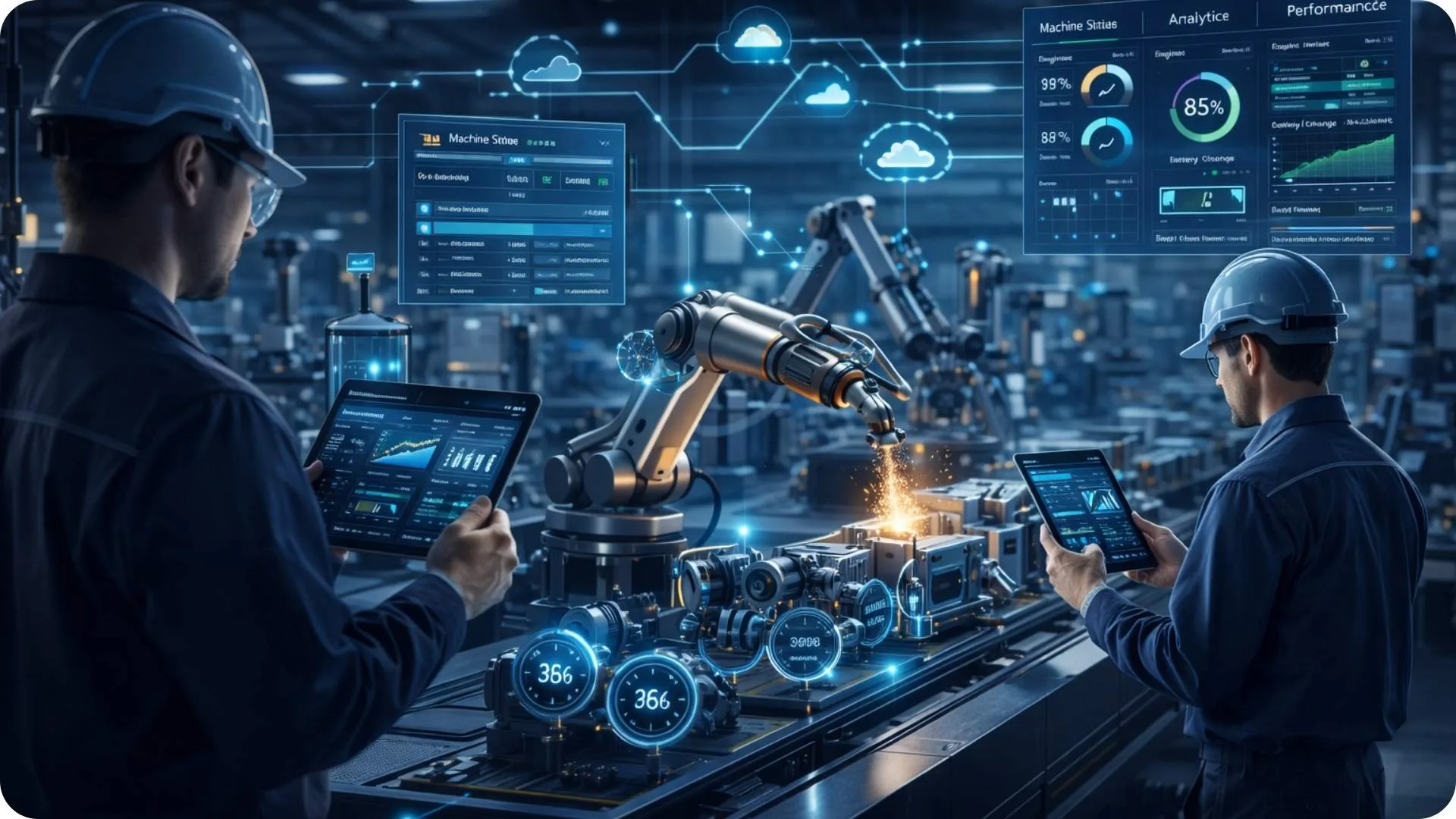
Industry 4.0, also known as the Fourth Industrial Revolution, refers to the integration of digital technologies, automation, data exchange, and smart systems into modern manufacturing and industrial processes.
It transforms traditional factories into smart factories where machines, systems, and humans communicate in real time using the internet and advanced analytics.
Evolution of Industrial Revolutions
Understanding Industry 4.0 becomes easier when we look at previous revolutions:
| Industrial Revolution | Period | Key Technology | Major Impact |
| 1st (Industry 1.0) | 18th century | Steam engine | Mechanization |
| 2nd (Industry 2.0) | 19th–20th century | Electricity | Mass production |
| 3rd (Industry 3.0) | 1970s | Computers & Automation | Digital manufacturing |
| 4th (Industry 4.0) | 21st century | IoT, AI, Big Data | Smart, connected factories |
Core Technologies of Industry 4.0
Industry 4.0 is built on several advanced technologies:
1. Internet of Things (IoT)
Machines and devices are equipped with sensors and connected to the internet for real-time data exchange.
Example: CNC machines sending production data to cloud servers.
2. Cyber-Physical Systems (CPS)
Integration of physical machines with digital control systems that monitor and control processes automatically.
3. Artificial Intelligence (AI) & Machine Learning
Used for:
- Predictive maintenance
- Quality inspection
- Production optimization
4. Big Data & Analytics
Large volumes of industrial data are analyzed to improve decision-making.
5. Cloud Computing
Enables remote monitoring and centralized data storage.
6. Digital Twin
A virtual replica of a physical system used for simulation and performance analysis.
7. Robotics & Automation
Collaborative robots (cobots) work alongside humans.
Key Features of Industry 4.0
- Real-time monitoring
- Self-optimizing systems
- Predictive maintenance
- Smart supply chains
- Reduced downtime
- Higher efficiency & productivity
1. Real-Time Monitoring
What It Means:
Real-time monitoring refers to the continuous tracking of machine parameters, production data, and system performance using sensors and connected devices.
How It Works:
- Sensors collect data (temperature, vibration, pressure, RPM, torque)
- Data is transmitted via Industrial IoT (IIoT)
- Dashboard displays live KPIs (OEE, cycle time, defect rate)
- Alerts are generated instantly if abnormal conditions occur
Mechanical Engineering Example:
In a CNC machining center:
- Spindle vibration is monitored continuously.
- If vibration exceeds set limits, an alert is triggered.
- Operator intervenes before tool breakage occurs.
Industry Example:
In automotive plants like those of Tesla, production lines use live dashboards to monitor battery assembly conditions.
Benefits:
- Immediate fault detection
- Improved quality control
- Reduced scrap rate
2. Self-Optimizing Systems
What It Means:
Machines automatically adjust operating parameters based on data analysis without human intervention.
How It Works:
- AI algorithms analyze performance data
- System identifies inefficiencies
- Parameters (speed, feed rate, temperature) are adjusted automatically
Mechanical Example:
Injection molding machine:
- Sensors detect slight temperature variation.
- System automatically adjusts heater band power.
- Ensures uniform plastic flow and reduces defects.
Real Industrial Application:
Smart assembly robots adjust torque automatically based on material type and thickness.
Benefits:
- Reduced human error
- Consistent product quality
- Energy savings
3. Predictive Maintenance
What It Means:
Instead of reactive (after failure) or preventive (scheduled) maintenance, predictive maintenance uses data analytics to predict equipment failure before it happens.
How It Works:
- Vibration analysis
- Oil analysis
- Thermal imaging
- AI-based failure prediction models
Mechanical Example:
A gearbox in a conveyor system:
- Vibration sensor detects abnormal frequency pattern.
- AI predicts bearing failure in 15 days.
- Maintenance is scheduled before breakdown.
Industry Example:
Companies like General Electric use predictive analytics in turbines to prevent catastrophic failures.
Benefits:
- Lower maintenance cost
- Extended machine life
- Reduced unexpected breakdowns
4. Smart Supply Chains
What It Means:
Digitally connected supply chains where inventory, logistics, and suppliers are integrated using IoT and cloud systems.
How It Works:
- RFID tags track materials
- ERP systems auto-update stock
- Automated reordering when stock drops below threshold
Mechanical Industry Example:
In an automotive parts factory:
- If bolt inventory reaches minimum level,
- ERP system automatically sends purchase request,
- Supplier dispatches materials before shortage occurs.
Real Example:
Companies like Amazon use robotics and real-time logistics tracking to optimize supply chain efficiency.
Benefits:
- Reduced inventory holding cost
- Faster delivery
- Minimized stockouts
5. Reduced Downtime
What It Means:
Downtime refers to the period when machines are not operational. Industry 4.0 minimizes both planned and unplanned downtime.
How It Works:
- Predictive maintenance prevents sudden failure
- Real-time alerts prevent minor faults from escalating
- Automated diagnostics speed troubleshooting
Mechanical Example:
In a forging press:
- Hydraulic pressure drop is detected instantly.
- Automatic shutoff prevents seal damage.
- Repair is done during scheduled break.
Result:
Machine availability increases from 85% to 95% (typical improvement seen in smart factories).
6. Higher Efficiency & Productivity
What It Means:
Improved output per unit time with optimal resource utilization.
How It Works:
- Data-driven cycle time optimization
- Automated material handling
- Reduced human intervention in repetitive tasks
Mechanical Example:
A robotic welding station:
- Adjusts welding parameters dynamically.
- Ensures consistent penetration depth.
- Increases throughput by 20–30%.
Measurable KPIs Improved:
- OEE (Overall Equipment Effectiveness)
- MTBF (Mean Time Between Failures)
- Cycle Time
- Energy consumption per unit
Summary Table
| Feature | Traditional Factory | Industry 4.0 Factory |
| Monitoring | Manual inspection | Real-time IoT dashboards |
| Maintenance | Reactive | Predictive & AI-based |
| Supply Chain | Manual ordering | Automated ERP integration |
| Optimization | Human decisions | Self-learning systems |
| Downtime | Frequent | Minimal |
Applications of Industry 4.0
In Manufacturing
- Smart factories
- Automated assembly lines
- Real-time production tracking
In Automotive Industry
- Connected vehicles
- EV battery monitoring systems
- Automated quality inspection
In Energy Sector
- Smart grids
- Remote monitoring of power plants
Advantages of Industry 4.0
- Increased productivity
- Reduced operational cost
- Better product quality
- Improved safety
- Data-driven decision making
Challenges of Industry 4.0
- High initial investment
- Cybersecurity risks
- Skill gap in workforce
- Data management complexity
Simple Example of Industry 4.0
Imagine a factory producing automotive gears:
- Sensors monitor temperature and vibration.
- AI predicts bearing failure before breakdown.
- Digital twin simulates load conditions.
- System automatically orders spare parts.
This reduces downtime and increases profitability.
Why Industry 4.0 is Important for Mechanical Engineers
Mechanical engineers today must understand:
- Automation systems
- Data analytics basics
- PLC & SCADA integration
- Robotics programming
- Smart manufacturing concepts
Industry 4.0 is not just IT, it is the future of mechanical manufacturing systems.
Conclusion
Industry 4.0 represents the transformation from traditional manufacturing to intelligent, connected, and automated production systems. It combines mechanical engineering with digital technologies to create smart, efficient, and flexible industries.