

A reciprocating pump is a type of positive displacement pump widely used where high pressure and precise fluid delivery are required. Unlike centrifugal pumps, it works by moving fluid using a back-and-forth (reciprocating) motion of a piston or plunger inside a cylinder. This mechanism makes it highly efficient for handling low flow rates at high pressures.
Reciprocating pumps are commonly used in industries such as oil and gas, chemical processing, water supply systems, and hydraulic applications. Their ability to handle viscous fluids and deliver accurate flow makes them essential in many engineering systems.
Understanding how reciprocating pumps work, their components, and their applications is crucial for mechanical engineers and anyone dealing with fluid machinery.
What is a Reciprocating Pump?
A reciprocating pump is a positive displacement pump that uses a piston, plunger, or diaphragm to move fluid in a cylinder through reciprocating motion.
Key Idea:
It delivers a fixed amount of fluid per cycle, regardless of pressure (within limits).
Main Parts of a Reciprocating Pump
- Cylinder: A closed chamber where fluid is drawn in and compressed during pump operation.
- Piston / Plunger: A moving component that reciprocates inside the cylinder to create suction and discharge of fluid.
- Crank and Connecting Rod: Mechanism that converts rotary motion of the motor into reciprocating motion of the piston.
- Suction Pipe: A pipe that carries fluid from the source into the pump cylinder.
- Delivery Pipe: A pipe that transports the pumped fluid from the cylinder to the desired destination.
- Suction Valve: A one-way valve that allows fluid to enter the cylinder during the suction stroke.
- Delivery Valve: A one-way valve that permits fluid to exit the cylinder during the delivery stroke.
- Air Vessel (Optional): A device used to reduce flow pulsations and ensure a smoother, continuous discharge.
Types of Reciprocating Pumps
1. Based on Mechanism
a) Piston Pump
A piston pump uses a piston with sealing rings to move fluid inside the cylinder. It is commonly used for water and oil applications at moderate pressures.
Key Characteristics:
- Good sealing due to piston rings
- Suitable for moderate pressure applications
- Simple construction and easy maintenance
- Widely used in domestic and industrial systems
b) Plunger Pump
A plunger pump uses a solid plunger instead of a piston, allowing operation at very high pressures. It is commonly used in hydraulic and high-pressure cleaning systems.
Key Characteristics:
- Excellent for very high-pressure applications
- Strong and durable construction
- Lower leakage compared to piston pumps
- Ideal for heavy-duty industrial use
c) Diaphragm Pump
This pump uses a flexible diaphragm to move fluid, preventing direct contact with moving mechanical parts. It is ideal for handling hazardous or corrosive fluids.
Key Characteristics:
- Leak-proof and safe operation
- Suitable for corrosive and toxic fluids
- Low maintenance requirements
- No contamination of fluid
2. Based on Number of Cylinders
a) Single-Acting Pump
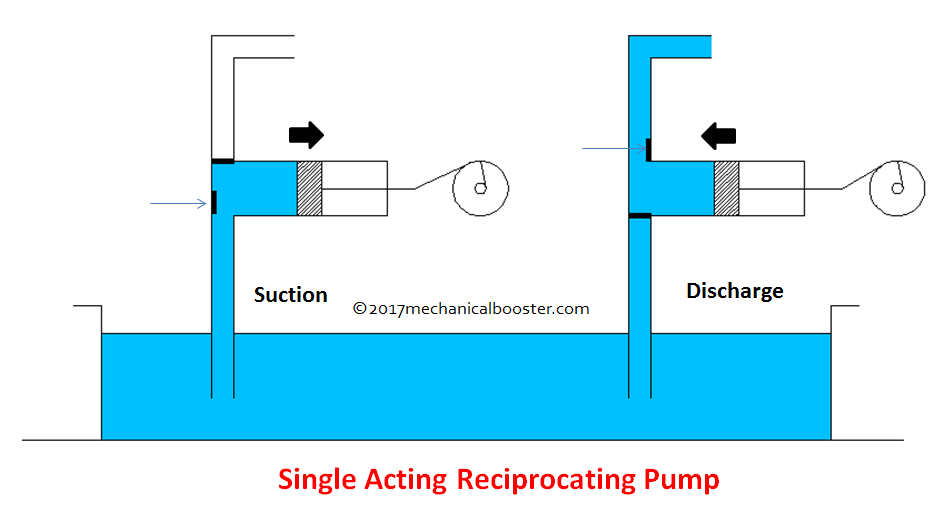
In this pump, fluid acts only on one side of the piston, producing one suction and one delivery stroke per cycle. It is simple but produces pulsating flow.
Key Characteristics:
- Simple and cost-effective design
- Produces pulsating discharge
- Lower efficiency compared to double-acting pumps
- Suitable for small-scale applications
b) Double-Acting Pump

A double-acting pump allows fluid to act on both sides of the piston, enabling suction and delivery in both strokes. This ensures smoother and more continuous flow.
Key Characteristics:
- Higher efficiency and output
- More uniform and continuous discharge
- Reduced pulsation compared to single-acting
- Complex design and higher cost
Also Read:
- Properties of Fluids in Fluid Mechanics
- Types of Fluids In Fluid Mechanics
- Rotary Positive Displacement Pump: Working, Types, Advantages & Applications
Working Principle of Reciprocating Pump
A reciprocating pump works by the back-and-forth motion of a piston inside a cylinder, creating alternating suction and delivery of fluid. It operates in two main strokes that repeat continuously to ensure fluid flow.
1. Suction Stroke
During this stroke, the piston moves away from the cylinder head, creating a vacuum inside the cylinder. This pressure difference allows fluid to enter through the suction valve.
Key Points:
- Piston moves outward from cylinder head
- Pressure inside cylinder decreases
- Suction valve opens
- Fluid enters the cylinder
2. Delivery Stroke
In this stroke, the piston moves towards the cylinder head, increasing the pressure inside the cylinder. This forces the fluid to exit through the delivery valve.
Key Points:
- Piston moves inward towards cylinder head
- Pressure inside cylinder increases
- Delivery valve opens
- Fluid is discharged out
Cycle Continuation:
- Suction and delivery strokes repeat continuously
- Ensures steady transfer of fluid (with slight pulsation)
Advantages of Reciprocating Pump
- High efficiency compared to centrifugal pumps
- Suitable for high-pressure applications
- Can handle viscous fluids
- Delivers precise and constant flow
- Self-priming capability
- Works well at low flow rates
Disadvantages of Reciprocating Pump
- High initial and maintenance cost
- Complex design
- Pulsating flow (needs air vessel)
- Low speed operation
- Not suitable for large flow rates
- Requires more maintenance
Applications of Reciprocating Pump
Reciprocating pumps are widely used in:
Industrial Applications
- Oil and gas industries
- Chemical processing plants
- Boiler feed water systems
Domestic Applications
- Hand pumps for water supply
- Small hydraulic systems
Specialized Applications
- Hydraulic presses
- Fuel injection systems
- Pressure washing systems
Comparison: Reciprocating Pump vs Centrifugal Pump
| Feature | Reciprocating Pump | Centrifugal Pump |
| Type | Positive displacement | Dynamic |
| Flow rate | Low | High |
| Pressure | High | Low to medium |
| Efficiency | High | Moderate |
| Fluid type | Viscous fluids | Low viscosity fluids |
Conclusion
Reciprocating pumps are essential machines in mechanical and industrial systems where high pressure and precise fluid control are required. Their positive displacement nature ensures accurate flow delivery, making them ideal for specialized applications such as hydraulic systems and chemical processing.
Although they come with higher costs and maintenance requirements, their efficiency and reliability in demanding conditions make them indispensable. Understanding their working, types, and applications helps in selecting the right pump for the right job, ultimately improving system performance and longevity.
For deeper learning, exploring related topics like centrifugal pumps and hydraulic systems can further strengthen your understanding of fluid machinery.