
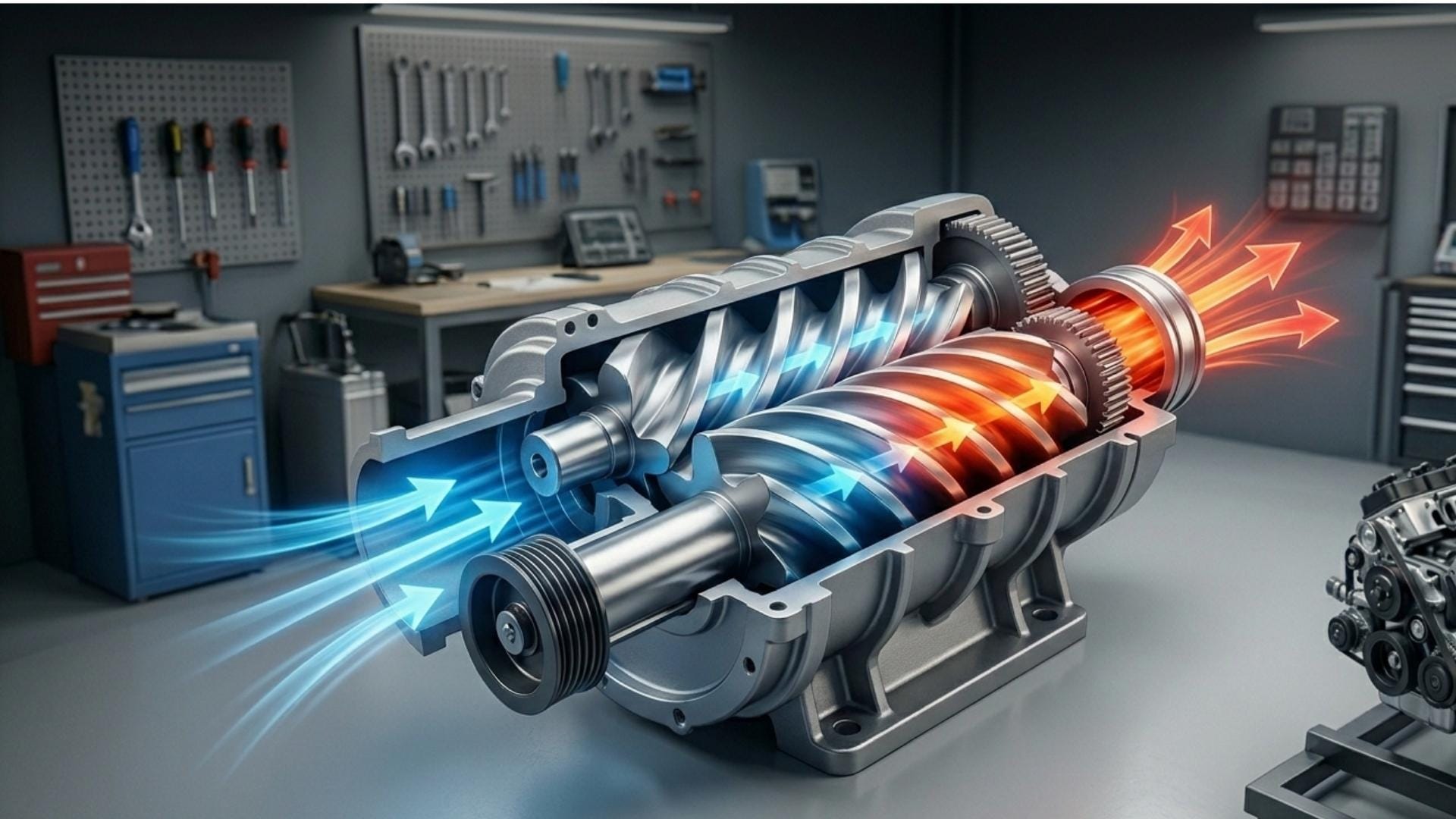
A twin screw supercharger is a high-performance forced induction device used in internal combustion engines to increase power output by compressing air before it enters the engine cylinder. Unlike conventional air intake systems, it delivers a continuous and controlled supply of compressed air, improving combustion efficiency.
This type of supercharger is widely used in performance cars, racing engines, and high-power automotive applications where immediate throttle response and consistent power delivery are critical. Its unique internal compression mechanism makes it more efficient than many other superchargers, especially at higher boost levels.
In this guide, you’ll understand how a twin screw supercharger works, its main components, advantages, limitations, and real-world applications.
What is a Twin Screw Supercharger?
A twin screw supercharger is a positive displacement compressor that uses two intermeshing helical rotors (screw-shaped) to compress air internally before delivering it to the engine.
Unlike Roots-type superchargers (which only move air), the twin screw design compresses air inside the housing itself, resulting in higher efficiency and better performance.
Main Parts of Twin Screw Supercharger
1. Bypass Actuator
- Controls the bypass valve operation
- Regulates boost pressure based on engine demand
- Controlled electronically via ECU
- At low speeds → valve open (no boost)
- At high speeds → valve closed (maximum boost)
2. Housing
- Outer casing containing rotors
- Made from cast aluminum or advanced composites
- Designed to withstand high temperature and pressure
3. Front Cover
- Holds the input shaft and pulley system
- Provides structural support to the drive mechanism
4. Drive Pulley
- Connected to engine crankshaft via belt
- Transfers rotational motion to rotors
- Determines boost level based on pulley ratio
5. Bearings
- Support rotor shafts
- Reduce friction and wear
- Ensure smooth and stable operation
6. Timing Gears
- Synchronize rotor movement
- Prevent rotor-to-rotor contact
- Require high precision for proper functioning
7. Rotors (Screw Elements)
- Two spiral-shaped rotors rotating in opposite directions
- One acts like a male rotor, the other like a female rotor
- Designed to compress air internally without contact
Also Read:
- How Turbocharger Works – Explained?
- What is Hydraulic Braking System and How It Works?
- Comparison Between Roots, Twin Screw and Centrifugal Supercharger
Working Principle of Twin Screw Supercharger
The twin screw supercharger operates through a continuous air compression cycle:
Step-by-Step Working:
- Power Input
- Engine crankshaft drives the pulley via belt or gears
- Rotor Rotation
- Two screw-shaped rotors rotate in opposite directions
- Air Intake
- Air enters through the inlet and gets trapped between rotor lobes
- Internal Compression
- As rotors rotate, trapped air volume decreases
- This reduces space and compresses air internally
- Air Delivery
- Compressed air moves toward the outlet
- Delivered to intercooler (if present)
- Cooling (Intercooler)
- Reduces air temperature
- Increases air density for better combustion
- Engine Intake
- Dense, compressed air enters engine cylinder
- More oxygen → better combustion → higher power
Why Twin Screw Supercharger is More Efficient
- Performs internal compression (not just air movement)
- Reduces energy losses
- Produces cooler and denser air
- Offers instant boost without lag
Advantages of Twin Screw Supercharger
- Higher efficiency compared to Roots supercharger
- Produces more horsepower across entire RPM range
- Immediate throttle response (no lag)
- Delivers consistent and smooth power output
- Lower noise compared to Roots type
- Better fuel-air mixing due to dense air supply
Disadvantages of Twin Screw Supercharger
- Complex design and manufacturing
- Higher cost compared to other superchargers
- Continuous operation even when boost is not required
- Generates heat (though less than Roots type)
- Requires precise alignment and maintenance
Twin Screw vs Roots Supercharger
| Feature | Twin Screw | Roots Type |
| Compression | Internal | External |
| Efficiency | Higher | Lower |
| Air Temperature | Lower | Higher |
| Noise | Less | More |
| Cost | Higher | Lower |
| Performance | Better at all RPM | Moderate |
Applications of Twin Screw Supercharger
Twin screw superchargers are commonly used in:
- High-performance sports cars
- Racing engines
- Muscle cars and modified vehicles
- Aircraft piston engines (select applications)
- Industrial air compression systems
Conclusion
The twin screw supercharger stands out as one of the most efficient forced induction systems due to its internal compression mechanism and instant power delivery. It plays a crucial role in enhancing engine performance by supplying dense, pressurized air, leading to improved combustion and higher output.
Although it comes with higher complexity and cost, its advantages in responsiveness, efficiency, and consistent performance make it a preferred choice in high-performance automotive applications. Understanding its working and components helps engineers and enthusiasts make better decisions when selecting or optimizing engine systems.