
A bolt is a type of mechanical fastener designed to join two or more components together. Unlike welding or riveting, bolts form a non-permanent joint, which means the connected parts can be dismantled and reassembled whenever needed using appropriate tools.
Bolts are almost always used with nuts and sometimes with washers to ensure even load distribution, prevent loosening, and provide a strong, secure fastening. They are widely used in construction, automotive, machinery, aerospace, and household applications.
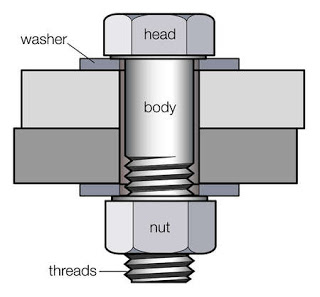
Parts of a Bolt

A typical bolt consists of two primary parts:
1. Head
- The top portion of the bolt, which allows a tool (like a wrench or spanner) to grip and rotate it.
- Heads come in different shapes and designs depending on usage:
- Hexagonal head – Most common, used in machinery and construction.
- Square head – Provides extra grip in heavy-duty applications.
- Round head – Used in furniture or when a smooth finish is required.
- Countersunk head – Fits flush with the surface, commonly in carpentry.
- Hexagonal head – Most common, used in machinery and construction.
Example: A hex head bolt is the standard choice in automotive engines because it offers excellent grip and torque transmission.
2. Shank
- The cylindrical body of the bolt extending below the head.
- Divided into two sections:
- Threaded section – Contains spiral grooves (threads) that allow the bolt to engage with a nut or threaded hole.
- Unthreaded section (grip length) – Provides shear strength and helps align parts.
- Threaded section – Contains spiral grooves (threads) that allow the bolt to engage with a nut or threaded hole.
- The end of the shank is chamfered (slightly rounded) to make it easier to insert into a hole.
Example: Long shank bolts with partial threading are used in structural steel connections to handle shear loads effectively.
Also Read:
- Different Types of Screws in Fastening Process
- 6 Types of Screwdrivers – Everyone Must Know
- 37 Types of Hammers that You Don’t Know?
Specifications of a Bolt

When selecting or describing a bolt, engineers consider several specifications to ensure the correct type is used. These include:
- Thread form – The profile of the threads (e.g., Unified National Thread, ISO metric thread).
- Pitch – The distance between adjacent threads; fine pitch offers more precision, while coarse pitch provides strength.
- Head shape – Hex, square, round, countersunk, etc.
- Body shape – Straight shank, tapered, or special profiles.
- Size (diameter) – Outer diameter of the threaded portion.
- Thread direction – Right-hand (tightens clockwise) is most common; left-hand threads are used where rotation may loosen the fastener.
- Length – Total length from head to tip, excluding the head unless countersunk.
- Material – Determines strength, corrosion resistance, and weight.
Example: A M12 × 1.75 × 80 hex bolt specifies metric thread (12 mm diameter), 1.75 mm pitch, and 80 mm length.
Dimensions of a Bolt
The dimensions of a bolt are standardized to ensure compatibility with nuts and washers. Key measurements include:
- Nominal diameter – The outside diameter of the bolt threads.
- Thread length – How much of the shank is threaded.
- Grip length – Unthreaded portion of the shank that bears shear loads.
- Head size – Distance across flats (spanner size).
- Overall length – From under the head to the bolt tip.
Example: In structural engineering, the American Institute of Steel Construction (AISC) specifies standard bolt dimensions for different grades to ensure interchangeability.
Materials Used for Bolts
The choice of material determines the bolt’s strength, durability, corrosion resistance, and application.
- Steel / Carbon Steel – Most common; used in construction and machinery.
- Hardened Steel (Alloy Steel) – High strength; used in automotive and aerospace.
- Stainless Steel – Excellent corrosion resistance; ideal for marine and outdoor use.
- Brass & Copper Alloys – Corrosion-resistant and decorative; used in plumbing and electronics.
- Aluminum – Lightweight, corrosion-resistant; used in aerospace.
- Titanium – Very strong and lightweight; used in aircraft and high-performance vehicles.
- Plastic / Nylon – Non-conductive and lightweight; used in electronics and light-duty applications.
Example: Stainless steel bolts are essential in shipbuilding to resist seawater corrosion.
Types of Bolts and Their Applications
Here are the most commonly used types of bolts with their specific functions:
- Anchor Bolt – Fixes structures to concrete foundations.
- Carriage Bolt – Rounded head with square neck; used in wood connections.
- Elevator Bolt – Flat head; commonly used in conveyor belts and elevators.
- Flange Bolt – Has a flange under the head for better load distribution.
- Hanger Bolt – Headless; one end has wood threads, other machine threads.
- Hex Bolt (Tap Bolt) – Most common type; used in all general applications.
- Lag Bolt – Heavy-duty wood fastener with hex head and coarse threads.
- Machine Bolt – Used in metal-to-metal fastening with a nut.
- Plow Bolt – Countersunk head; used in plows, heavy machinery.
- Sex Bolt (Chicago Bolt) – Used in furniture, leather goods, and bookbinding.
- Shoulder Bolt – Has a smooth shoulder; used in moving parts like pulleys.
- Square Head Bolt – Older style, provides high torque grip.
- Stud Bolt – Threaded rod without a head; used in flanged connections.
- Timber Bolt – Used in heavy timber construction.
- T-Head Bolt – Designed to fit into T-slots.
- Toggle Bolt – Spring-loaded for fastening in hollow walls.
- U-Bolt – U-shaped, used to secure pipes or round objects.
- J-Bolt – J-shaped, often embedded in concrete for structural supports.
- Eye Bolt – Has a loop for attaching ropes, chains, or cables.
- Spline Bolt / Special Bolts – Designed for specific industrial applications.
Example: U-bolts are widely used in automotive exhaust systems to clamp pipes securely.
Bolt Types and Their Applications in Tabular Form
| Bolt Type | Description | Common Applications |
| Anchor Bolt | Used to attach structures to concrete foundations | Building columns, bridges, heavy equipment anchoring |
| Carriage Bolt | Round head with square neck to prevent turning | Wooden joints, fencing, furniture |
| Elevator Bolt | Flat, large head with short shank | Conveyor belts, elevators, agricultural machinery |
| Flange Bolt | Has a flange under the head for load distribution | Automotive, machinery, structural connections |
| Hanger Bolt | Wood screw threads on one end, machine threads on the other | Wooden furniture, framing, electrical installations |
| Hex Bolt (Tap Bolt) | Hexagonal head, threaded body | Machinery, construction, automotive |
| Lag Bolt | Heavy-duty wood fastener with coarse threads | Decks, wooden beams, heavy timber |
| Machine Bolt | Square/hex head, fully/partially threaded | Metal-to-metal fastening, industrial equipment |
| Plow Bolt | Countersunk head for flush fitting | Bulldozers, plows, road construction machinery |
| Sex Bolt (Chicago Bolt) | Two-part fastener (barrel + screw) | Furniture, books, leather goods |
| Shoulder Bolt | Smooth shoulder between head and threads | Pulleys, linkages, moving parts |
| Square Head Bolt | Square head for higher torque grip | Heavy machinery, vintage equipment |
| Stud Bolt | Fully threaded rod, no head | Pipe flanges, pressure vessels |
| Timber Bolt | Large bolt with oversized head | Heavy timber construction, docks, bridges |
| T-Head Bolt | “T”-shaped head fits into slots | Machine tool tables, structural frames |
| Toggle Bolt | Spring-loaded, for hollow surfaces | Drywalls, ceilings, wall-mounted fixtures |
| U-Bolt | “U”-shaped with threaded ends | Pipe fittings, automotive exhausts, marine applications |
| J-Bolt | “J”-shaped, embedded in concrete | Foundation supports, structural columns |
| Eye Bolt | Circular eye-shaped head | Lifting, rigging, securing cables and ropes |
Conclusion
Bolts are one of the most essential fasteners in engineering and construction. By understanding their parts (head and shank), specifications, materials, and types, you can select the right bolt for any job.
From anchor bolts securing buildings to eye bolts handling lifting loads, each type has a unique purpose. Choosing the correct bolt ensures safety, efficiency, and durability in mechanical, structural, and industrial applications.
Frequently Asked Questions (FAQs)
A bolt is used to join two or more parts together in a non-permanent way. They are widely used in construction, automotive, machinery, and household applications.
A bolt has two main parts:
(i) Head – the top portion used for gripping with tools.
(ii) Shank – the cylindrical body, part of which is threaded for nut engagement.
Bolts usually require a nut to fasten objects, whereas screws are driven directly into a material without needing a nut. Bolts are also generally stronger and used for heavy-duty applications.
Bolts are commonly made of steel, stainless steel, brass, aluminum, titanium, and copper alloys. The choice of material depends on strength requirements and environmental conditions.
The hex bolt (hexagonal head bolt) is the most widely used type due to its strength and versatility in construction, automotive, and machinery.
(i) Stud Bolt: A fully threaded rod with no head, usually used with two nuts.
(ii) Machine Bolt: Has a head and may be partially or fully threaded, commonly used for metal-to-metal fastening.
Choosing the right bolt depends on application, load requirements, bolt material, thread type, and environmental conditions (e.g., corrosion resistance in marine use).
What are the high points of the flat area called on a standard six sided bolt head or nut