
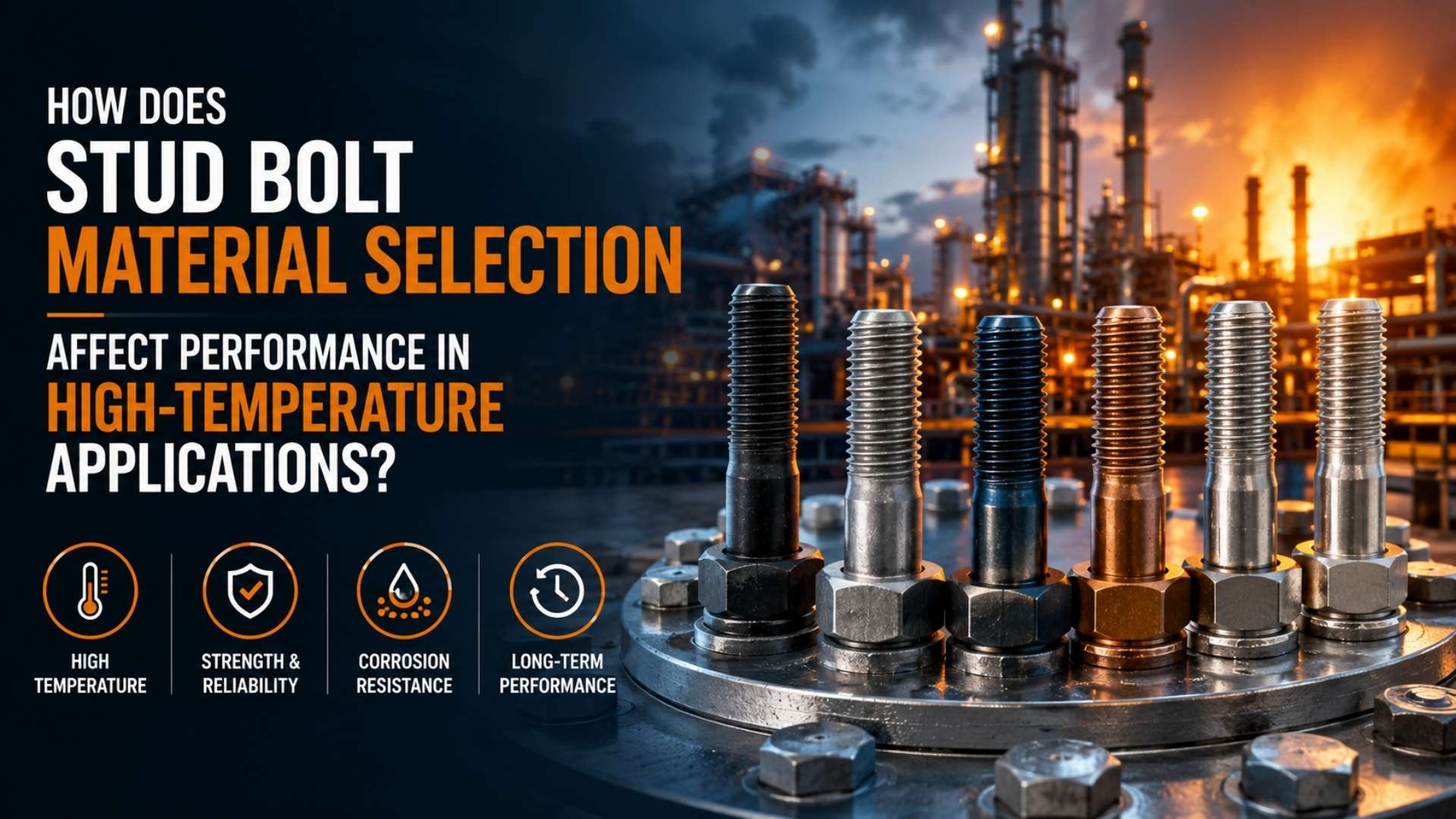
A bolted joint can look perfectly adequate during installation and still fail when the temperature rises. That is the mistake many operators make in high-heat environments: they focus on dimensions, coatings, or availability, while the real performance question starts with material behaviour under stress. In refineries, power plants, processing facilities, and other demanding settings, stud bolts do more than hold parts together. They preserve clamp load, support sealing integrity, and absorb thermal cycling that can gradually weaken the joint. When material selection is wrong, failure usually begins gradually. It usually begins as relaxation, distortion, loss of preload, or accelerated damage that spreads through the assembly.
Strength At Room Temperature Misleads
Elevated Heat Changes The Equation
Stud bolt selection becomes more complex the moment service temperatures climb beyond ordinary operating ranges. A material that performs well under ambient conditions may lose a significant portion of its strength as temperature increases. Yield strength, tensile strength, and hardness values that look reassuring on a datasheet can become less useful when the joint must remain stable under sustained exposure, temperature swings, and pressure fluctuations.
That is why manufacturers and procurement teams working with suppliers such as STS Industrial often treat high-temperature bolting as a performance decision rather than a simple buying decision. The right material must not only meet the specification at installation but also retain enough mechanical integrity to support preload after repeated expansion and contraction. In practical terms, that means the joint must remain tight when the system is at its hottest, not merely when it is assembled.
Creep Resistance Matters Over Time
One of the primary concerns in high-temperature bolting is creep. When a stud bolt operates under load at elevated temperatures for long periods, the material can deform gradually even if the applied stress never appears extreme. That slow deformation reduces clamp force, and once preload falls, the joint becomes more vulnerable to leakage, gasket instability, and fatigue-related movement.
This is why creep resistance is such an important selection factor. In many hot-service applications, the problem is not that the bolt snaps. The problem is that it slowly stops doing its job. Materials chosen for these environments need to resist time-dependent deformation well enough to preserve long-term joint reliability. A stud bolt that looks intact during inspection can still be underperforming if it has relaxed enough to compromise the sealing load across the flange or pressure boundary.
Also Read:
- What is a Bolt and Its Types?
- Difference Between Bolt and Screw
- Different Types of Screws in Fastening Process
Thermal Expansion Influences Joint Stability
Material selection also affects how the fastener expands and contracts relative to the components it is clamping. In high-temperature service, differing expansion rates among studs, nuts, flanges, and surrounding hardware can significantly affect bolt stress as the system heats and cools. If the stud material expands too differently from the joint members, preload can shift in ways that reduce stability or overstress the assembly.
That makes compatibility a practical issue, not a theoretical one. Contractors and engineers need to consider the whole joint, not just the bolt in isolation. A material that appears mechanically strong may still cause problems if its thermal response does not align with the equipment design. Stable performance often depends on selecting a stud material that behaves predictably alongside the mating components throughout the entire operating cycle.
Oxidation And Corrosion Add Pressure
High temperatures often intensify surface degradation. Oxidation, scaling, and corrosive attack can all reduce the effective life of a stud bolt, especially in process environments where heat combines with moisture, chemicals, or combustion byproducts. Once surface condition starts to degrade, thread integrity, cross-sectional strength, and removal reliability can all suffer.
This is one reason material selection cannot stop at strength class alone. A bolt used near furnaces, turbines, exhaust systems, heat exchangers, or aggressive processing lines may require alloy properties that offer better resistance to oxidation or corrosion at service temperatures. If the material cannot withstand the surrounding environment, even a strong initial installation may become difficult to maintain safely over time. Performance in these settings depends on durability under actual exposure, not just lab values taken in isolation.
Thermal Cycling Accelerates Fatigue Risk
Many high-temperature assemblies do not operate at one steady temperature. They cycle up and down during shutdowns, startups, and varying production loads. That repeated expansion and contraction places stress on bolted joints, especially when preload has already dropped or when the selected material lacks the toughness and fatigue resistance needed for repeated movement. Over time, that can produce cracking, thread damage, or loosening that would not be obvious in a constant-temperature application.
This is where material choice directly affects maintenance intervals and reliability planning. A stud bolt material with stronger resistance to thermal fatigue can help the joint tolerate repeated operating changes without degrading as quickly. In facilities where uptime matters, that difference can influence inspection frequency, unplanned outages, and repair costs. The bolt may be a small component, but under cycling heat, it becomes a major factor in system consistency.
Mechanical Properties Must Stay Relevant
A common purchasing mistake is assuming that a material grade known for high strength is automatically the right answer for hot service. In reality, the useful question is how much of that strength remains at the actual operating temperature and whether the material can maintain its properties without becoming too brittle, too relaxed, or too vulnerable to degradation. Some materials perform well in moderate heat but lose too much reliability as conditions become more severe.
That is why engineers consider more than one property when choosing stud-bolt materials. They assess retained strength, creep resistance, oxidation behavior, thermal expansion, fatigue response, and compatibility with the joint design. High-temperature performance is a combined result, not a single-number decision. The more demanding the application, the more dangerous it becomes to base material selection solely on availability or cost.
Reliable Joints Begin With Material Discipline
The choice of stud bolt material directly affects how a joint performs under heat, pressure, and time. Even with correct installation, the wrong material can lose preload, gradually deform, corrode faster, or respond poorly to thermal cycling. The right material helps the joint stay stable, sealed, and maintainable under conditions that expose every weakness.
For owners, operators, and maintenance teams, that makes material selection a reliability decision with real operational consequences. High-temperature applications do not forgive assumptions for long. They reward careful choices based on how the stud bolt will behave after weeks, months, and years of service. When material is properly matched to temperature and environment, the joint has a much stronger chance of maintaining performance where it matters most: under sustained operating stress, not just at assembly.