
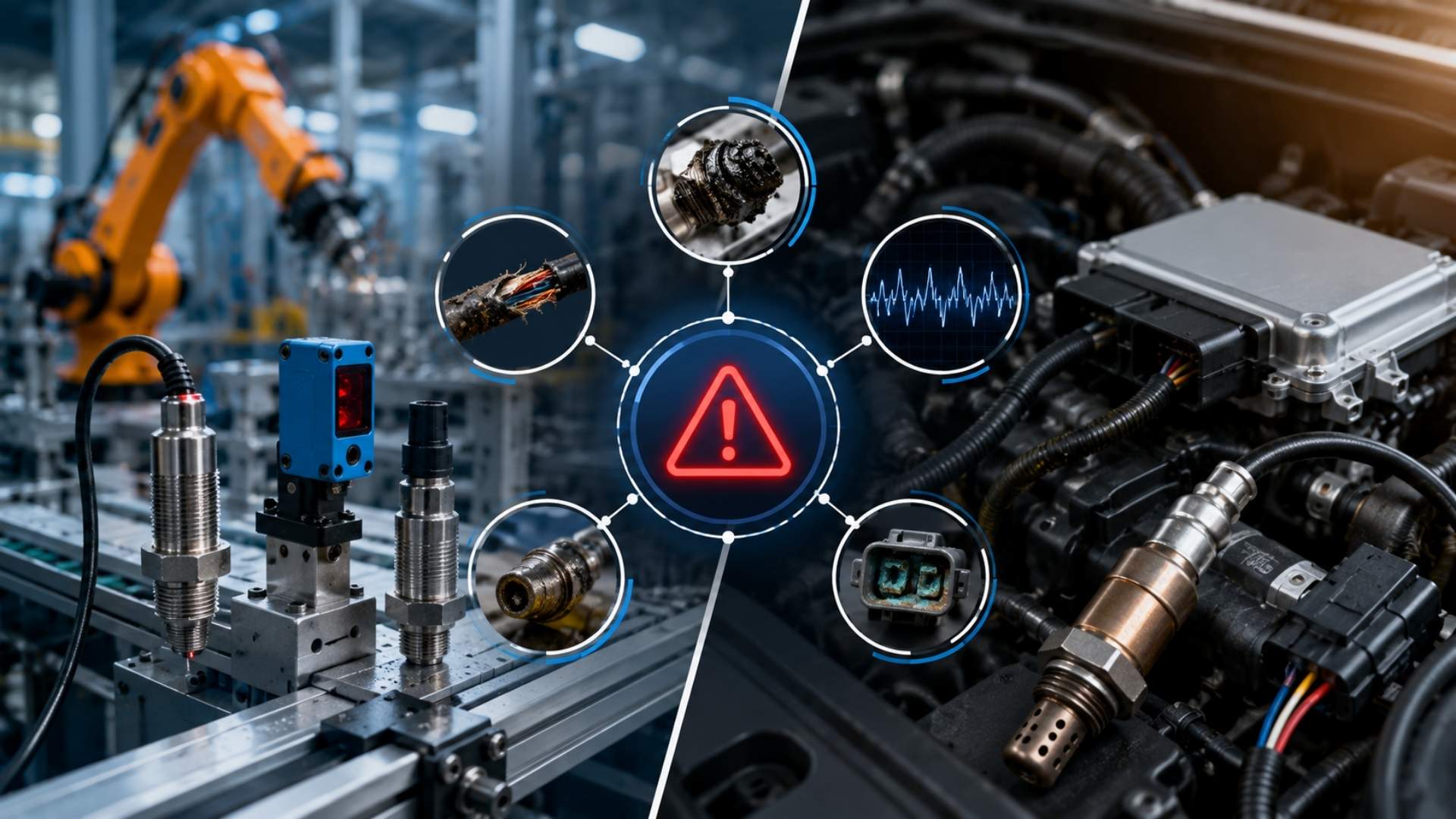
Modern industrial machines and vehicles rely heavily on sensors to monitor operating conditions and provide real-time feedback. These devices act as the “eyes and ears” of control systems, enabling everything from precise engine management and active safety systems to fully automated production lines.
A single faulty sensor can trigger inaccurate readings, unexpected shutdowns, reduced efficiency, or catastrophic equipment damage. On the factory floor, we often find that the root cause of a system failure isn’t a massive mechanical breakdown, but a localized issue with a single feedback loop.
This article examines five common sensor-related problems, breaking down their causes, warning signs, and practical solutions.
Why Sensors Are Critical to Reliable System Performance
Sensors are the foundational layer of automation. Without accurate field data, programmable logic controllers (PLCs) and electronic control units (ECUs) cannot execute their programmed logic effectively. Common roles include temperature monitoring, pressure measurement, position detection, speed feedback, vibration monitoring, and proximity sensing.
When these devices fail, the ripple effects move quickly through the system. Incorrect control decisions lead to process instability and safety risks. Maintenance costs spike, and unplanned downtime heavily impacts production quotas.
| Industrial Systems | Automotive Systems |
|---|---|
| Conveyor lines | Engine management systems |
| CNC machines | ABS braking systems |
| Packaging equipment | Transmission control |
| Hydraulic systems | Emissions control |
| Robotics | Driver assistance systems |
Problem #1 – Contamination and Environmental Exposure
Sensors rarely operate in pristine conditions. They are frequently exposed to harsh environments involving dust, oil mist, active coolants, moisture, road debris, and chemical exposure. Over time, particulate buildup on optical lenses or fluid ingress into electrical housings compromises functionality.
We typically see this manifest as intermittent readings, delayed response times, false alarms, or complete signal loss. Proximity, optical, pressure, and temperature sensors are especially vulnerable to physical contamination.
Engineering Takeaway: A high IP (Ingress Protection) rating does not guarantee immunity to all environmental factors. Chemical compatibility is just as critical as waterproofing.
Quick Troubleshooting Checklist:
- Inspect sensor surfaces and lenses for residue.
- Check cable entry points for signs of fluid ingress.
- Verify that the sensor’s environmental ratings match actual operating conditions.
- Review maintenance records to identify recurring failure locations.
To prevent contamination failures, engineers should prioritize proper enclosure selection, establish rigid cleaning schedules, utilize environmental sealing, and consider protective mounting locations away from direct spray or impact zones.
Problem #2 – Wiring and Connection Failures
Wiring issues remain one of the most frequent culprits behind sensor faults. Even the most robust, military-grade sensor will fail if its connection to the control panel degrades. Loose terminals, damaged cables, connector corrosion, and vibration-induced wear are common across all sectors.
Warning signs include sporadic fault codes, communication interruptions, rapid signal fluctuations, and random machine stops that are difficult to reproduce.
| Industrial Equipment Challenges | Vehicle Challenges |
|---|---|
| Continuous cable flexing (e.g., robotic arms) | High-frequency engine vibration |
| Electrical noise from heavy machinery | Severe heat cycling under the hood |
| Moisture ingress from washdown procedures | Exposure to road salt and corrosive elements |
Applying best practices for reliable connections is non-negotiable. This means implementing proper strain relief, utilizing shielded cables where required, securing connector locking mechanisms, and initiating routine inspection programs.
Problem #3 – Sensor Drift and Calibration Errors
Sensor drift is the gradual deviation from true measurement values over time. It is particularly common in analog sensing technologies where component aging, thermal stress, or mechanical fatigue slowly alters the sensor’s output characteristics.
Systems most vulnerable to calibration issues include pressure monitoring systems, flow measurement pipelines, temperature control loops, and emissions monitoring equipment. The operational consequences are significant: reduced product quality, energy inefficiency, incorrect maintenance decisions, and potential regulatory compliance violations.
How do engineers detect this slow degradation? It requires cross-referencing field data. When investigating long-term measurement deviations, maintenance teams often compare specifications across different types of industrial sensors and monitoring devices to understand expected accuracy ranges and calibration intervals. By utilizing historical trend analysis, calibration audits, and reference instruments, teams can catch drift before it impacts the final product.
Problem #4 – Electrical Noise and Signal Interference
Sensors communicate via low-voltage electrical signals, making them highly susceptible to electromagnetic interference (EMI) and radio frequency interference (RFI).
Common sources of electrical noise include variable frequency drives (VFDs), large electric motors, high-voltage power cables, switching devices, and ignition systems. When noise infiltrates a sensor circuit, it leads to unstable readings, unexpected machine behavior, false triggering events, and communication errors.
Modern systems are especially vulnerable. Dense wiring layouts, increased automation, and higher communication speeds mean that signal integrity is harder to maintain. Reducing signal interference requires strict adherence to physical separation of power and signal cables, rigorous noise filtering techniques, proper grounding, and appropriate cable shielding.
For additional guidance on electromagnetic compatibility principles, engineers often reference IEC electromagnetic compatibility standards when designing reliable sensing systems.
Problem #5 – Incorrect Sensor Selection for the Application
A surprisingly common engineering mistake occurs during the design phase: specifying the wrong sensor for the application. Not all sensors are built to handle the same operating conditions.
Using indoor-rated sensors in outdoor applications is a frequent error. Other selection mistakes include specifying an incorrect sensing distance, underestimating temperature ranges, choosing incompatible housing materials, or accepting insufficient ingress protection. This inevitably leads to premature failure, inaccurate measurements, increased downtime, and higher maintenance costs.
When selecting a sensor, weigh these key factors heavily:
- Environmental Conditions: Maximum/minimum temperatures, ambient humidity, dust levels, and chemical exposure.
- Performance Requirements: Baseline accuracy, necessary response time, resolution, and total measurement range.
- Mechanical Considerations: Available mounting space, vibration resistance, and shock tolerance.
Emerging Trends in Sensor Reliability
The landscape of automation is shifting to address these historical failure points. Modern developments are actively reducing the frequency and severity of sensor-related downtime. Smart sensors equipped with self-diagnostics can now alert control systems when their lenses are dirty or when internal temperatures exceed safe thresholds.
Furthermore, condition monitoring systems, predictive maintenance analytics, Industrial IoT (IIoT) integration, and remote monitoring capabilities allow teams to move away from reactive troubleshooting. Data improves fault detection through trend analysis, automated alerts, and historical comparison, giving technicians early-warning indicators rather than post-failure alarms.
Organizations promoting smart manufacturing initiatives frequently highlight sensor health monitoring as a foundation of predictive maintenance strategies, including guidance available through NIST smart manufacturing resources.
Best Practices for Preventing Sensor-Related Disruptions
Preventing disruptions requires a standardized approach to both installation and ongoing maintenance.
Installation Checklist:
- Select the correct sensor type based on engineering specifications.
- Verify environmental suitability before procurement.
- Follow manufacturer mounting recommendations precisely.
- Protect cables from mechanical damage through conduit or strategic routing.
- Document baseline readings and expected maintenance intervals.
Maintenance Checklist:
- Inspect sensors and their physical housings regularly.
- Verify wiring integrity at both the sensor head and the termination block.
- Clean sensing surfaces using approved methods.
- Confirm that calibration schedules are being met.
- Review alarm histories in the PLC/SCADA system to identify recurring, brief faults.
Training Matters: Hardware is only half the equation. Operators and maintenance personnel must be trained to recognize sensor warning signs, execute basic diagnostic procedures, understand common failure modes, and follow proper escalation processes.
Conclusion
Sensors play an uncompromising role in both industrial automation and automotive systems. When we trace system failures back to their origin, we frequently find that many issues do not originate from a defective sensor itself, but from severe environmental conditions, degraded wiring, electrical interference, neglected calibration, or incorrect application choices.
Understanding these common failure modes gives engineers and maintenance teams the perspective needed to improve reliability, reduce system downtime, and extend the functional life of heavy equipment. As sensing technologies become increasingly intelligent and interconnected, proactive data monitoring will continue to take on a larger role in preventing costly operational disruptions.
FAQs: Frequently Asked Questions
Common indicators include unstable or erratic readings, intermittent operational dropouts, localized fault codes, unexpected system alarms, and noticeable performance changes in the machine or vehicle being monitored.
Wiring and connection issues are often among the most frequent causes. Unlike a completely dead sensor, compromised wiring can produce intermittent faults that are notoriously difficult to track down and diagnose, leading to prolonged troubleshooting periods.
No. Industrial environments are inherently destructive over long timelines. However, proper selection, meticulous installation, rigorous calibration, and scheduled maintenance can significantly reduce the likelihood of unexpected sensor-related disruptions.