
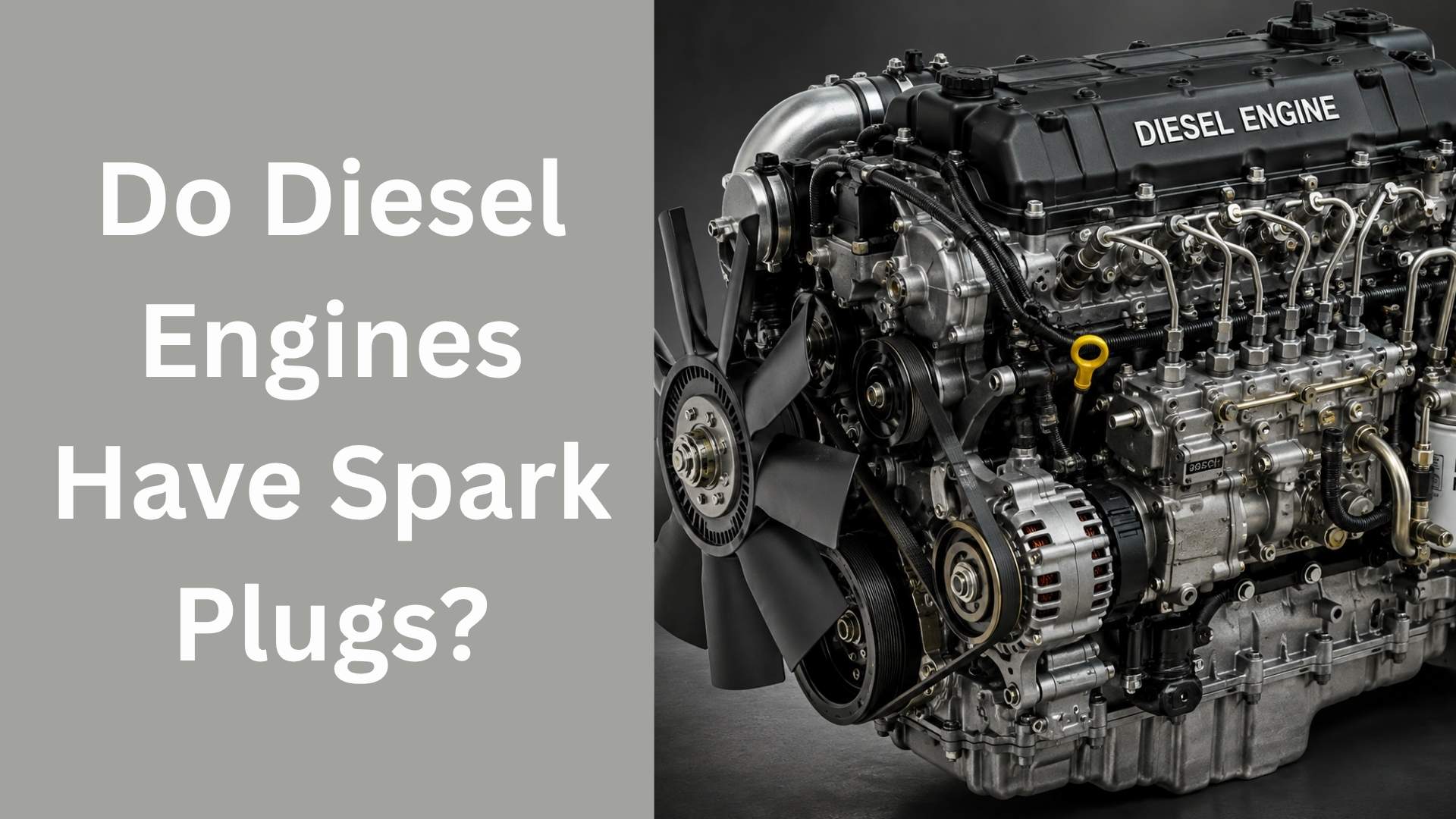
No, diesel engines do not have spark plugs. Unlike gasoline engines, which rely on a spark plug to ignite the air-fuel mixture, diesel engines use a process called compression ignition. The air inside the cylinder is compressed so intensely – raising its temperature above 500°C (932°F) – that diesel fuel ignites on its own the moment it is injected. No spark is needed.
This fundamental difference shapes everything about how a diesel engine is designed, maintained, and operated.
Why Do Diesel Engines Not Have Spark Plugs?
Diesel engines do not have spark plugs because their combustion process does not require an external ignition source. The engine compresses air to a ratio between 14:1 and 25:1 – far higher than a gasoline engine’s typical 8:1 to 12:1 – generating enough heat through compression alone to auto-ignite diesel fuel on contact.
The Science Behind Compression Ignition
When a gas is compressed rapidly, its temperature rises. This is a basic principle of thermodynamics. Diesel engines exploit this principle deliberately.
Here is what happens inside a diesel cylinder on every power stroke:
- Intake stroke – The piston moves down, drawing in only clean air (no fuel yet).
- Compression stroke – The piston rises and compresses the air to 1/14th to 1/25th of its original volume.
- Fuel injection – Diesel fuel is injected as a fine mist directly into the superheated air.
- Auto-ignition – The fuel contacts the hot air and combusts spontaneously.
- Power stroke – The expanding gases push the piston down, producing power.
- Exhaust stroke – Burned gases are expelled, and the cycle repeats.
Because the air temperature alone triggers ignition, a spark plug serves no purpose in this system.
For a better understanding of how a diesel engine works. Watch this video
Does a Diesel Engine Have a Spark Plug? The Short Answer
Quick Answer: No. Diesel engines use compression ignition – not spark ignition. A gasoline engine fires a spark to ignite a premixed air-fuel charge. A diesel engine injects fuel into already-compressed hot air, which ignites the fuel without any spark.
This is the single most important distinction between a compression ignition (CI) engine and a spark ignition (SI) engine.
What Do Diesel Engines Use Instead of Spark Plugs?
Diesel engines use glow plugs – but only as a cold-weather starting aid, not as a primary ignition component. A glow plug is an electrically heated element located inside the combustion chamber or prechamber. It warms the intake air and cylinder walls before the engine starts in cold conditions, reducing the chance of hard starting or misfires.
Once the engine is running and the cylinders are hot, glow plugs shut off entirely. They play no role in normal engine operation.
Glow Plug vs. Spark Plug – Key Differences
| Feature | Spark Plug | Glow Plug |
| Function | Creates a spark to ignite air-fuel mixture | Pre-heats combustion chamber for cold starts |
| Engine type | Gasoline (petrol) engines | Diesel engines |
| Active during | Every combustion cycle | Engine warm-up only |
| Ignition role | Primary ignition source | Starting aid – not an ignition source |
| Operating voltage | ~12,000–45,000 volts | 5–12 volts |
| Replacement interval | Every 30,000–100,000 miles | Every 60,000–100,000 miles |
| Number per cylinder | One per cylinder | One per cylinder (some engines: none) |
How Does a Diesel Engine Work Without Spark Plugs?
A diesel engine operates on the diesel cycle, a thermodynamic process defined by constant-pressure combustion. Rudolf Diesel patented this concept in 1892, specifically to achieve higher thermal efficiency than gasoline engines of his time.
The key mechanism is the high compression ratio. When air is compressed to 1/20th of its volume (a 20:1 ratio), its temperature can reach 700–900°C (1,292–1,652°F). Diesel fuel’s auto-ignition temperature is approximately 250°C (482°F). The math works clearly in the engine’s favor – compressed air is always hot enough to fire diesel fuel without any external ignition.
Why Diesel Fuel Does Not Work in a Gasoline Engine
Diesel fuel has a higher cetane number – a measure of how readily it ignites under compression. Gasoline has a high octane number, meaning it resists auto-ignition. In a gasoline engine, premature auto-ignition causes “engine knock,” a damaging condition. Diesel fuel is specifically formulated to ignite easily under compression, which is why the two fuels are not interchangeable.
Diesel Engine Ignition System: What’s Actually Inside?
A diesel engine’s ignition system is fundamentally different from that of a petrol engine. There is no distributor, no ignition coil, and no high-voltage spark plug wire. Instead, the system revolves around fuel delivery precision.
Core components of a diesel ignition/combustion system:
- High-pressure fuel injection pump – Pressurizes fuel to 1,000–30,000 PSI for modern common-rail systems.
- Fuel injectors – Deliver a precise, atomized spray of diesel directly into the cylinder.
- Glow plugs – Preheat chambers during cold starts (not used during normal operation).
- Turbocharger (in most modern diesels) – Forces more air into the cylinder, improving combustion efficiency.
- Engine Control Unit (ECU) – Manages injection timing, duration, and fuel quantity electronically.
Modern diesel engines like those in the Ford Power Stroke, Ram Cummins, or GM Duramax use common-rail direct injection, where fuel is stored at extremely high pressure in a common rail and injected with millisecond precision. This technology improves power, efficiency, and emissions compared to older mechanical injection systems.
Gasoline vs. Diesel Engines: Ignition System Comparison
| Attribute | Gasoline Engine | Diesel Engine |
| Ignition type | Spark ignition (SI) | Compression ignition (CI) |
| Ignition component | Spark plug | None (compression alone) |
| Cold-start aid | None typically | Glow plug |
| Compression ratio | 8:1 – 12:1 | 14:1 – 25:1 |
| Fuel delivery | Port injection or direct injection | Direct injection only |
| Fuel type | Gasoline (petrol) | Diesel |
| Thermal efficiency | ~25–35% | ~35–45% |
| Ignition trigger | Electric spark | Compressed air heat |
Are There Any Exceptions? Diesel Engines That Use Spark-Like Devices
In some older or specialty diesel engine designs – particularly small prechamber diesels used in compact vehicles and generators – a device called a heater plug or heat glow plug stays on briefly after starting to stabilize combustion. This is still not the same as a spark plug; it generates heat, not a spark.
Additionally, dual-fuel engines (which run on both diesel and natural gas) sometimes use a small diesel pilot charge as a substitute ignition source for natural gas, but these are specialized industrial applications, not typical automotive diesel engines.
Key Takeaways
- Diesel engines do not have spark plugs. They use compression ignition – air compressed to extreme pressure generates enough heat to auto-ignite diesel fuel.
- Glow plugs are not spark plugs. Glow plugs only assist with cold-weather starting; they are not part of the normal combustion cycle.
- The compression ratio is the key. Diesel engines compress air at ratios of 14:1 to 25:1, versus 8:1 to 12:1 in gasoline engines, producing cylinder temperatures well above diesel’s auto-ignition point.
- Diesel fuel is formulated for compression ignition. Its high cetane number means it ignites readily under pressure – the opposite of gasoline, which is formulated to resist premature ignition.
- Modern diesel ignition relies on precision fuel injection. Common-rail systems inject fuel at up to 30,000 PSI with exact timing managed by the ECU.
- Diesel engines are thermally more efficient. The compression ignition process and higher compression ratios give diesel engines a thermal efficiency of 35–45% versus 25–35% for typical gasoline engines.
- No spark plug = fewer ignition-related maintenance items. Diesel owners skip spark plug replacements, ignition coil failures, and plug wire problems – but must maintain injectors, glow plugs, and fuel filters diligently.
Frequently Asked Questions (FAQs)
A diesel engine fires through compression ignition. During the compression stroke, air alone is compressed to a very high ratio – typically between 14:1 and 25:1. This compression raises the air temperature to 700–900°C (1,292–1,652°F). When diesel fuel is injected into this superheated air, it ignites spontaneously without any spark. The high cetane rating of diesel fuel ensures it auto-ignites reliably under these conditions.
Yes, most modern diesel engines have glow plugs – one per cylinder. They are electrically heated elements that warm the combustion chamber before cold starts, making it easier for the engine to reach the compression temperature needed for reliable ignition. Once the engine is warm, glow plugs deactivate automatically. Some newer diesels with very high compression ratios may not require glow plugs even in cold weather.
Yes – once the engine is already warm, it runs perfectly without glow plugs. Glow plugs only assist with cold starting. On a warm engine, compression alone generates sufficient heat for ignition. However, in cold climates, faulty glow plugs can cause hard starting, white smoke, rough idling, and misfires. Driving regularly in sub-zero temperatures with failed glow plugs can eventually cause starting failures.
Spark plugs create a high-voltage electrical arc to ignite a premixed air-fuel charge in gasoline engines – they fire on every combustion cycle. Glow plugs are low-voltage heating elements in diesel engines that only warm the combustion chamber during cold starts; they do not generate a spark and play no role once the engine reaches operating temperature. The two components serve entirely different purposes and are not interchangeable.
Diesel engines achieve greater fuel efficiency for three main reasons. First, diesel fuel contains about 10–15% more energy per gallon than gasoline. Second, diesel’s higher compression ratio extracts more mechanical work from each combustion cycle, yielding a thermal efficiency of 35–45% versus 25–35% for gasoline engines. Third, diesel engines operate without a throttle plate, reducing pumping losses. Together, these factors give diesel vehicles significantly better fuel economy, especially under load or highway driving.
Conclusion
So, do diesel engines have spark plugs? The answer is a clear no. Diesel engines rely entirely on the physics of compression ignition – squeezing air so forcefully that it heats to temperatures far above diesel fuel’s auto-ignition point. No spark, no coil, no plug wire required.
This design gives diesel engines higher thermal efficiency, greater torque output, and longer service life compared to equivalent gasoline engines. The tradeoff is a more complex fuel injection system and, in colder climates, a dependence on properly functioning glow plugs for cold starts.
Understanding why diesel engines work without spark plugs is not just academic. It explains why diesel maintenance is different, why diesel fuel cannot be used in a gasoline engine (and vice versa), and why compression ratio is such a critical specification in engine design.
Whether you own a diesel pickup, manage a diesel fleet, or are simply curious about how engines work, this fundamental difference – spark ignition vs. compression ignition – is the cornerstone of internal combustion engineering.