
A spark ignition engine (SI engine) is a type of internal combustion engine where the air–fuel mixture is ignited by a spark produced by a spark plug. These engines typically use petrol (gasoline) as fuel and operate on the Otto cycle, which is widely used in light-duty vehicles and small machines.
Spark ignition engines play a crucial role in modern transportation because they are lightweight, efficient, and capable of smooth operation at high speeds. You will commonly find them in motorcycles, passenger cars, scooters, and small power equipment.
Unlike compression ignition engines that rely on high pressure to ignite fuel, SI engines depend on controlled electrical ignition, allowing better control over the combustion process. Understanding how these engines work helps explain the operation of many everyday machines powered by gasoline.
What is a Spark Ignition Engine?
A spark ignition engine is an internal combustion engine in which the combustion of the air-fuel mixture is initiated by a spark plug.
Inside the engine cylinder, a mixture of air and petrol is compressed by a piston. At the end of the compression process, the spark plug produces a high-voltage electrical spark, igniting the mixture and generating power.
Key characteristics of a spark ignition engine include:
- Uses petrol or gasoline as fuel
- Operates on the Otto thermodynamic cycle
- Ignition occurs through a spark plug
- Typical compression ratio ranges from 6:1 to 10:1
- Widely used in lightweight and high-speed engines
Because of their relatively simple design and smooth operation, SI engines are the most common engine type used in passenger vehicles worldwide.
Main Components of a Spark Ignition Engine
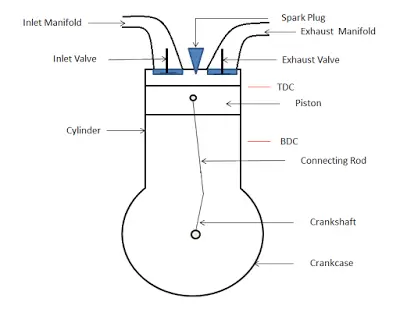
A spark ignition engine consists of several mechanical and electrical components that work together to produce power.
1. Cylinder
The cylinder is a hollow chamber where the combustion process takes place. It provides space for the piston to move up and down during engine operation.
2. Piston
The piston is a reciprocating component that moves inside the cylinder. It compresses the air-fuel mixture and converts the pressure generated by combustion into mechanical motion.
3. Connecting Rod
The connecting rod links the piston to the crankshaft. It transfers the motion of the piston to the crankshaft.
4. Crankshaft
The crankshaft converts the reciprocating motion of the piston into rotary motion, which ultimately drives the vehicle wheels or mechanical equipment.
5. Inlet Valve
The inlet valve allows the air-fuel mixture to enter the cylinder during the suction stroke.
6. Exhaust Valve
The exhaust valve opens to release the burnt gases produced during combustion.
7. Spark Plug
The spark plug generates an electric spark at the correct moment in the cycle. This spark ignites the compressed air-fuel mixture and initiates combustion.
Also Read:
- Types of Cars: A Comprehensive Guide to Vehicle Categories for Every Need
- What is a Hatchback Car?
- How Much Does It Cost to Buy A Used Tesla?
Working of Spark Ignition Engine
A typical spark ignition engine operates on a four-stroke cycle. Each stroke corresponds to one movement of the piston inside the cylinder.
The four strokes are:
- Suction Stroke
- Compression Stroke
- Power Stroke
- Exhaust Stroke
Let’s understand each stage in detail.
1. Suction Stroke
During the suction stroke:
- The piston moves downward from top dead center (TDC) to bottom dead center (BDC).
- The inlet valve opens, and the exhaust valve remains closed.
- A mixture of air and fuel enters the cylinder through the inlet valve.
This stage fills the cylinder with a combustible mixture.
2. Compression Stroke
During the compression stroke:
- The piston moves upward from BDC to TDC.
- Both inlet and exhaust valves remain closed.
- The air-fuel mixture is compressed into a small volume.
Compression increases the temperature and pressure, making the mixture ready for ignition.
3. Power Stroke
At the end of the compression stroke:
- The spark plug produces a spark.
- The compressed mixture ignites instantly.
- Rapid combustion produces high pressure inside the cylinder.
This pressure pushes the piston downward, rotating the crankshaft and generating useful mechanical power.
This is the only stroke that produces power in the cycle.
4. Exhaust Stroke
During the exhaust stroke:
- The piston moves upward again.
- The exhaust valve opens while the inlet valve remains closed.
- Burnt gases produced during combustion are expelled from the cylinder.
Once this stroke finishes, the engine cycle begins again with the suction stroke.
Valve Operation During Four Strokes
| Stroke | Inlet Valve | Exhaust Valve | Operation |
| Suction Stroke | Open | Closed | Air-fuel mixture enters cylinder |
| Compression Stroke | Closed | Closed | Mixture compressed |
| Power Stroke | Closed | Closed | Combustion and power generation |
| Exhaust Stroke | Closed | Open | Burnt gases expelled |
Types of Spark Ignition Engines
Spark ignition engines are mainly classified into two types based on their operating cycle.
1. Two-Stroke SI Engine
In a two-stroke engine, the complete engine cycle occurs in two piston strokes (one crankshaft revolution). These engines are simpler and lighter but generally less fuel-efficient.
Common examples include:
- Small motorcycles
- Chainsaws
- Portable equipment
2. Four-Stroke SI Engine
A four-stroke engine completes its cycle in four piston strokes (two crankshaft revolutions). These engines offer better efficiency and lower emissions.
They are widely used in:
- Passenger cars
- Motorcycles
- Scooters
Applications of Spark Ignition Engines
Spark ignition engines are used in many machines that require lightweight and efficient power sources.
Common applications include:
- Automobiles such as cars and motorcycles
- Scooters and small vehicles
- Motorboats
- Aircraft piston engines
- Lawn mowers
- Chainsaws
- Portable power equipment
Their reliability and smooth performance make them ideal for everyday transportation and small machines.
Advantages of Spark Ignition Engines
Spark ignition engines offer several advantages compared to other engine types.
- Lightweight construction
- Smooth and quiet operation
- Easy starting
- High engine speed capability
- Lower vibration levels
- Suitable for light-duty vehicles
Limitations of Spark Ignition Engines
Despite their advantages, SI engines also have some limitations.
- Lower fuel efficiency compared to diesel engines
- Lower torque output
- Risk of knocking at high compression ratios
- Higher fuel consumption for heavy loads
Conclusion
Spark ignition engines are among the most widely used internal combustion engines, especially in lightweight vehicles and small machines. By igniting the compressed air-fuel mixture with a spark plug, these engines deliver smooth, reliable, and efficient performance.
Understanding the components, four-stroke working process, and applications of SI engines provides valuable insight into how many modern transportation systems operate. From motorcycles and cars to small equipment like lawn mowers and chainsaws, spark ignition engines continue to play a significant role in everyday mechanical systems.