
A Compression Ignition (CI) engine is an internal combustion engine in which the fuel ignites automatically due to the high temperature created by compressing air inside the cylinder. Unlike spark ignition engines that require a spark plug to ignite the fuel-air mixture, CI engines rely solely on high compression pressure and temperature to start combustion.
These engines are commonly known as diesel engines because they operate using diesel fuel and follow the diesel combustion principle. Compression ignition engines are widely used in trucks, buses, ships, heavy machinery, power generators, and construction equipment due to their high efficiency, durability, and ability to produce high torque.
Because of their strong performance and fuel efficiency, CI engines play a critical role in transportation, power generation, and industrial applications worldwide.
Table of Contents
ToggleWhat is a Compression Ignition Engine?
A Compression Ignition Engine (CI Engine) is an internal combustion engine in which fuel is injected into highly compressed hot air inside the cylinder, causing the fuel to ignite automatically without the use of a spark plug.
Simple Definition
A compression ignition engine is an engine where combustion occurs due to the high temperature of compressed air rather than an external spark.
Working Principle of Compression Ignition Engine

The working of a CI engine is based on the diesel cycle. The fuel is injected into the combustion chamber after the air is compressed to a very high pressure.
The engine generally works in four strokes.
1. Suction Stroke
- The inlet valve opens.
- Only air enters the cylinder.
- The piston moves downward creating suction.
2. Compression Stroke
- Both valves remain closed.
- The piston moves upward compressing the air.
- The air temperature rises to about 500–700°C due to compression.
3. Power Stroke
- Diesel fuel is injected through a fuel injector.
- The fuel instantly ignites because of the hot compressed air.
- Combustion produces high pressure that pushes the piston downward.
4. Exhaust Stroke
- The exhaust valve opens.
- Burnt gases are expelled from the cylinder.
- The piston moves upward removing exhaust gases.
This process repeats continuously to produce mechanical power.
Also Read:
Main Components of a Compression Ignition Engine
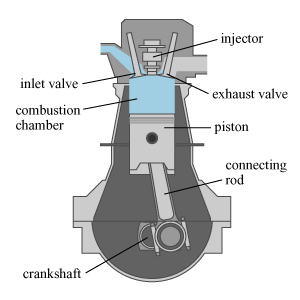
A compression ignition engine consists of several important components.
1. Cylinder
The cylinder is the main chamber where air compression and combustion occur.
2. Piston
The piston moves up and down inside the cylinder and transmits power to the crankshaft.
3. Crankshaft
It converts the reciprocating motion of the piston into rotary motion.
4. Fuel Injector
The injector sprays diesel fuel into the combustion chamber in atomized form.
5. Inlet Valve
Allows air to enter the cylinder during the suction stroke.
6. Exhaust Valve
Allows burnt gases to leave the cylinder during the exhaust stroke.
7. Connecting Rod
Connects the piston to the crankshaft and transmits motion.
8. Combustion Chamber
The space where fuel combustion takes place.
Characteristics of Compression Ignition Engines
Compression ignition engines have several distinguishing features:
- High compression ratio (14:1 to 25:1)
- No spark plug required
- Fuel injected directly into cylinder
- Higher thermal efficiency than petrol engines
- Strong and robust engine construction
- Higher torque output at low speeds
Also Read:
Advantages of Compression Ignition Engines
Compression ignition engines provide many benefits:
1. High Fuel Efficiency
CI engines consume less fuel because of higher compression ratios.
2. High Torque
They produce large torque at low speeds, making them suitable for heavy-duty vehicles.
3. Longer Engine Life
Their strong construction makes them durable and reliable.
4. Better Fuel Economy
Diesel fuel contains more energy compared to petrol.
5. Suitable for Heavy Applications
Used in trucks, buses, tractors, ships, and generators.
Disadvantages of Compression Ignition Engines
Despite their advantages, CI engines also have some drawbacks.
1. Higher Initial Cost
Diesel engines are more expensive to manufacture.
2. Heavier Engine
Stronger components increase engine weight.
3. Higher Noise and Vibration
CI engines are generally noisier than petrol engines.
4. Higher Maintenance Cost
Fuel injection systems are more complex.
5. Cold Starting Difficulty
Starting can be difficult in extremely cold climates.
Applications of Compression Ignition Engines
Compression ignition engines are widely used in many sectors.
Transportation
- Trucks
- Buses
- Tractors
- Heavy vehicles
Power Generation
- Diesel generators
- Backup power systems
Marine Industry
- Ships
- Boats
Construction Equipment
- Bulldozers
- Excavators
- Cranes
Industrial Machines
- Pumps
- Compressors
- Heavy machinery
Difference Between CI Engine and SI Engine
Feature | CI Engine | SI Engine |
Ignition Method | Self ignition due to compression | Spark plug ignition |
Fuel Used | Diesel | Petrol |
Compression Ratio | High | Low |
Fuel Injection | Direct injection | Carburetor or injection |
Efficiency | Higher | Lower |
Applications | Heavy vehicles | Light vehicles |
Learn more about the difference between CI engine and SI engine
Conclusion
A Compression Ignition Engine is a highly efficient internal combustion engine that ignites fuel through high air compression instead of a spark. This principle allows diesel engines to deliver greater fuel efficiency, higher torque, and superior durability, making them ideal for heavy-duty applications such as transportation, construction equipment, marine systems, and power generation.
Understanding how CI engines work—from air compression and fuel injection to combustion and power production—helps engineers design more efficient machines and energy systems. As technology evolves, modern diesel engines continue to improve with advanced fuel injection systems, emission control technologies, and better efficiency, ensuring their ongoing importance in industrial and transportation sectors.
FAQs
A compression ignition engine is an internal combustion engine in which fuel ignites automatically due to the high temperature created by compressing air inside the cylinder.
It is called a diesel engine because it operates on the diesel combustion principle and typically uses diesel fuel.
No. CI engines do not use spark plugs. Fuel ignites automatically due to high temperature of compressed air.
Compression ignition engines mainly use diesel fuel, although biodiesel and some heavy fuels can also be used.
High compression ratios increase air temperature enough to ignite the injected fuel without a spark.
The compression ratio of a compression ignition engine typically ranges from 14:1 to 25:1.
They are commonly used in trucks, buses, ships, tractors, generators, and heavy machinery.
Yes. CI engines usually have higher thermal efficiency and better fuel economy.
They require stronger components to withstand the high pressure generated during combustion.
A compression ignition engine operates on the diesel cycle.
Compression Ignition Engine – Knowledge Check
⚠️ Please select an option before continuing.