
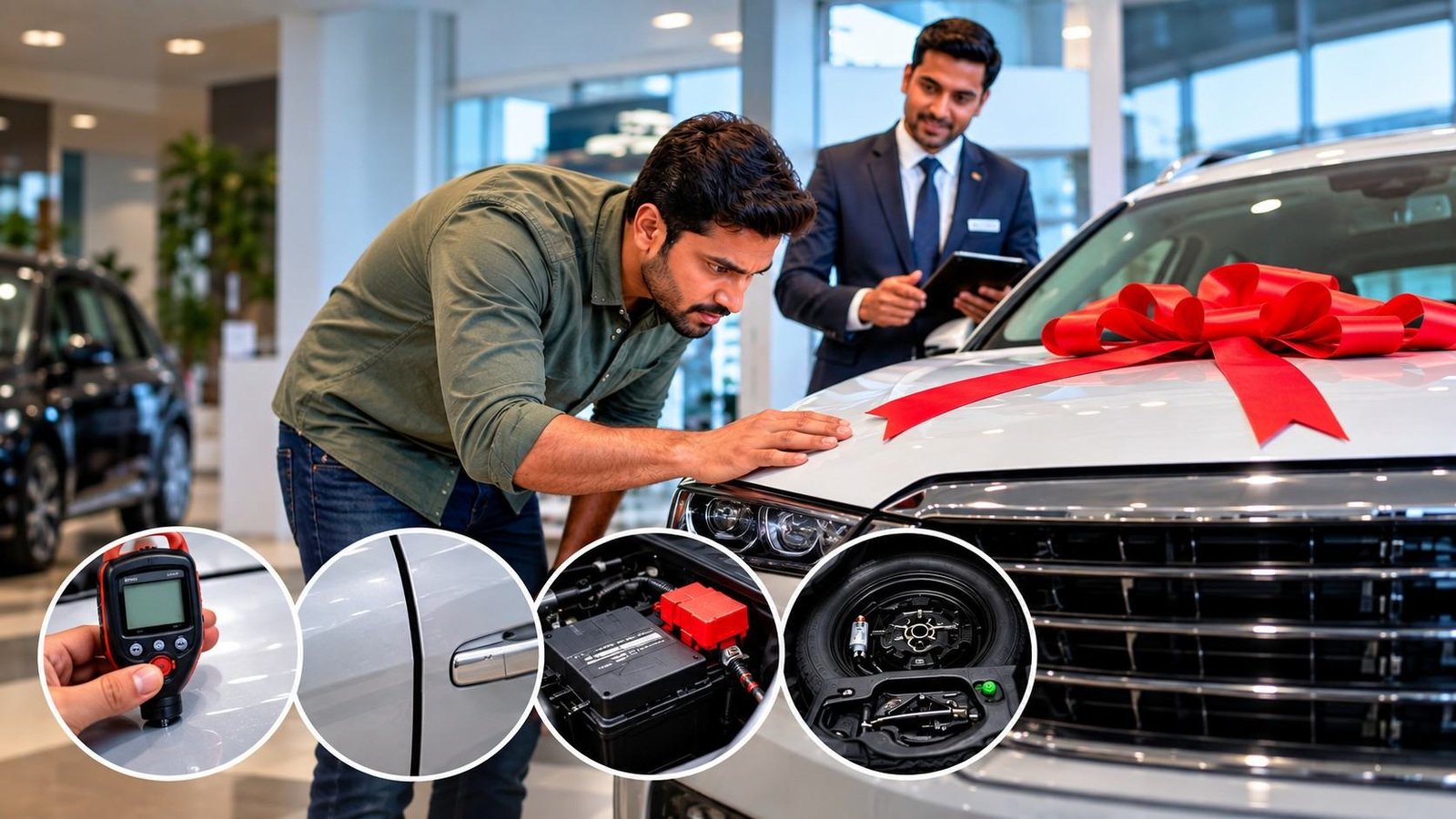
Buying a new car is one of the larger financial decisions most people make. And yet the moment that matters most in the entire process, the delivery itself, is also the one most buyers are least prepared for. You are excited, the showroom is busy, the salesperson is congratulating you, someone is taking photographs for Instagram, and somewhere in the middle of all of that you are expected to make a clear-headed assessment of a vehicle worth several lakhs.
That window is your only real opportunity to reject the car, raise objections, and have them addressed without any legal grey area. Once you sign the delivery receipt and drive away, everything changes.
The Delivery Day Window Is Shorter Than You Think
Most buyers assume that accepting a new car and driving it home is not a point of no return. That there will be time to flag issues later, that the dealer will sort things out, that the warranty covers everything anyway. None of these assumptions hold up under scrutiny.
The delivery receipt you sign is an acknowledgement that you have received the vehicle in an acceptable condition. From a legal and commercial standpoint, your signature is a statement that you inspected the car and found it satisfactory. After that point, any defect you raise becomes a warranty claim, not a delivery dispute. The process, the timelines, and the leverage all shift in the dealer’s favour.
The window during which you can simply refuse to accept a defective car, or insist on a replacement unit, is entirely within the pre-signing period. Not a day after. Not an hour after. Before.
What Legal Protection You Actually Have Before Signing
Under the Consumer Protection Act, a buyer has the right to receive goods that match the description and quality represented at the point of sale. A new car with transit damage that was not disclosed, a battery that has deteriorated due to long storage, or a vehicle that was used as a demo unit without being declared as such, all of these are grounds for raising a formal objection before accepting delivery.
Before you sign, you are a buyer who has not yet received what they paid for. You are in a position to demand rectification, request a replacement unit, or in serious cases, request a refund of your advance. These are options that are available to you in that window and become significantly harder to exercise once you have driven the car off the lot.
After signing, the same Consumer Protection Act still technically protects you, but the burden of proof shifts. You now have to establish that the defect existed at the time of delivery, not that it appeared later. That distinction matters enormously in any dispute.
The Most Common Defects Found at the Point of Delivery
Knowing what to look for is the difference between a productive inspection and a polite walk around the car before someone hands you the keys. A Cars24 PDI covers more than 300 checkpoints, and the defects that surface most frequently during these inspections fall into a few predictable categories.
- Paint irregularities from transit damage that have been touched up without disclosure. These are invisible to the naked eye but detectable with a paint depth gauge, which measures the thickness of paint layers and flags areas where additional coats have been applied over repaired bodywork.
- Battery degradation from extended storage. A car that sat in a stockyard for three months may start perfectly well on delivery day but show significantly reduced battery health within weeks. A battery health test at the time of PDI catches this before it becomes your problem.
- Panel misalignment caused by handling during transport. Doors, bonnets, and boot lids that are slightly off their proper alignment create wind noise at speed and can indicate that the car was disturbed and reassembled without proper checking.
- Missing or incorrect accessories. Spare tyre, jack, toolkit, manuals, and any add-ons you paid for should all be physically verified against your invoice before you accept delivery.
How to Raise an Objection Without Killing the Deal
Many buyers hesitate to flag issues at delivery because the social pressure of the moment makes it feel confrontational. The salesperson is enthusiastic. The family is excited. The paperwork is ready. Raising an objection feels like you are being difficult.
You are not being difficult. You are protecting a purchase worth several lakhs. And there is a way to do it that is firm without being aggressive.
If you have had a professional PDI done before delivery day, the inspection report does the work for you. Services like Cars24’s PDI conduct the inspection at your location before you accept the car, and hand you a detailed written report of every finding. You are not making a personal accusation at the dealership. You are presenting documented findings from a qualified third-party inspector and asking the dealer to address them. This shifts the conversation from confrontation to resolution. Most dealers, when faced with a written report rather than a verbal complaint, move to fix the issue rather than argue about whether it exists.
State clearly what you want: rectification, a replacement unit, or more time to assess. Put any agreement in writing, even as a WhatsApp message that creates a paper trail. Do not sign the delivery receipt until the agreed action has been completed or formally committed to.
What Happens If You Sign and Then Find a Problem
This is the scenario most buyers end up in because they do not get a professional PDI done before delivery. They accept the car, drive it home, and then notice something: a noise at a certain speed, a paint blemish in different lighting, a feature that does not work as expected.
At this point, your recourse is through the warranty process. For genuine manufacturing defects, this should work. For issues that fall into grey areas, such as transit damage that was repaired but not disclosed, battery health that was poor at delivery but only became a problem weeks later, or accessories that were missing and you only noticed when you needed them, warranty claims become harder to prosecute without evidence from the delivery period.
This is where a PDI report from a service like Cars24, conducted before delivery, becomes genuinely valuable after the fact. If the report flagged an issue that the dealer agreed to address, and the issue has now resurfaced, you have documentation from before delivery that supports your claim. Without it, you are trying to prove that a problem existed before you accepted the car, and that is a harder argument to make.
Make the Moment Count
The delivery of a new car should be a good day. A PDI done right, before the handover, by an independent inspector with the right tools and a structured checklist, makes it a good day with a clean conscience. You are not hoping the car is fine. You know it is.
That one chance to inspect, object, and insist on what you paid for is worth every minute you invest in it. Use it before you sign. It does not come around again.