
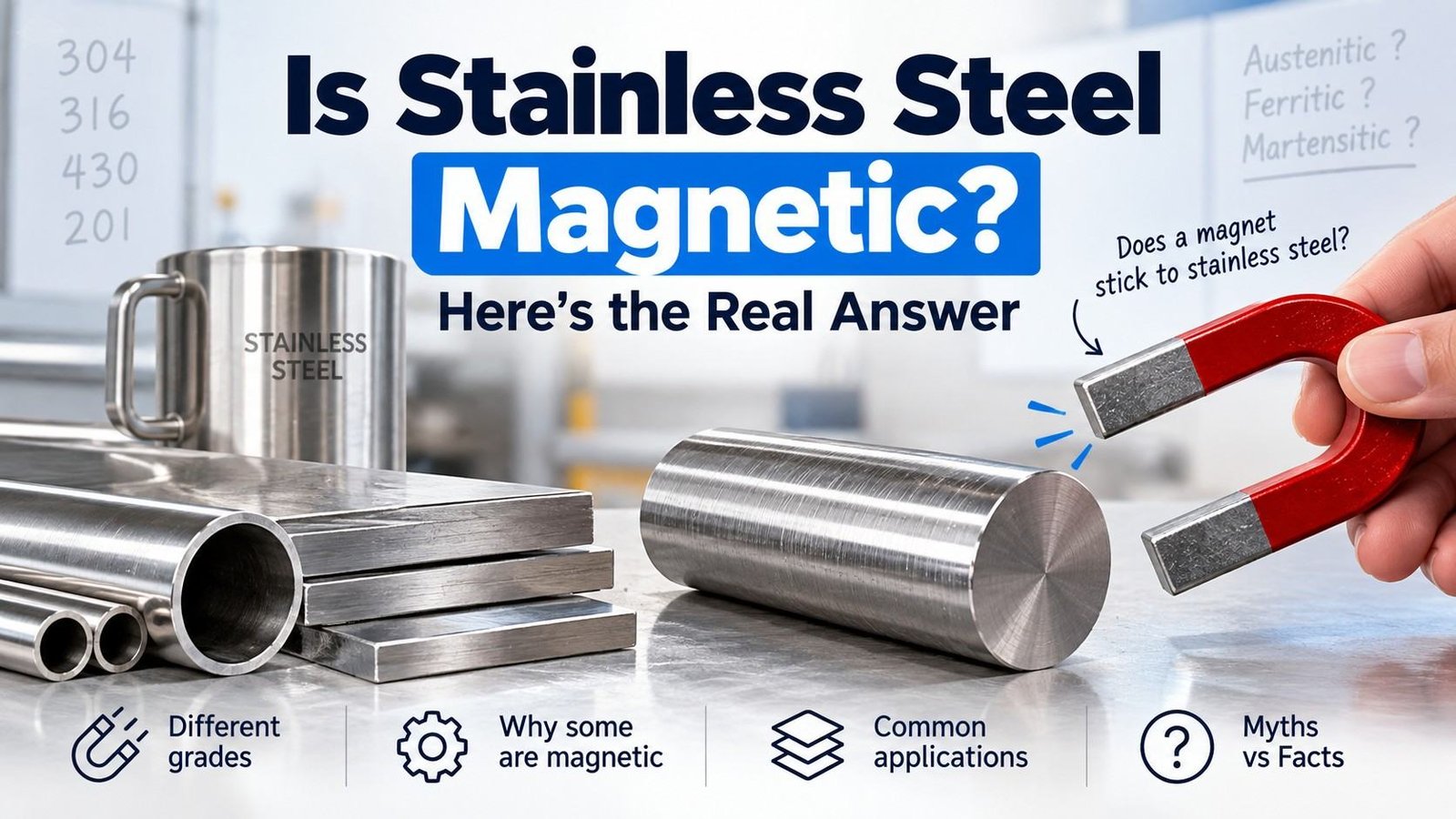
Sometimes. Stainless steel isn’t one material, it’s a family of alloys, and whether a given piece is magnetic depends almost entirely on its internal crystal structure, which is set by its chemical composition. Common austenitic grades like 304 and 316 are essentially non-magnetic. Common ferritic and martensitic grades like 430, 410, and 420 are strongly magnetic. And to make things messier, a “non-magnetic” grade can pick up magnetism after it’s bent, stamped, machined, or welded.
If you’re holding a fridge magnet up to something right now trying to figure out if it’s “real” stainless steel, stop. Magnetism tells you almost nothing about quality or corrosion resistance. Here’s what it actually tells you, grade by grade.
Why People Assume Stainless Steel Isn’t Magnetic
Stainless steel is famous for two things: not rusting, and (supposedly) not sticking to magnets. The second one is a myth in the sense that it’s only true for some stainless steel, but it’s a persistent myth because the most common stainless steel most people touch every day, 18/8 or 18/10 flatware and kitchen sinks (grade 304), genuinely is non-magnetic. People generalize from there.
Meanwhile, stainless steel obviously contains iron. It’s a steel, and iron is the poster child for magnetic metals. So the intuition cuts both ways, and both intuitions are half-right. The resolution isn’t about how much iron is present. It’s about how the atoms are arranged.
The Real Factor: Crystal Structure, Not Iron Content
Every metal’s magnetic behavior comes down to its atomic lattice. In stainless steel, alloying elements, mainly chromium, nickel, and carbon, determine which of a few possible lattice structures the steel settles into as it cools:
- Ferritic structure (body-centered cubic): atoms pack in a way that allows magnetic domains to align easily → magnetic
- Martensitic structure (also body-centered, but harder/more strained): same story → magnetic
- Austenitic structure (face-centered cubic): the atomic packing doesn’t support the same magnetic domain alignment → non-magnetic (or very weakly magnetic)
Nickel is the key ingredient that pushes steel into the austenitic, non-magnetic camp. Chromium (which every stainless steel needs at 10.5%+ to qualify as “stainless” at all) pushes toward the magnetic ferritic structure on its own. It’s specifically the addition of nickel on top of chromium that flips the structure to austenitic and kills the magnetism. According to the Nickel Institute, it’s the addition of roughly 8 to 10% nickel that shifts steel into this austenitic structure, and nickel-containing grades now make up the large majority of all stainless steel produced worldwide.
Stainless Steel Families: Magnetic or Not?
| Family | Typical Grades | Nickel Content | Magnetic? | Common Uses |
|---|---|---|---|---|
| Austenitic | 304, 316, 321, 301 | High (8%+) | No (weakly at most) | Kitchen sinks, food equipment, cutlery, architecture |
| Ferritic | 430, 409, 439 | None/negligible | Yes, strongly | Appliance panels, exhaust systems, induction cookware bases |
| Martensitic | 410, 420, 440C | Low | Yes, strongly | Knife blades, surgical instruments, fasteners, turbine blades |
| Duplex | 2205, 2507 | Moderate (mixed structure) | Yes, moderately | Marine, chemical processing, oil & gas |
| Precipitation-hardening | 17-4 PH | Low-moderate | Yes, usually | Aerospace, high-strength fasteners |
Austenitic grades are the ones people usually mean when they say “stainless steel isn’t magnetic.” They’re by far the most common grades in consumer products, which is why the myth persists.
Is 304 Stainless Steel Magnetic?
304 (the classic 18/8 or 18/10 stainless, 18% chromium, 8 to 10% nickel) is austenitic and, in its annealed (freshly formed, unstressed) state, essentially non-magnetic. But there’s a catch that trips a lot of people up:
Cold-working 304 makes it magnetic. Bending, stamping, rolling, or machining austenitic stainless steel can locally convert some of that austenite into martensite, the magnetic structure, through a process called strain-induced transformation. This is why:
- The flat bottom of a stainless sink barely responds to a magnet, but the curved, pressed corners feel noticeably magnetic
- A 304 stainless bolt that’s been cold-rolled or thread-rolled can stick to a magnet even though the raw stock didn’t
- Welded seams on 304 stainless are often more magnetic than the surrounding metal, because welding and rapid cooling can promote the same structural shift
The British Stainless Steel Association confirms this pattern directly, noting that cold work and welding tend to increase the amount of martensite and ferrite in the steel respectively, and that this is exactly why a pressed sink bowl shows more magnetic response than its flat drainer.
None of this changes the corrosion resistance. Magnetism and rust resistance are governed by different mechanisms; chromium content controls corrosion resistance regardless of whether the piece happens to be magnetic.
Is 316 Stainless Steel Magnetic?
316 (the marine-grade stainless, with added molybdenum) behaves like 304: austenitic and non-magnetic in its base form, with the same tendency to develop weak magnetism after cold working or welding. It’s slightly more resistant to that shift than 304 because of its alloy chemistry, which is one reason it’s favored for surgical implants and marine hardware where consistent non-magnetic behavior matters.
Is 430 Stainless Steel Magnetic?
Yes, strongly and consistently. 430 is ferritic, with 16 to 18% chromium and little to no nickel. That’s exactly why it’s the grade used on the base of induction-compatible stainless cookware: induction cooktops only generate heat in cookware that responds to a magnetic field, and 430 delivers that reliably while austenitic grades like 304 and 316 generally don’t (unless it’s a multi-ply pan with a magnetic layer bonded underneath a 304 cooking surface).
Do Stainless Steel Knives Stick to Magnets?
Usually, yes. Most knife blades, kitchen knives, pocket knives, surgical blades, are made from martensitic grades like 420 or 440C because martensitic structure is what allows the steel to be heat-treated to a hard, sharp-holding edge. That hardness and that magnetism come from the same underlying structure, so a knife that sticks firmly to a magnet is behaving exactly as expected.
The 10-Second Magnet Test
Want to check a piece you have on hand? Grab any ordinary magnet (a fridge magnet works fine) and touch it to the metal.
- Strong, immediate pull → likely ferritic or martensitic (430, 410, 420, 440-series, or similar)
- No response at all → likely austenitic in an unworked state (304, 316, 321)
- Weak, inconsistent pull, stronger at bends/welds/edges → likely austenitic stainless that’s picked up surface magnetism from forming or welding, still fundamentally a “non-magnetic” grade
What the magnet test does not tell you: whether the metal will rust, how strong it is, or whether it’s “real” stainless steel. Don’t use it as a quality check.
Where Magnetism Actually Matters
For most uses, whether stainless steel sticks to a magnet is trivia. But it’s a real engineering spec in a few situations:
- MRI and medical environments: ferromagnetic metal near an MRI machine is a serious safety hazard, so equipment and implants near imaging suites specify austenitic grades and sometimes a maximum permeability limit
- Induction cooking: cookware needs a magnetic base layer to heat at all
- Compasses, sensors, and electronics: magnetic stainless steel near sensitive instruments can throw off readings, so enclosures near compasses or magnetometers often require non-magnetic (austenitic) stainless
- Marine hardware: fasteners and fittings near navigation equipment are frequently specified as austenitic for the same reason
Quick Answer Recap
- Stainless steel is a family of alloys, not one material; magnetism depends on the specific grade
- Austenitic (304, 316): non-magnetic, but can become weakly magnetic after cold working or welding
- Ferritic (430) and martensitic (410, 420, 440C): magnetic, often strongly
- Nickel content is the main factor that suppresses magnetism, per the Nickel Institute
- A magnet test tells you the crystal structure, not the quality or corrosion resistance
- If you need genuinely non-magnetic performance (MRI, marine electronics), specify austenitic grades and, for critical applications, a maximum permeability spec
Sources: Nickel Institute, British Stainless Steel Association