
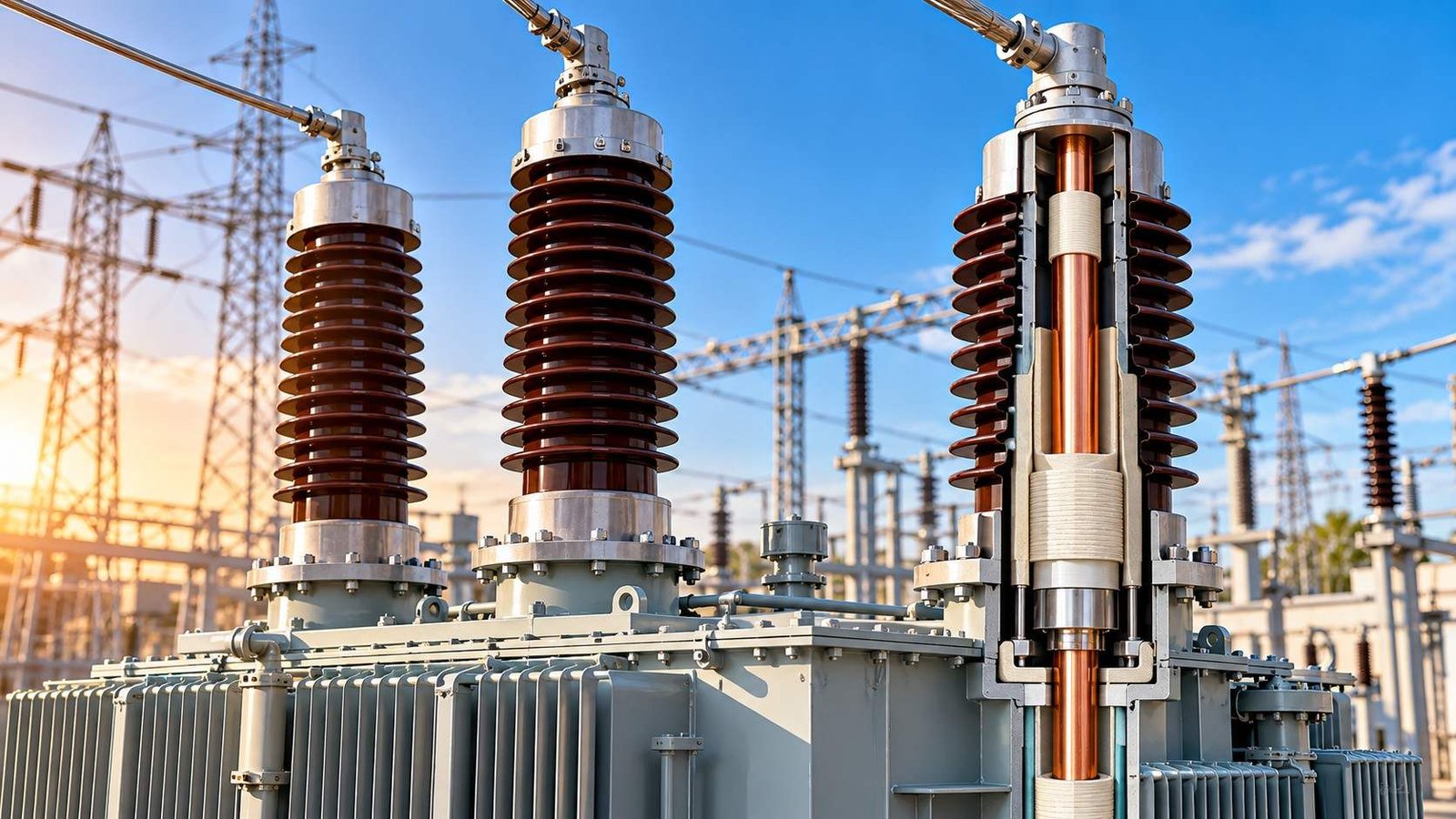
A power transformer spends its whole working life sealed inside a grounded steel tank filled with oil. That design keeps the high-voltage windings protected and cool, but it creates an obvious problem. How do you get thousands of volts into and out of a sealed metal box without the current jumping straight to the tank wall? If that ever happened, the arcing and dielectric breakdown would wreck the equipment in an instant, sending current straight to the grounded steel. Transformer bushings solve this. They are the parts that let high-voltage power flow safely to and from the transformer.
What Is a Transformer Bushing?
Transformer bushings act like a gateway that lets electricity flow in and out of the transformer while keeping everything insulated and safe. It not only provides safe passage to electricity but also distributes electrical stress across its grading layers along the length of the bushing, preventing concentration of stress at any one point, which reduces the risk of partial discharge and insulation failure. This component plays a crucial role in stable electricity transmission.
There is a third job that gets less attention. The conductor heats up as current flows, and that heat has to travel outward through the insulation before it can escape into the oil inside the tank or the air outside. Managing this is really a heat transfer problem as much as an electrical one. A well-designed bushing sheds that heat steadily instead of letting it build up in the insulation.
How Does a Transformer Bushing Work?
The clever part of a high-voltage bushing is how it controls electrical stress. If you simply wrapped a conductor in a thick layer of insulation, the voltage may concentrate at one point or unevenly, straining the insulation until it broke down. The condenser design fixes this. Inside the bushing, thin conductive foils are placed between layers of insulating paper, forming a stack of capacitors in series.
These capacitors share the voltage in even steps from the conductor out to the grounded flange, so no single layer takes more stress than it can handle. That is why these components are often called capacitance-graded or condenser bushings.
The insulating layers need a medium to fill every gap and push out moisture and trapped air. In oil-impregnated paper (OIP) designs, refined mineral oil soaks the paper, giving strong dielectric strength and efficient heat movement. In resin-impregnated paper or synthetic (RIP/RIS) designs, a cured resin fills the core instead, producing a dry, solid body. Each construction suits different service conditions, and both are widely used across the power industry.
Why Do Transformer Bushings Matter in Power Transmission?
For a component that rarely gets a second glance, a bushing carries a lot of responsibility. Reliability surveys run by CIGRE, the international body for large electrical systems, consistently rank bushings among the top few sources of trouble in power transformers. Depending on the study, they account for somewhere between a tenth and a quarter of reported transformer faults. On transmission units operating above 100 kV, that share tends to sit toward the higher end.
The reason this matters comes down to consequences. When a bushing develops a fault, it can escalate fast, and bushing-related events are one of the leading triggers of transformer fires. A single incident can pull a transformer out of service for months, interrupt supply across a wide area, and cost many times the price of the part itself. In a transmission network where one large transformer may feed thousands of homes and businesses, keeping bushings healthy is a direct investment in grid stability.
Common Types of Transformer Bushings
Bushings come in several forms, each shaped by where it works and what it connects to. The main types you will meet in transmission and generation systems include:
- OIP condenser bushings, which use oil-impregnated paper and are trusted across a very large installed base worldwide for their proven dielectric performance.
- RIP and RIS condenser bushings, built around a dry resin core, suited to installations where an oil-free design and fire safety are priorities.
- High-current bushings, engineered to carry very large currents, such as the connections on generator step-up transformers.
- Wall bushings, which carry a conductor through a building or barrier wall rather than a transformer tank.
- Oil-to-oil bushings, used where a conductor passes between two oil-filled compartments.
Choosing among them comes down to the application. The voltage class and current rating set the baseline, and the service environment, whether indoor or outdoor, mild or harsh, narrows the choice from there.
Common Bushing Problems and Early Warning Signs
Most bushing trouble starts small and gives warning long before it turns serious. The single most common culprit is moisture. Reliability studies have long pointed to water creeping in through worn gaskets or seals, which gradually degrades the paper insulation from the inside. Other contributors include partial discharge, a low-level internal sparking that eats away at insulation over time, along with thermal stress and simple aging of the seals.
The encouraging part is that these problems tend to announce themselves. Operators watch for a handful of tell-tale signs:
- Unusual heating on the bushing, often visible with infrared cameras.
- Oil seepage or a dropping oil level in oil-filled types.
- A rising tan delta reading, which shows the insulation is losing quality.
- Growing partial discharge activity measured during testing.
Catching any of these early turns what could have been an unplanned outage into a scheduled, manageable repair.
How Bushings Are Kept Reliable: Standards, Testing and Monitoring
Reliable bushings start with tight standards. Most are designed and tested to the IEC 60137 standard, specifically its 2017 edition, which sets the characteristics and test routines for insulated bushings used on AC systems above 1,000 volts. In North America, the IEEE C57.19.00 and C57.19.01 standards cover performance requirements and physical dimensions, so bushings from different makers fit and behave predictably. These documents define the electrical and mechanical tests a bushing must pass before it ever reaches service.
Once installed, a bushing is kept healthy through condition monitoring rather than guesswork. Several diagnostic methods work together:
- Tan delta and capacitance testing, which track the quality of the insulation over time.
- Partial discharge measurement, which detects internal sparking before it spreads.
- Dissolved gas analysis (DGA) on oil-filled types, which reveals the chemical byproducts of internal stress.
- Infrared thermography, which spots abnormal heating during normal operation.
This condition-based approach lets operators plan work around real evidence instead of fixed schedules. It extends service life and heads off surprises. When testing shows a bushing is nearing the end of its useful life, a planned replacement or retrofit keeps the wider transformer in service and avoids a far more expensive interruption later.
Conclusion
Transformer bushings rarely make headlines, yet they sit at one of the most demanding junctions in the entire power system. They carry high-voltage current through a grounded barrier, manage electrical stress, and distribute heat, all while standing up to weather and years of continuous service. When they are well designed, built to standard, and monitored properly, they quietly keep power flowing. When they are neglected, they become one of the costliest weak points on the grid. For anyone working in power transmission, the time spent understanding transformer bushings pays for itself.
Frequently Asked Questions
Not quite. It insulates, but it also conducts current along its central conductor and manages the heat that the current produces. Doing all of that at high voltage or high current is what makes it a specialized component rather than a simple insulator.
It varies by utility and maintenance plans. Routine visual inspection and thermography happen regularly, while detailed electrical tests such as tan delta are scheduled during maintenance windows. Continuous online monitoring is increasingly used on critical transformers to catch changes as they happen.