
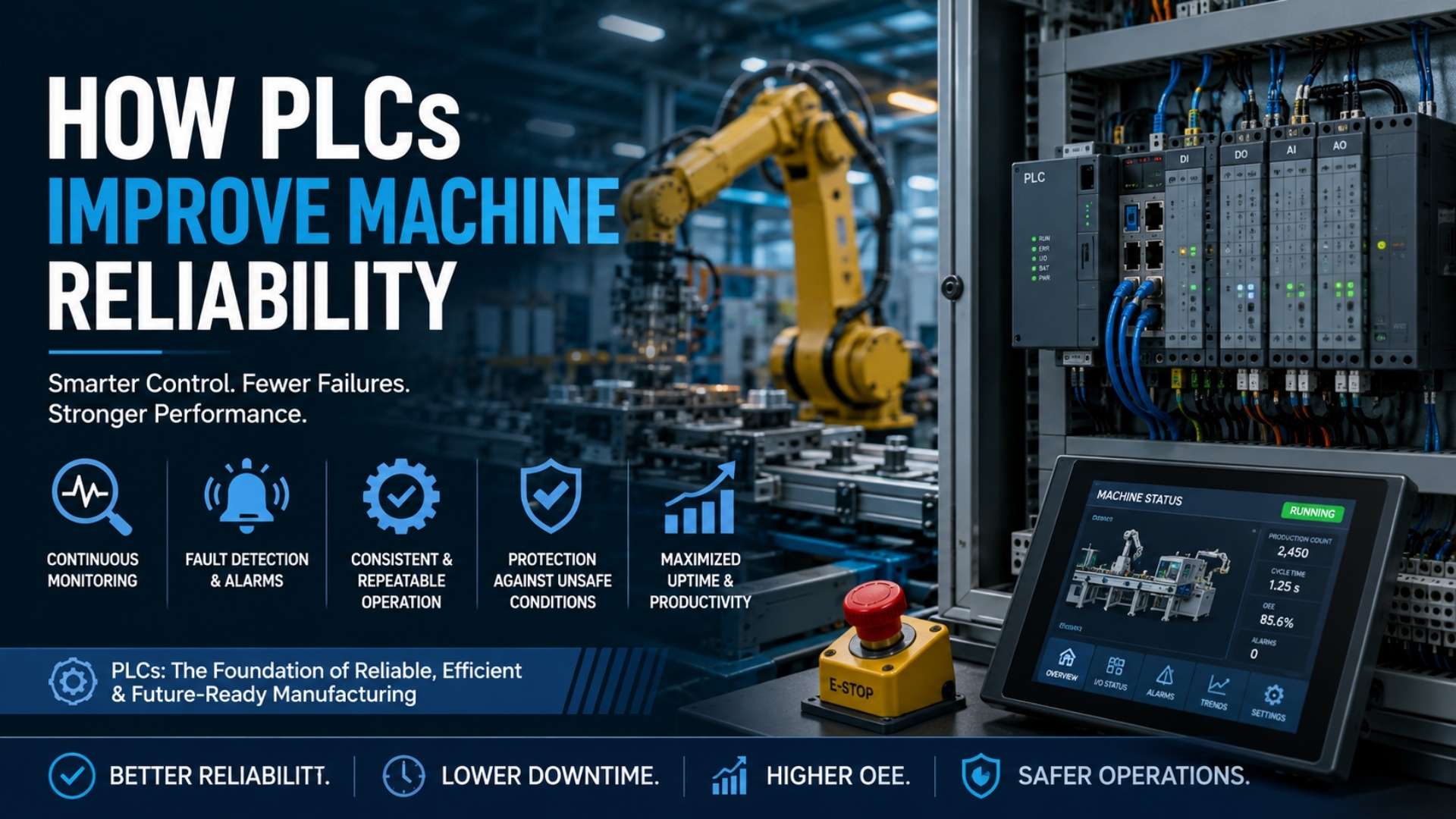
Modern manufacturing lines depend on consistent machine performance to maintain productivity and product quality. Unplanned downtime remains one of the most expensive challenges in industrial operations. When a line stops, the financial impact cascades through the entire facility.
At the core of most downtime mitigation strategies is the Programmable Logic Controller (PLC). Originally developed to replace cumbersome relay banks, the PLC has become the definitive standard control platform in industrial machinery. However, PLCs do far more than merely automate machine sequences. They actively improve overall reliability, reduce mechanical and electrical failures, and form the foundational infrastructure for predictive maintenance programs.
Why Machine Reliability Matters in Modern Manufacturing
Equipment failure is rarely an isolated event. The cost of unexpected downtime manifests rapidly through direct production losses and missed delivery schedules. As maintenance teams scramble to replace broken components, maintenance expenses spike. Furthermore, erratic machine behavior leading up to a failure often causes severe quality defects and an increase in scrap material.
On the factory floor, we frequently trace machine failures back to a predictable set of common causes:
- Electrical faults:Short circuits, ground faults, and power surges.
- Sensor failures:Physical damage or degradation of proximity switches and photoeyes.
- Motor overloads:Excessive mechanical binding drawing high current.
- Human operating errors:Incorrect manual overrides or flawed sequence initiation.
- Communication interruptions:Dropped packets on industrial networks.
- Environmental factors:Sustained exposure to heat, heavy vibration, and airborne dust.
Viewing reliability purely as a maintenance metric is a mistake. Reliability acts as a distinct competitive advantage. Achieving higher Overall Equipment Effectiveness (OEE) translates directly to reduced maintenance costs, improved product consistency, and a significantly better workplace safety record.
What Makes PLCs Different from Traditional Control Systems?
Before microprocessors became robust enough for the plant floor, control logic was entirely physical. The evolution of industrial machine control highlights exactly why digital logic systems dominate today.
| Control Method | Typical Characteristics | Reliability Impact |
| Relay Logic | Hard-wired electromechanical circuits | Complex troubleshooting; high physical failure rate due to moving parts. |
| Mechanical Timers | Gear-driven, limited flexibility | High wear rate; timing drifts as physical components degrade. |
| PLC-Based Control | Programmable logic, diagnostic-rich | Faster fault recovery; zero mechanical wear on the logic sequence itself. |
Key PLC characteristics specifically support mechanical and electrical reliability. These devices feature a rugged industrial design built to withstand extreme temperatures and electrical noise. Their deterministic operation ensures that code executes precisely within a guaranteed timeframe, eliminating the timing collisions that cause mechanical crashes. Furthermore, modular architecture allows for the swift replacement of individual I/O cards without tearing down the entire panel.
Typical PLC components found in manufacturing equipment include the central processing unit (CPU), discrete digital inputs and outputs, analog modules for variable data, and human-machine interfaces (HMIs) for operator visibility.
Modern systems often combine CPUs, communication modules, drives, and distributed I/O networks. Engineers evaluating different control architectures can compare examples of industrial PLC controllers and automation modules to better understand how various hardware configurations support machine reliability.
Five Ways PLCs Improve Machine Reliability
1. Continuous Monitoring of Machine Conditions
Unlike human operators who can only observe the macroscopic behavior of a machine, PLCs constantly monitor micro-level inputs. They track raw sensor signals, precise motor status, fluctuating temperature values, hydraulic pressure levels, and exact servo position feedback.
The benefits of this constant vigilance are immediate. Abnormal conditions are detected in milliseconds. This allows the system to enact a faster response to developing faults, drastically reducing the risk of catastrophic physical failures.
2. Built-In Fault Detection and Alarm Management
A machine without diagnostics is a black box when it fails. PLCs provide built-in fault detection that generates specific, actionable data. Examples include sensor disconnect alarms, overcurrent warnings on variable frequency drives, motor overload detection, and constant emergency stop loop monitoring.
This identifies faults before actual equipment damage occurs. Consequently, maintenance personnel spend their time fixing the problem rather than searching for it, vastly reducing overall troubleshooting time.
3. Consistent and Repeatable Machine Operation
Variability is the enemy of reliability. When machines operate inconsistently, mechanical components experience irregular stress patterns. Consistent PLC logic eliminates operator-dependent variations and maintains strict process stability.
Consider a heavy material handling system. By standardizing conveyor start-up sequencing to include proper dwell times and staggered motor activation, the PLC reduces the inrush current and mechanical shearing forces that cause premature wear.
4. Protection Against Unsafe Operating Conditions
An automated system must protect itself. PLC logic can automatically stop equipment during overload events, prevent physically conflicting machine motions, and enforce strict safety interlocks before allowing a cycle to start.
Safety-related machine controls increasingly follow guidance from IEC functional safety standards when designing protective automation systems. Modern safety PLCs monitor redundancy circuits to ensure that even if a component fails, the machine fails into a safe, non-destructive state.
5. Support for Predictive and Preventive Maintenance
Reactive maintenance guarantees maximum downtime. PLCs pivot operations toward predictive maintenance by collecting operational data over time. A properly programmed PLC can reveal rising motor current profiles, slowly increasing cycle times, temperature drift in bearings, and vibration abnormalities.
Maintenance can be scheduled during planned outages before a total failure occurs. This leads to a longer equipment lifespan and tangibly lower maintenance costs.
Real-World Examples of PLC-Driven Reliability Improvements
“The transition from reactive to proactive maintenance on the factory floor is largely facilitated by the localized processing power of the modern PLC. It catches micro-faults long before they cascade into mechanical failures.”
Example 1: Conveyor Systems
Long-run conveyor systems face common issues like sudden motor overloads, severe belt jams, and degraded sensor failures. PLC solutions utilize automatic shutdown logic triggered by current spikes. By generating immediate fault logging, the system prevents a simple jammed box from burning out an expensive three-phase motor.
Example 2: Packaging Machines
Packaging lines endure high-speed operation and relentless cycle repetition. The reliability challenge here is mechanical fatigue. PLCs deliver highly accurate timing and consistent sequencing. By perfectly timing pneumatic actuations, the PLC prevents mechanisms from colliding, directly reducing the mechanical stress on the machine chassis.
Example 3: CNC and Automated Manufacturing Cells
In complex cells, robotic arms load parts into CNC mills. PLCs coordinate these multiple disparate subsystems. They monitor the overarching machine status to prevent catastrophic collision conditions, ensuring the robot arm never enters the cell while the mill door is closing.
The Growing Role of Data and Industrial Connectivity
We are transitioning from simple standalone automation to smart reliability. Modern PLCs sit at the center of this shift by supporting high-speed Ethernet communication, remote diagnostics, persistent data logging, and advanced condition monitoring.
The reliability benefits of connected systems are profound. Remote support capabilities mean an engineer can diagnose a fault sequence from an entirely different facility. Historical fault analysis allows engineering teams to identify the root cause of chronic micro-stops, driving down the Mean Time To Repair (MTTR).
Industrial data trends point heavily toward condition-based maintenance and broader digital manufacturing initiatives. Organizations such as NIST Industry 4.0 resources highlight the growing importance of connected industrial systems for improving operational reliability and maintenance efficiency.
Best Practices for Maximizing PLC Reliability
Even the best hardware can fail if implemented poorly. To truly maximize machine uptime, engineering and maintenance teams must adhere to a strict set of best practices.
1. Hardware Selection: Always utilize authentic industrial-grade components. Ensure the hardware meets appropriate environmental ratings (like IP67 for washdown environments) and utilize proper power supply design with adequate line filtering and surge protection.
2. Programming Best Practices: Spaghetti code causes downtime. Utilize structured code with clear commenting. Build robust error-handling routines and implement strict alarm prioritization so operators are not overwhelmed by nuisance faults.
3. Maintenance Recommendations: Keep regular, verified backups of the running PLC program. Maintain strict firmware management protocols. Physically, conduct regular inspections of field wiring and terminal connections, periodically verify the calibration of analog sensors, and perform routine system testing of safety interlocks.
4. Training Operators and Maintenance Teams: Hardware is only as effective as the people managing it. Proper training results in faster troubleshooting, better interpretation of HMI alarm responses, and drastically reduced human error during manual operations.
The Path Forward for Industrial Reliability
Machine reliability dictates productivity, quality, and ultimately, profitability. PLCs form the backbone of this reliability through relentless monitoring, deep diagnostics, rigorous safety functions, and unparalleled operational consistency.
As the manufacturing sector becomes increasingly interconnected, PLCs will continue evolving from simple sequence controllers into highly advanced, reliability-enabling nodes on the network. Facilities that properly specify, implement, and maintain PLC-based systems position themselves to drastically reduce unwanted downtime and secure long-term operational excellence.
Frequently Asked Questions
No. PLCs cannot defy physics or eliminate every physical component failure. However, they significantly reduce downtime by detecting faults early, securely controlling machine behavior to prevent operator-induced damage, and supporting highly targeted maintenance activities.
PLCs replace guesswork with data. They provide exact diagnostic information, historical alarm logs, and real-time operational data that help maintenance personnel identify the exact sensor or drive causing the issue, resolving problems quickly instead of testing components randomly.
Yes. The scale of control hardware has evolved. Modern PLC platforms are highly scalable and are available for everything from compact standalone machines with minimal I/O to massive, plant-wide automated production lines.