
Hybrid cars are becoming increasingly popular as people look for fuel-efficient and eco-friendly vehicles. But many still ask:
- What is a hybrid car?
- What are hybrid vehicles and how do they work?
In this complete guide, you’ll learn everything from basics to advanced concepts in simple, easy-to-understand language.
What Is a Hybrid Car?
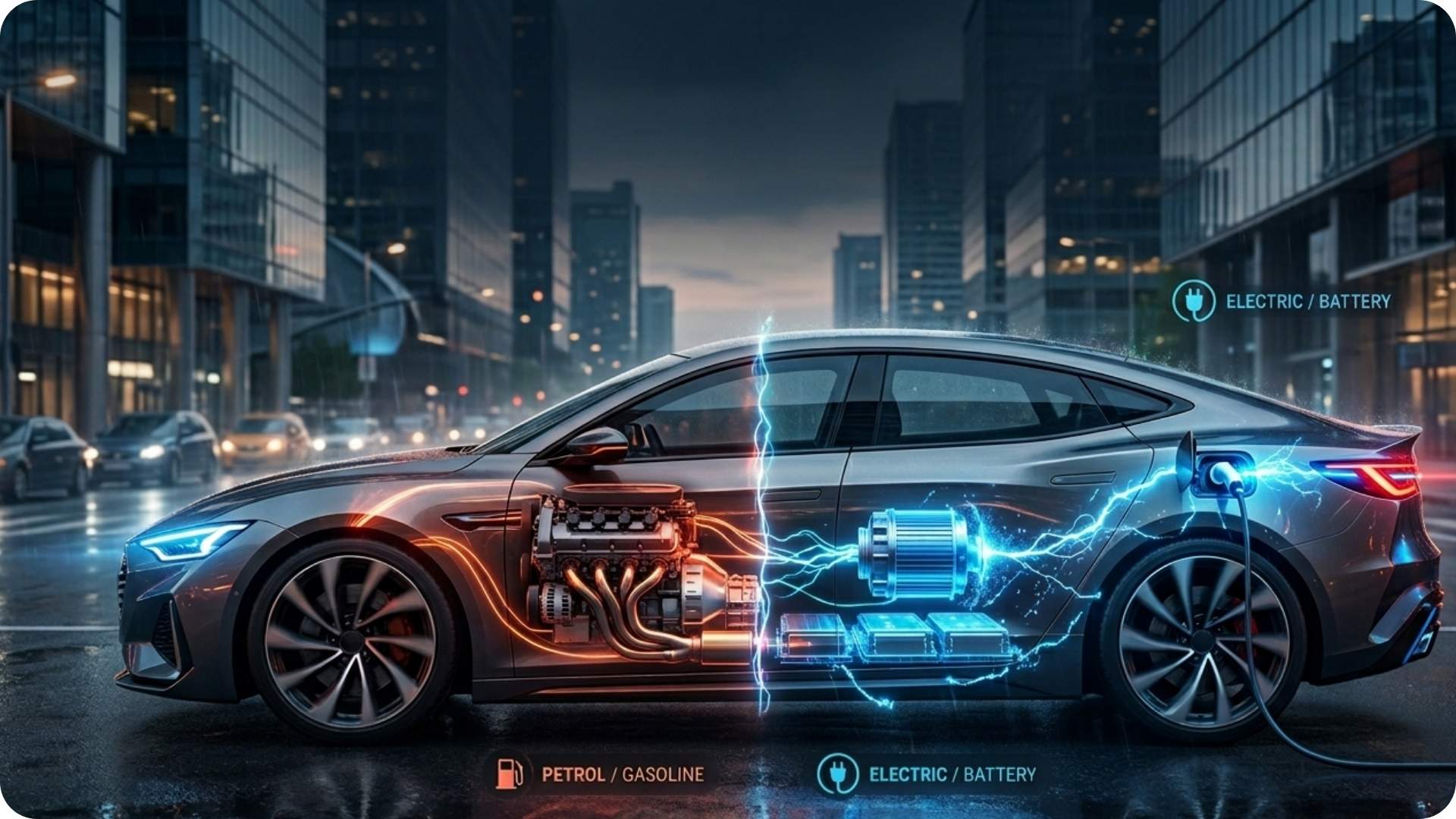
A hybrid car (or hybrid vehicle) is a vehicle that uses two power sources:
- A petrol/diesel engine
- An electric motor
Both systems work together to improve fuel efficiency, reduce emissions, and enhance performance.
In simple terms:
A hybrid car = Engine + Battery + Electric Motor
How Hybrid Cars Work
Hybrid vehicles use smart technology to switch between power sources.
Key Working Principle:
- Low Speed / Traffic
- Runs on electric motor
- Saves fuel
- High Speed
- Petrol engine activates
- Acceleration
- Both engine + motor work together
- Braking
- Energy is stored in battery (Regenerative braking)
This is why hybrid cars are highly efficient in city driving.
Types of Hybrid Vehicles
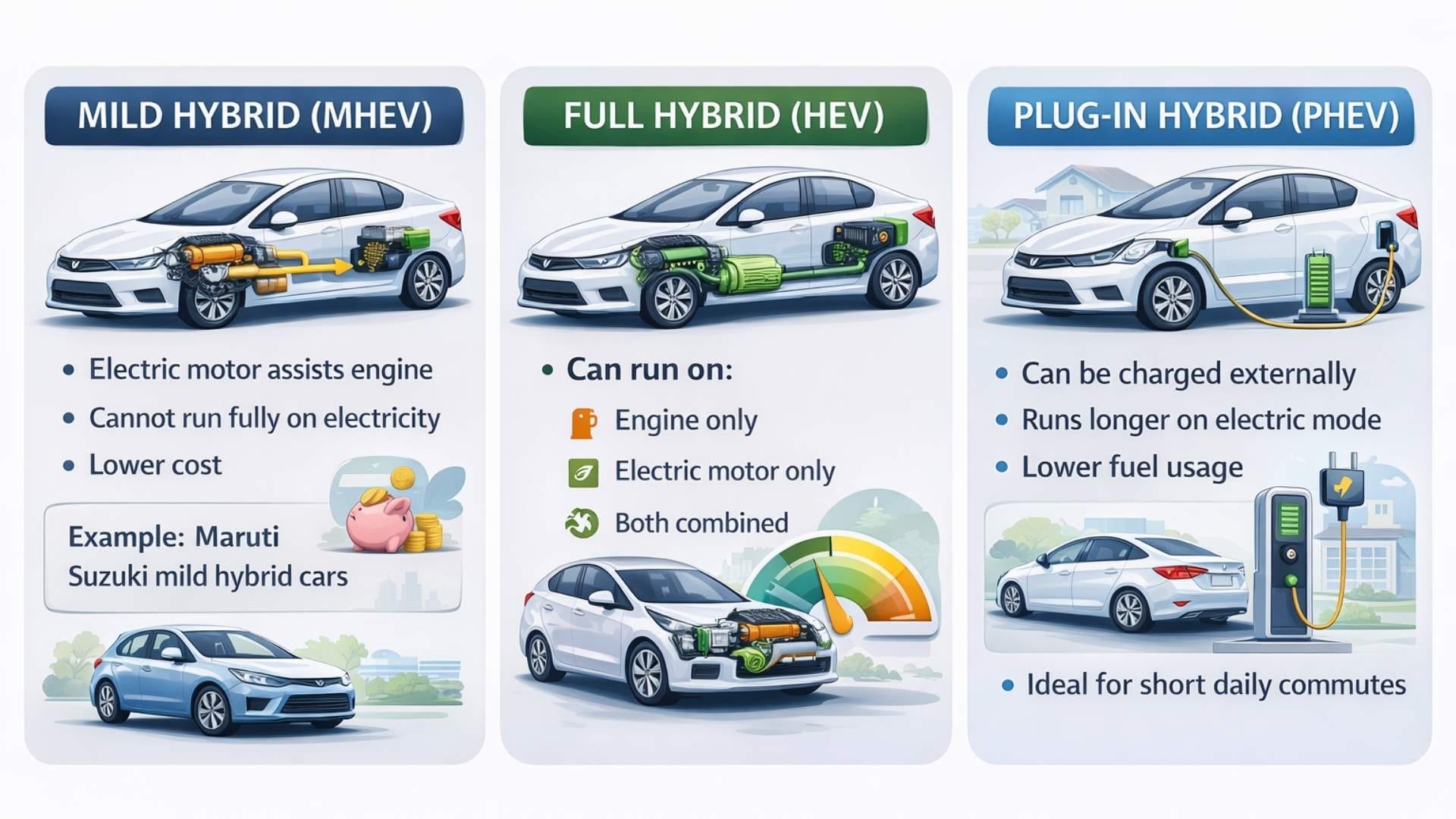
There are 3 main types of hybrid cars:
1. Mild Hybrid (MHEV)
A Mild Hybrid Electric Vehicle (MHEV) uses a small electric motor to assist the engine, but it cannot run on electricity alone.
- Electric motor assists engine
- Cannot run fully on electricity
- Lower cost
Example: Maruti Suzuki mild hybrid cars
2. Full Hybrid (HEV)
Can run on:
- Engine only
- Electric motor only
- Both combined
Best balance of performance + efficiency
3. Plug-in Hybrid (PHEV)
- Can be charged externally
- Runs longer on electric mode
- Lower fuel usage
Ideal for short daily commutes
Benefits of Hybrid Cars
- Better Fuel Efficiency: Hybrid cars consume less fuel compared to petrol cars.
- Lower Emissions: They produce less CO₂, making them environmentally friendly.
- Cost Savings
- Lower fuel cost
- Reduced maintenance (less engine load)
- Smooth Driving Experience: Electric motors provide silent and smooth operation.
- No Range Anxiety: Unlike electric vehicles, hybrids don’t rely fully on charging.
Disadvantages of Hybrid Cars
- Higher Initial Cost: Hybrid cars are more expensive than regular cars.
- Battery Replacement Cost: Battery replacement can be costly after several years.
- Complex System: More components = slightly higher maintenance complexity.
Best Hybrid Cars in 2026
If you’re planning to buy, here are some of the best hybrid cars:
Toyota Prius
- Most popular hybrid globally
- Excellent mileage
- Reliable and proven technology
Honda Accord Hybrid
- Premium sedan
- Powerful + fuel efficient
- Comfortable for long drives
Hyundai Ioniq Hybrid
- Stylish and modern
- Affordable hybrid option
Toyota Camry Hybrid
- Luxury + efficiency
- Great for city and highway
Hybrid Cars vs Electric Cars
| Feature | Hybrid Cars | Electric Cars |
| Fuel | Petrol + Electric | Fully Electric |
| Charging | Not required (except PHEV) | Required |
| Range | Long | Limited |
| Cost | Moderate | Higher |
| Maintenance | Medium | Low |
Hybrid cars are best if you want efficiency without charging dependency.
Are Hybrid Cars Worth It?
Yes, for most people, hybrid cars are a smart investment.
Best for:
- City driving
- Daily commuters
- Fuel cost saving
Not ideal for:
- Very high-speed highway driving only
- People looking for full electric experience
Conclusion
Hybrid cars are a perfect bridge between traditional petrol cars and electric vehicles. They offer:
- Better mileage
- Lower emissions
- Smooth performance
If you’re looking for a cost-effective and eco-friendly vehicle, hybrid cars are definitely worth considering in 2026.