
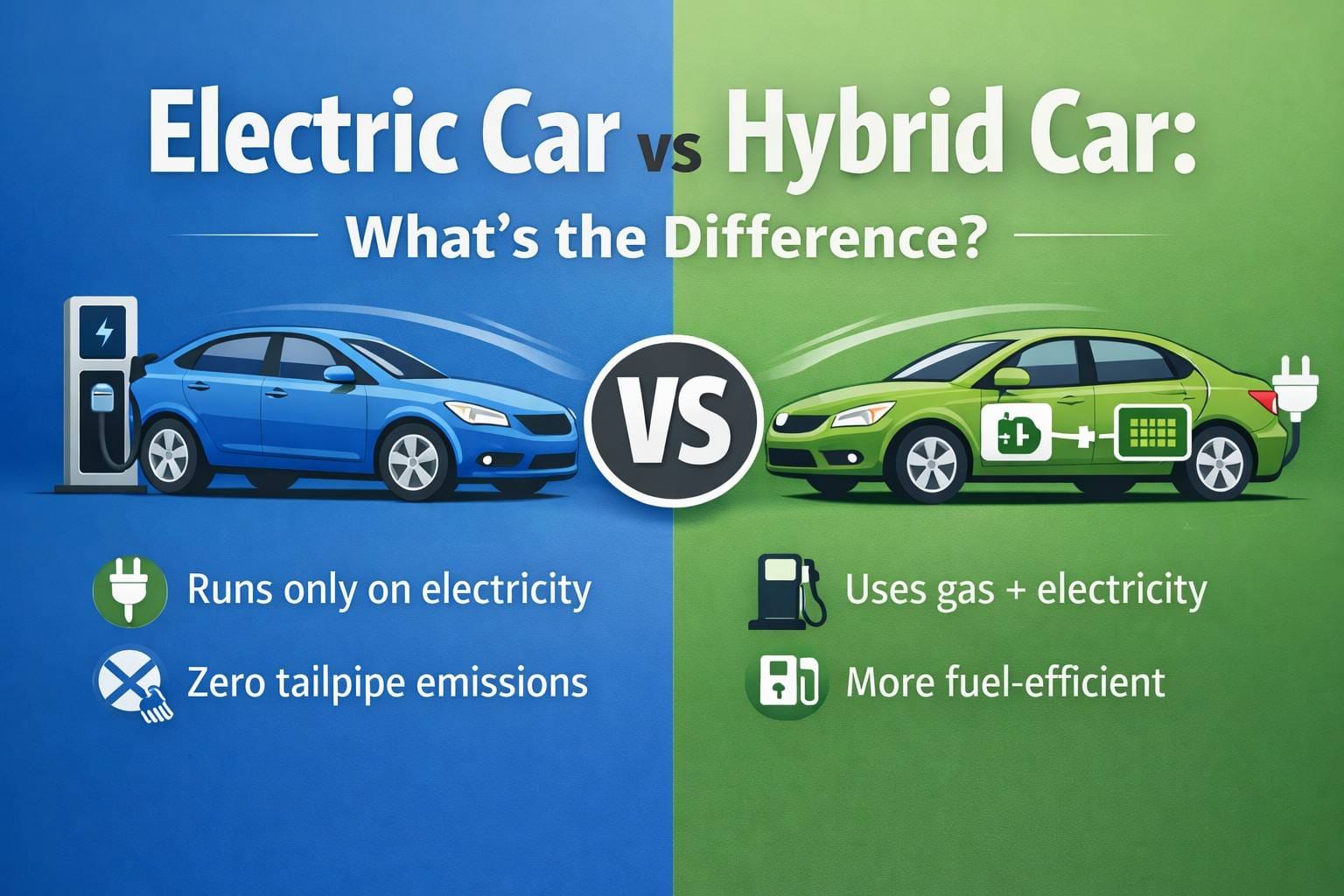
If you are planning to buy a new car in the USA, you’ve likely faced this confusing question: electric car vs hybrid car — what’s the real difference?
Both are marketed as fuel-efficient, eco-friendly alternatives to petrol cars, but they work very differently, cost differently, and suit different driving needs.
This beginner-friendly, expert-verified guide explains everything step by step so you can make the right buying decision.
The main difference between an electric car and a hybrid car is the power source.
An electric car runs only on electricity using a battery and electric motor, while a hybrid car uses both a petrol engine and an electric motor together to improve fuel efficiency and reduce emissions.
What Is an Electric Car?
An electric car, also called a Battery Electric Vehicle (BEV), runs 100% on electricity.
There is no petrol engine, no fuel tank, and no exhaust pipe.
How an Electric Car Works (Step-by-Step)
- Electricity is stored in a large lithium-ion battery
- Battery supplies power to an electric motor
- Motor turns the wheels
- Car is charged using:
- Home charger
- Public charging station
- DC fast charger
Key Components of an Electric Car
| Component | Purpose |
| Battery Pack | Stores electrical energy |
| Electric Motor | Drives the wheels |
| Inverter | Converts DC to AC |
| Onboard Charger | Manages charging |
| Regenerative Braking | Recovers energy while braking |
Popular Electric Cars in the USA
- Tesla Model 3
- Chevrolet Bolt EV
- Ford Mustang Mach-E
- Nissan Leaf
What Is a Hybrid Car?
A hybrid car combines two power sources:
- A petrol engine
- A small electric motor + battery
The goal is better fuel efficiency, not full electric driving.
How a Hybrid Car Works
- Car starts using electric motor at low speeds
- Petrol engine engages at higher speeds
- Battery charges automatically using:
- Regenerative braking
- Engine power
- No external charging needed (in most hybrids)
Types of Hybrid Cars
| Type | Description |
| Mild Hybrid (MHEV) | Motor assists engine only |
| Full Hybrid (HEV) | Short electric-only drive possible |
| Plug-in Hybrid (PHEV) | Can be charged externally |
Popular Hybrid Cars in the USA
- Toyota Prius
- Honda Accord Hybrid
- Hyundai Elantra Hybrid
- Ford Escape Hybrid
Electric Car vs Hybrid Car: Detailed Comparison
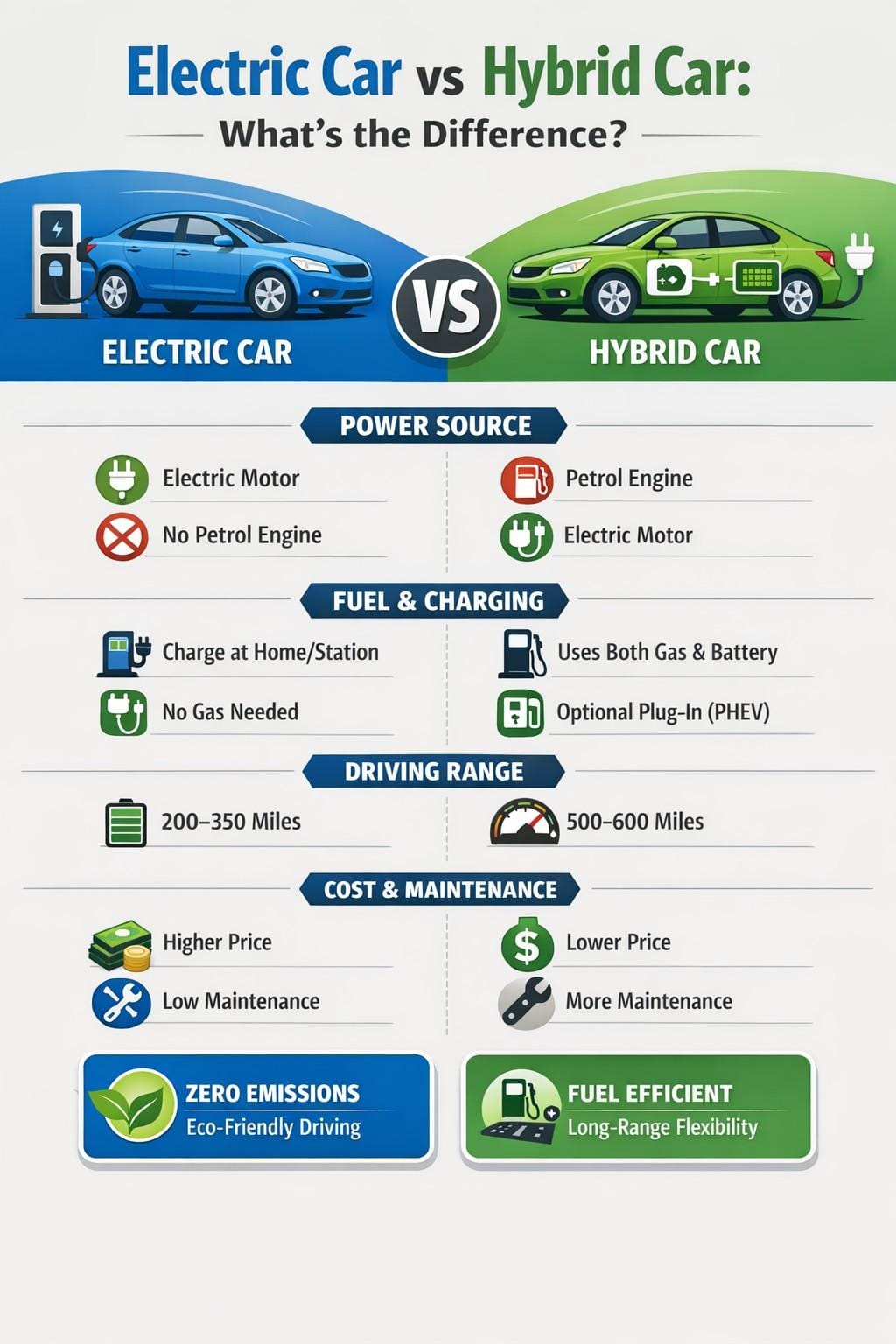
1. Power Source
| Feature | Electric Car | Hybrid Car |
| Electricity | Yes | Partial |
| Petrol | No | Yes |
2. Fuel & Charging
| Aspect | Electric | Hybrid |
| Charging Plug | Required | Optional (PHEV only) |
| Fuel Station | Not needed | Required |
| Home Charging | Yes | No |
3. Driving Range
- Electric Car: 200–350 miles per charge
- Hybrid Car: 500–600 miles combined
4. Cost Comparison (USA)
| Factor | Electric | Hybrid |
| Purchase Price | Higher | Lower |
| Fuel Cost | Very low | Medium |
| Maintenance | Low | Medium |
| Federal Tax Credit | Up to $7,500 | Limited |
Also Read
- Hydrogen vs Electric Cars: Which Is the Future of Sustainable Transportation?
- Advantages of Hybrid Cars – Are they Worth It?
- What are Advantages of Electric Vehicle?
Pros and Cons
Advantages of Electric Cars
- Zero tailpipe emissions
- Lowest running cost
- Quiet and smooth driving
- Fewer moving parts
- Federal & state incentives
Disadvantages of Electric Cars
- Charging infrastructure still growing
- Higher upfront price
- Longer road trips need planning
Advantages of Hybrid Cars
- No range anxiety
- Better fuel economy than petrol cars
- No charging required (HEV)
- Lower upfront cost
Disadvantages of Hybrid Cars
- Still burns petrol
- More complex engine system
- Higher maintenance than EVs
Environmental Impact: Which Is Better?
| Factor | Electric | Hybrid |
| Tailpipe Emissions | Zero | Reduced |
| CO₂ Over Lifetime | Lowest | Medium |
| Fossil Fuel Use | None | Partial |
Electric cars are cleaner in the long term, especially in the USA where renewable energy is increasing.
Electric Car vs Hybrid: Which Should You Buy?
Choose an Electric Car if you:
- Drive mostly in cities
- Can charge at home/work
- Want lowest running cost
- Care about environment
Choose a Hybrid Car if you:
- Travel long distances often
- Lack charging access
- Want fuel efficiency without lifestyle change
Myths vs Facts
| Myth | Fact |
| EV batteries die quickly | Last 8–15 years |
| EVs are slow | Instant torque = quick acceleration |
| Hybrids don’t need maintenance | Still have engine servicing |
| EVs pollute more | Lower lifetime emissions |
Future of Electric and Hybrid Cars in the USA
- EV charging networks expanding rapidly
- Battery prices falling
- Many automakers shifting to EV-only lineups by 2035
- Hybrids act as a transition technology
FAQs
Yes for city driving and low running cost. Hybrid is better for long-distance flexibility.
Standard hybrids do not. Plug-in hybrids can be charged.
Electric cars generally last longer due to fewer moving parts.
Yes. No oil changes, fewer mechanical parts.
Only for very short distances at low speeds.