
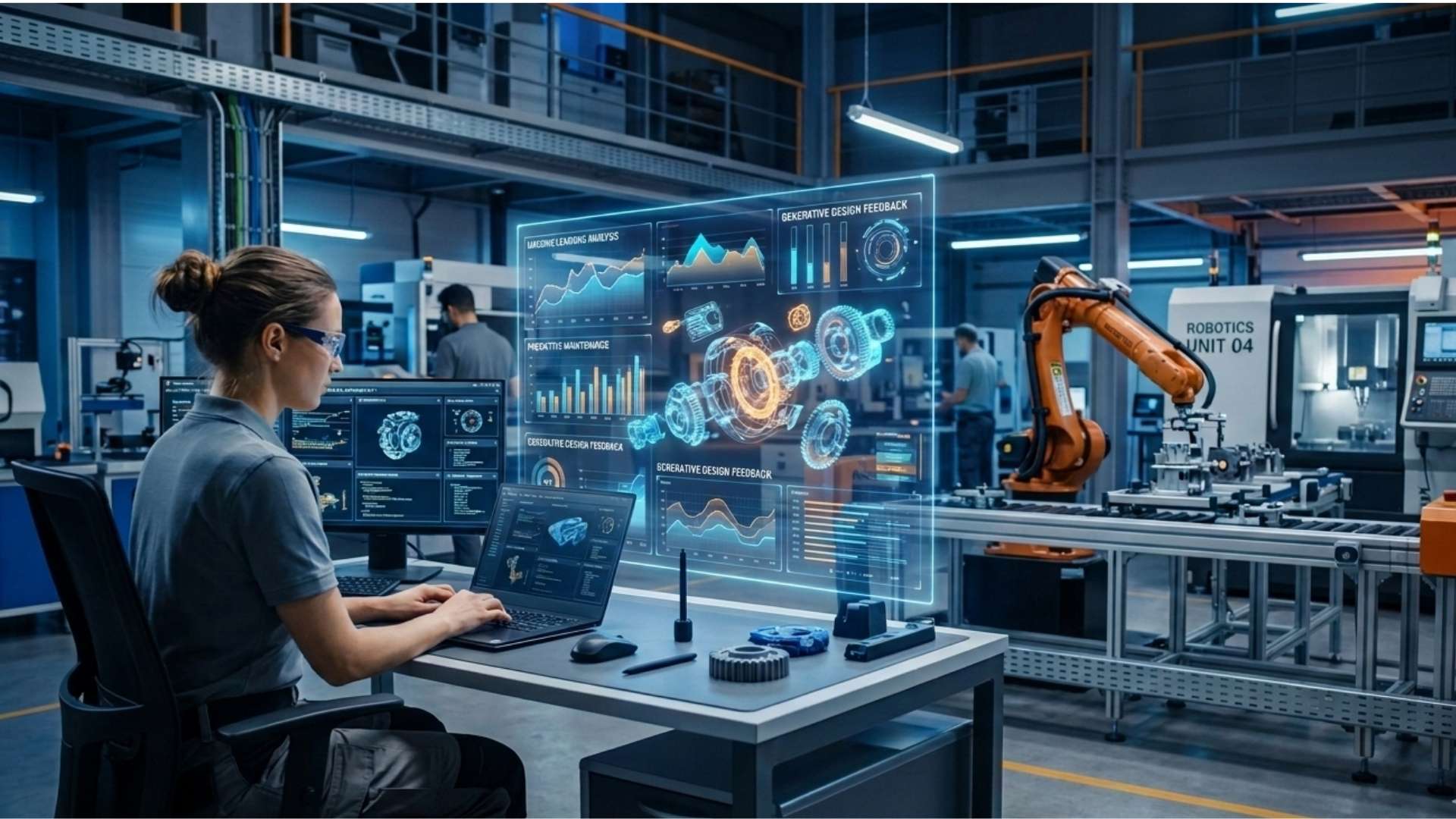
Artificial Intelligence (AI) is rapidly transforming industries such as manufacturing, automotive, aerospace, and robotics. As companies adopt smart technologies, mechanical engineers are increasingly required to understand and work with AI-driven systems. From predictive maintenance in factories to AI-powered design optimization, engineers who combine mechanical knowledge with AI skills will be in high demand.
Learning AI does not mean mechanical engineers must become full-time data scientists. Instead, they need to develop a set of complementary skills that allow them to use AI tools effectively in engineering applications. This article explains the most important skills mechanical engineers need to work with AI and succeed in the era of Industry 4.0.
Table of Contents
ToggleWhy AI is Becoming Important in Mechanical Engineering
Artificial Intelligence is being integrated into many engineering processes to improve efficiency, accuracy, and productivity. Traditional mechanical systems are now enhanced with sensors, data analytics, and intelligent algorithms.
Some major areas where AI is used in mechanical engineering include:
- Predictive Maintenance: AI analyzes machine data to predict failures before they occur.
- Smart Manufacturing: AI optimizes production lines and improves quality control.
- Design Optimization: Engineers use AI to generate efficient design solutions.
- Robotics and Automation: AI enables robots to perform complex tasks autonomously.
- Energy Efficiency: AI systems optimize energy usage in industrial processes.
Because of these applications, modern mechanical engineers must combine traditional engineering knowledge with digital and AI-related skills.
Top Skills Mechanical Engineers Need to Work with AI
1. Programming Skills (Especially Python)
Programming is one of the most important skills for engineers working with AI. Mechanical engineers use programming to analyze data, automate calculations, and build machine learning models.
Python is the most widely used programming language in AI and engineering because it is easy to learn and has powerful libraries.
Key programming skills include:
- Writing Python scripts
- Data processing and visualization
- Automating engineering tasks
- Interfacing with engineering software
Other useful languages include:
- MATLAB
- C++
- R (for data analysis)
Among these, Python is considered essential for AI applications.
2. Data Analysis and Statistics
AI systems rely on large amounts of data. Mechanical engineers must understand how to collect, analyze, and interpret data from machines and systems.
Important concepts include:
- Statistical analysis
- Data visualization
- Probability
- Data cleaning
- Pattern recognition
For example, in predictive maintenance, engineers analyze vibration and temperature data from machines to detect early signs of failure.
Understanding statistics helps engineers make better decisions based on data rather than assumptions.
3. Machine Learning Fundamentals
Machine learning is the core technology behind AI systems. Mechanical engineers should understand the basic concepts even if they are not developing complex algorithms.
Important machine learning concepts include:
- Supervised learning – predicting outcomes using labeled data
- Unsupervised learning – discovering patterns in data
- Regression models – predicting numerical values
- Classification models – categorizing data into groups
For example:
- Predicting machine failure
- Detecting defects in manufacturing
- Optimizing production processes
Understanding these concepts allows engineers to collaborate effectively with AI specialists.
4. Knowledge of AI Libraries and Tools
AI development becomes easier with specialized libraries and frameworks. Mechanical engineers should be familiar with some common AI tools.
Popular AI libraries include:
- TensorFlow
- PyTorch
- Scikit-learn
- Keras
These tools allow engineers to build machine learning models without writing complex algorithms from scratch.
For example, engineers can use these libraries to analyze machine performance data and predict maintenance needs.
5. Understanding Sensors and IoT Systems
Modern industrial machines generate large amounts of data through sensors and Internet of Things (IoT) devices. Mechanical engineers must understand how these systems collect and transmit data.
Important areas include:
- Industrial sensors
- Data acquisition systems
- IoT networks
- Real-time monitoring systems
For example, sensors installed on turbines or motors can send temperature, vibration, and pressure data to AI systems that monitor equipment health.
This combination of mechanical systems and digital technologies is a key part of smart manufacturing.
6. Simulation and Digital Twin Technology
Simulation has always been important in mechanical engineering. With AI integration, simulation tools have become even more powerful.
Digital twin technology creates a virtual model of a physical system. Engineers can simulate performance, detect issues, and optimize designs using AI-driven analysis.
Applications include:
- Predicting system performance
- Testing product designs
- Monitoring real-time machine behavior
- Improving operational efficiency
Simulation tools like ANSYS and other advanced platforms are increasingly integrating AI capabilities.
7. Robotics and Automation Knowledge
Robotics is a major field where mechanical engineering and AI intersect. Industrial robots are widely used in manufacturing, assembly, welding, and material handling.
Engineers working with AI should understand:
- Robot kinematics
- Control systems
- Automation systems
- Machine vision
AI helps robots perform tasks more intelligently, such as recognizing objects, adjusting movements, and improving accuracy.
This knowledge is particularly important in automated manufacturing environments.
8. Problem-Solving and Systems Thinking
AI tools are powerful, but they still require human engineers to define problems and interpret results. Mechanical engineers must develop strong problem-solving abilities.
Key capabilities include:
- Identifying engineering problems
- Selecting the right AI tools
- Interpreting model predictions
- Integrating AI solutions with mechanical systems
Engineers who can combine engineering principles with AI insights will provide the greatest value in modern industries.
Software Mechanical Engineers Should Learn for AI
To work effectively with AI technologies, mechanical engineers should learn several software tools commonly used in engineering and data science.
Important software includes:
Software | Purpose |
Python | AI programming and data analysis |
MATLAB | Numerical computing and modeling |
SolidWorks | Mechanical design and simulation |
ANSYS | Advanced engineering simulation |
Excel / Power BI | Data analysis and visualization |
Learning these tools helps engineers analyze data, simulate designs, and integrate AI solutions into engineering workflows.
Real Applications of AI in Mechanical Engineering
AI is already transforming many mechanical engineering fields.
Predictive Maintenance
AI analyzes machine data to predict equipment failure before it occurs, reducing downtime and maintenance costs.
Generative Design
AI algorithms automatically generate design options that meet performance requirements while minimizing weight and material usage.
Smart Manufacturing
Factories use AI to optimize production processes, detect defects, and improve quality control.
Autonomous Vehicles
Mechanical engineers work with AI systems to develop intelligent control systems for self-driving vehicles.
These applications demonstrate how AI is becoming a critical tool in engineering innovation.
How Mechanical Engineers Can Start Learning AI
Mechanical engineers interested in AI can begin learning through several practical approaches.
Take Online Courses
Platforms such as Coursera, edX, and Udemy offer AI and machine learning courses designed for engineers.
Learn Python Programming
Start with Python basics and gradually move toward machine learning libraries.
Work on Engineering Projects
Build small projects such as:
- Predicting machine failure
- Analyzing vibration data
- Creating design optimization models
Explore Open-Source Platforms
Websites like GitHub contain many AI projects that engineers can study and modify.
Hands-on practice is the most effective way to learn AI skills.
Future Career Opportunities for Mechanical Engineers with AI Skills
Mechanical engineers who understand AI can pursue many emerging career paths.
Some of the most promising roles include:
- AI Engineer in Manufacturing
- Robotics Engineer
- Data-Driven Design Engineer
- Simulation Engineer
- Automation Engineer
- Smart Factory Specialist
These roles are expected to grow rapidly as industries adopt digital technologies.
Conclusion
Artificial Intelligence is reshaping the future of mechanical engineering. Modern engineers must go beyond traditional mechanical design and develop skills in programming, data analysis, machine learning, and automation.
Mechanical engineers who learn AI will not be replaced by technology. Instead, they will lead the next generation of innovation in manufacturing, robotics, energy systems, and smart factories.
By combining engineering expertise with AI capabilities, mechanical engineers can unlock new opportunities and play a crucial role in the future of Industry 4.0.
FAQs
Yes, mechanical engineers should learn basic AI concepts because artificial intelligence is increasingly used in manufacturing, robotics, predictive maintenance, and design optimization. Understanding AI helps engineers analyze machine data, automate processes, and improve engineering decisions.
The most recommended programming language for mechanical engineers working with AI is Python. It is widely used for data analysis, machine learning, and automation. Other useful languages include MATLAB, C++, and R, but Python is considered the most important for AI applications.
Yes, machine learning is becoming an important skill for mechanical engineers. It helps engineers analyze large datasets, predict equipment failures, optimize product designs, and improve manufacturing processes.
Yes, mechanical engineers can become AI engineers by learning programming, machine learning, and data analysis. Many industries such as robotics, autonomous vehicles, smart manufacturing, and industrial automation require engineers with both mechanical and AI knowledge.
AI is used in several areas of mechanical engineering, including:
- Predictive maintenance
- Smart manufacturing
- Generative design
- Robotics and automation
- Energy optimization
- Autonomous vehicles
- These applications help improve efficiency, reduce costs, and increase productivity.
Mechanical engineers interested in AI should learn software such as:
- Python
- MATLAB
- SolidWorks
- ANSYS
- TensorFlow
- PyTorch
These tools help engineers analyze data, simulate systems, and develop AI-driven solutions.
Mechanical engineers can start learning AI by studying Python programming, learning basic machine learning concepts, taking online courses, and working on practical projects such as predictive maintenance models or engineering data analysis.
No, AI will not replace mechanical engineers. Instead, it will change how engineers work. Engineers who understand AI will have better career opportunities and will be able to design smarter and more efficient systems.