
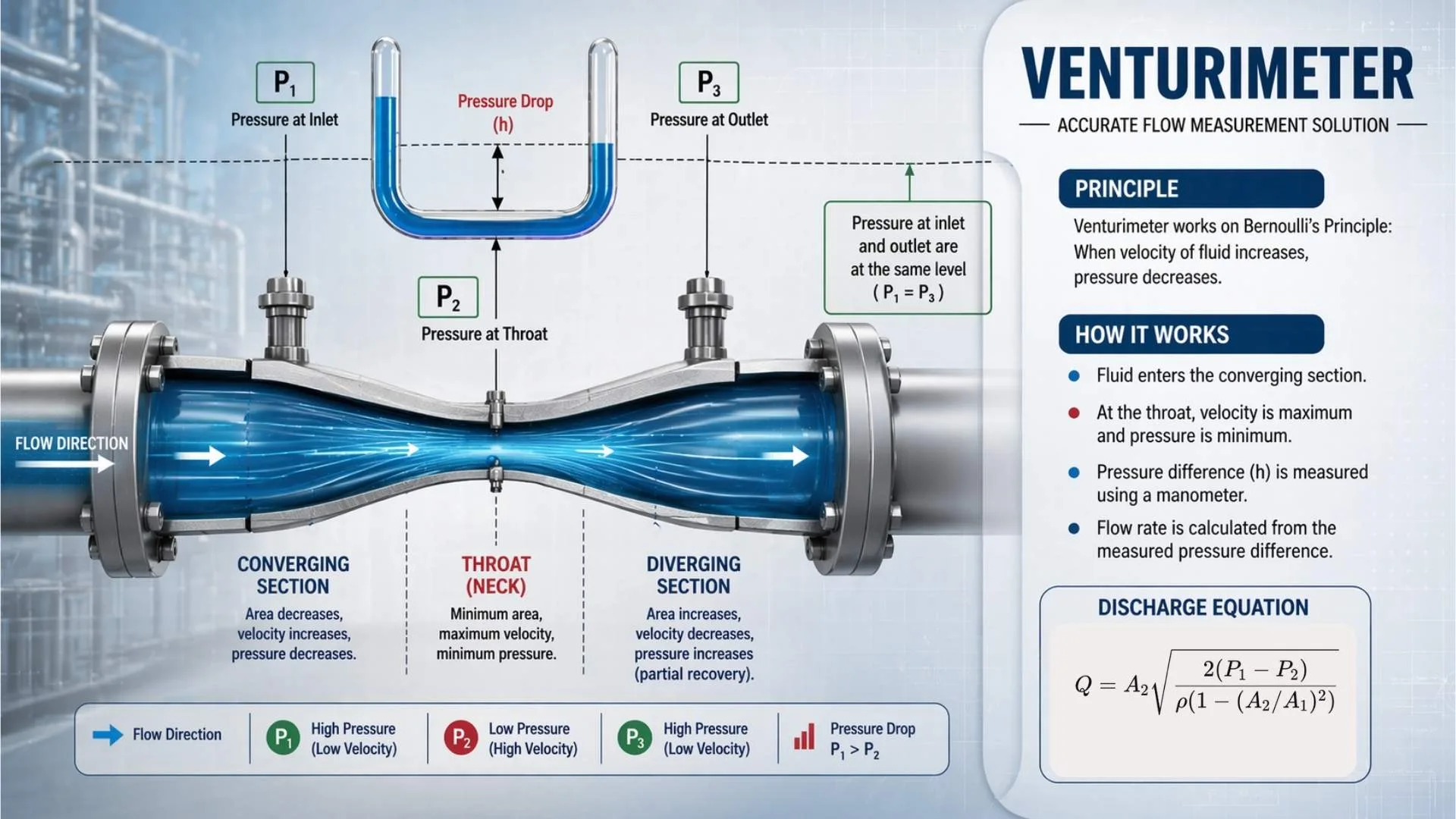
A venturimeter is a highly reliable device used to measure the flow rate of fluids in pipelines. It works on a simple yet powerful principle derived from fluid mechanics—pressure and velocity are inversely related in a flowing fluid. You’ll commonly find venturimeters in water supply systems, chemical plants, oil pipelines, and HVAC systems where accurate flow measurement is critical.
Unlike many other flow meters, a venturimeter offers high accuracy with minimal energy loss, making it ideal for industrial applications. Understanding how it works helps engineers design efficient systems and troubleshoot flow-related issues effectively.
Venturimeter Principle
The venturimeter operates on Bernoulli’s Principle, which states:
When the velocity of a fluid increases, its pressure decreases, and vice versa.
How the Principle Applies:
- Fluid enters a wider section → velocity is low, pressure is high
- Fluid passes through a narrow throat → velocity increases, pressure drops
- Pressure difference is measured and used to calculate flow rate
This pressure difference is directly related to the discharge of fluid flowing through the pipe.
Venturimeter Construction
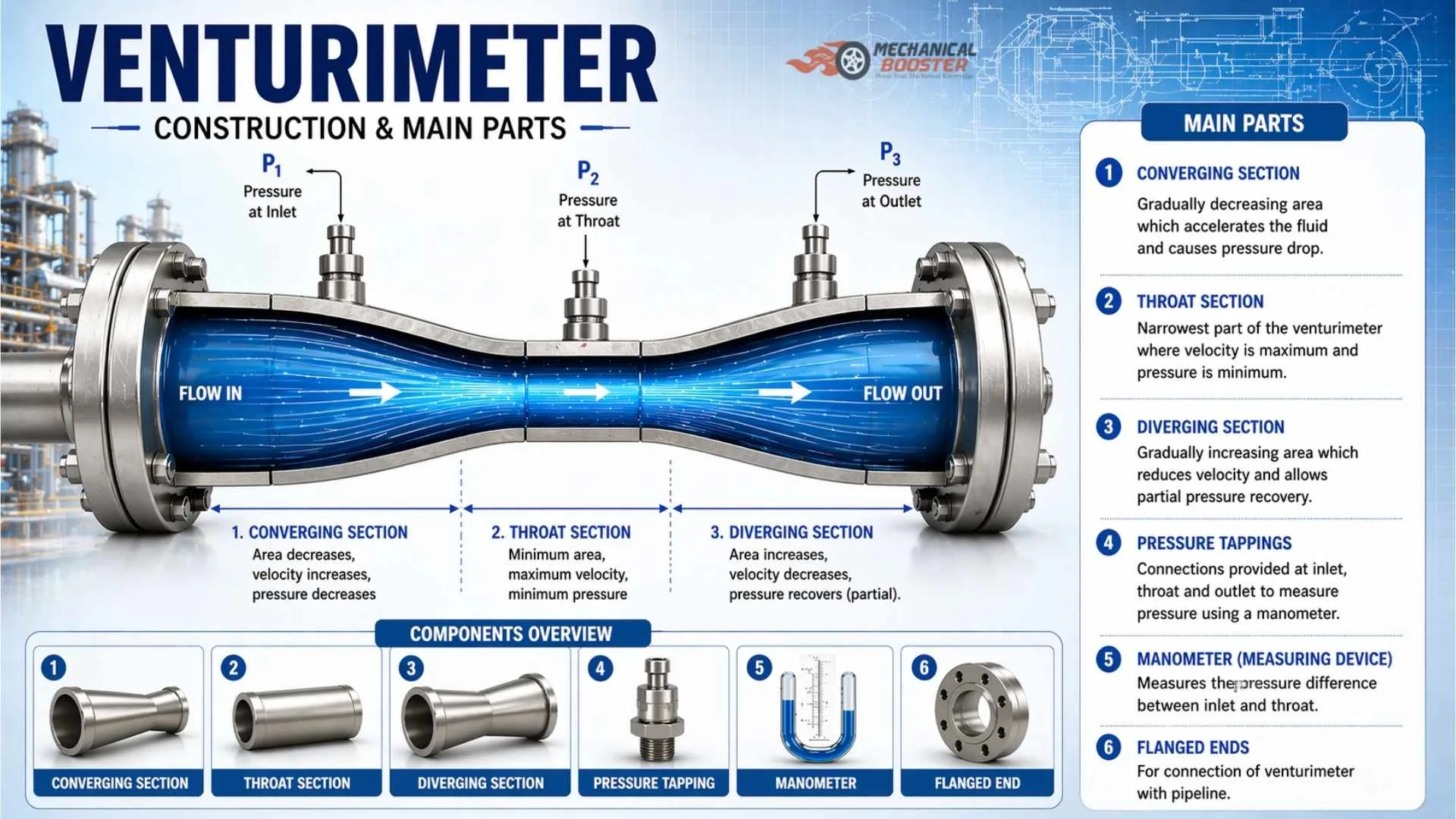
A venturimeter consists of three main parts:
1. Converging Section
- The inlet portion where the pipe diameter gradually decreases
- Velocity increases as fluid moves forward
- Pressure starts dropping
2. Throat Section
The narrowest part of the venturimeter
- Maximum velocity occurs here
- Minimum pressure is observed
3. Diverging Section
- Pipe diameter increases gradually
- Velocity decreases
- Pressure recovers partially
Additional Components:
- Pressure tapping points (before throat and at throat)
- Manometer or pressure gauge for measurement
Also Read:
- Centrifugal Pump – Working Principle, Main Parts with Application
- Positive Displacement Pump – Definition, Types, Working
- What is Cavitation and How it Occurs?
Working of Venturimeter
The working process follows a sequence:
Step-by-Step Operation:
- Fluid enters the converging section with low velocity
- As area decreases, velocity increases and pressure drops
- At the throat, velocity becomes maximum and pressure minimum
- Pressure difference is measured using a manometer
- Using Bernoulli’s equation, flow rate is calculated
Discharge Equation:
The flow rate (Q) is given by:
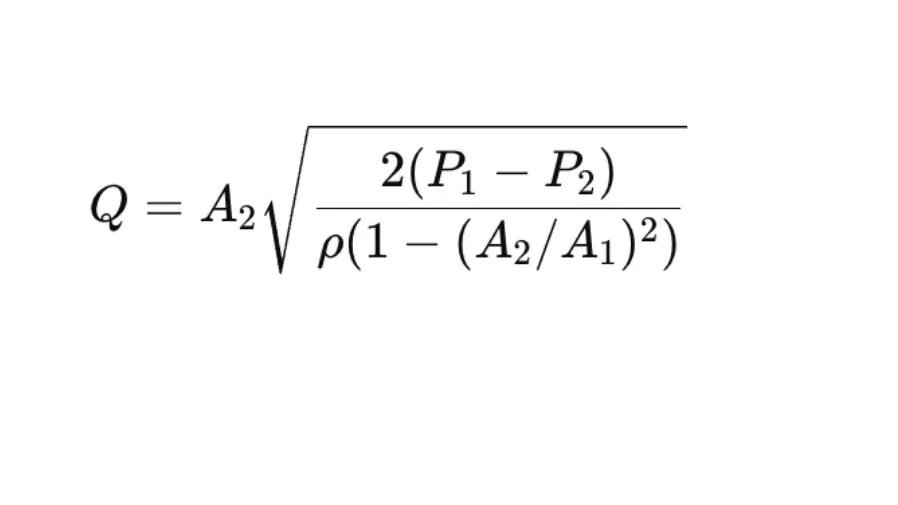
Where:
- 𝐴1,𝐴2A1,A2 = Areas of inlet and throat
- 𝑃1,𝑃2P1,P2 = Pressures at inlet and throat
- 𝜌ρ = Density of fluid
Advantages of Venturimeter
- High accuracy in flow measurement
- Low energy loss compared to orifice meter
- No moving parts → low maintenance
- Suitable for large flow rates
- Works well with liquids and gases
Disadvantages of Venturimeter
- Expensive compared to other flow meters
- Requires large installation space
- Not suitable for very small pipelines
- Difficult to install in existing systems
Applications of Venturimeter
- Water supply systems
- Oil and gas pipelines
- Chemical processing plants
- HVAC systems
- Irrigation systems
Difference Between Venturimeter and Orifice Meter
| Feature | Venturimeter | Orifice Meter |
| Accuracy | High | Moderate |
| Cost | High | Low |
| Energy Loss | Very low | High |
| Maintenance | Low | Moderate |
| Installation | Complex | Simple |
Conclusion
A venturimeter is one of the most efficient and accurate devices for measuring fluid flow in pipelines. By applying Bernoulli’s principle, it converts pressure differences into measurable flow rates with minimal energy loss. Its robust design, reliability, and precision make it indispensable in industries like water management, oil transport, and chemical processing. While it may be costlier than simpler devices, its performance justifies the investment in critical applications. Understanding its principle, construction, and working equips engineers to design better systems and ensure optimal fluid flow management.