
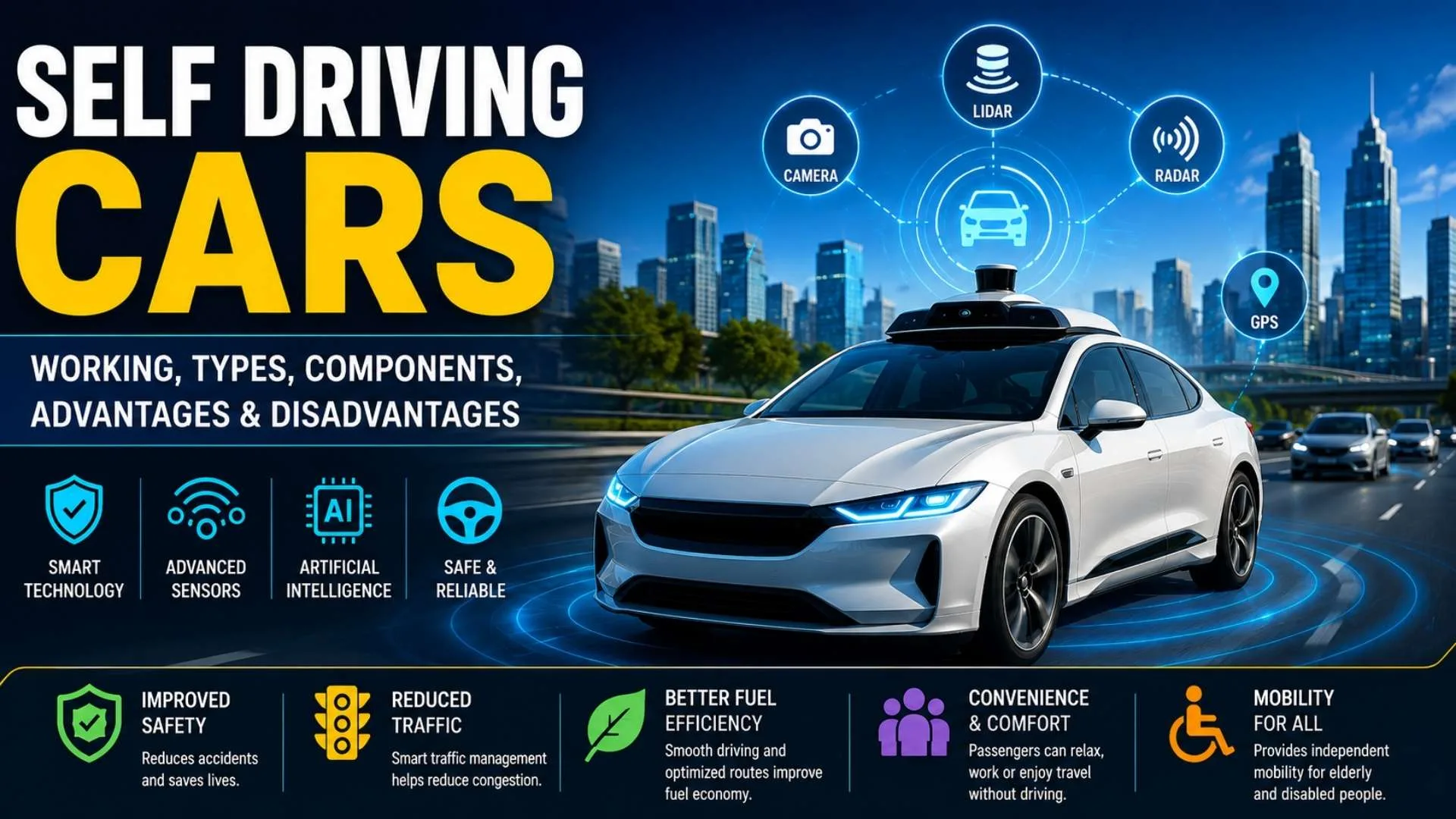
Self-driving cars are one of the most advanced innovations in the automotive industry. These vehicles are designed to move from one place to another with little or no human intervention by using artificial intelligence (AI), sensors, cameras, and advanced software systems. Also known as autonomous vehicles or driverless cars, self-driving cars can analyze road conditions, detect obstacles, follow traffic rules, and make driving decisions automatically.
The development of self-driving cars is changing the future of transportation by improving road safety, reducing traffic congestion, and making travel easier for people who cannot drive. From robot taxis in major cities to advanced driver assistance systems in modern vehicles, autonomous driving technology is becoming increasingly important worldwide. In this article, we will discuss the working, types, components, advantages, disadvantages, and future scope of self-driving cars in detail.
Table of Contents
ToggleWhat Are Self Driving Cars?
A self-driving car is an automobile capable of sensing its surroundings and operating with minimal or no human control. These vehicles use a combination of hardware and software technologies to understand the environment and make driving decisions in real time.
Unlike traditional vehicles that depend completely on a human driver, self-driving cars rely on advanced computing systems to control steering, acceleration, braking, and navigation.
In simple words, a self-driving car is like a smart vehicle that can “see,” “think,” and “act” without constant driver involvement.
Working of Self Driving Cars
The working of a self-driving car mainly depends on collecting road data, processing that information, and making driving decisions.
1. Environment Detection
The car first collects information from its surroundings using multiple sensors and devices such as:
- Cameras
- Radar
- LiDAR
- GPS
- Ultrasonic sensors
These systems detect road signs, pedestrians, traffic signals, nearby vehicles, road markings, and obstacles.
2. Data Processing
After collecting data, the onboard computer processes it using artificial intelligence and machine learning algorithms.
The system analyzes:
- Road conditions
- Vehicle speed
- Distance from nearby vehicles
- Traffic patterns
- Pedestrian movement
This helps the vehicle understand what is happening around it.
3. Decision Making
Once the system understands the environment, it makes driving decisions such as:
- When to accelerate
- When to brake
- Lane changing
- Turning at intersections
- Avoiding obstacles
- Maintaining safe distance
4. Vehicle Control
The control system sends commands to different vehicle components to perform actions.
These include:
- Steering system
- Brake system
- Throttle control
- Transmission system
As a result, the vehicle moves safely and smoothly without constant human input.
Main Components of Self Driving Cars
Self-driving cars depend on several advanced components for proper operation.
1. Cameras
Cameras capture visual information from the surroundings.
They help in:
- Lane detection
- Traffic sign recognition
- Pedestrian identification
- Traffic signal monitoring
2. LiDAR (Light Detection and Ranging)
LiDAR creates a detailed 3D map of the environment using laser beams.
It helps the vehicle understand:
- Distance of nearby objects
- Shape of obstacles
- Road structure
3. Radar
Radar systems use radio waves to detect the speed and position of nearby vehicles.
Radar performs effectively in:
- Rain
- Fog
- Dust
4. Ultrasonic Sensors
These sensors are mainly used for:
- Parking assistance
- Detecting nearby objects
- Low-speed obstacle detection
5. GPS and Navigation System
GPS helps the vehicle identify its exact location and determine the best route.
6. Artificial Intelligence (AI)
AI acts as the brain of a self-driving car.
It helps the vehicle:
- Learn driving behavior
- Analyze situations
- Predict road movements
- Make safe decisions
7. High-Performance Computer
The onboard computer processes massive amounts of data in real time and controls vehicle functions.
Types of Self Driving Cars
Self-driving cars are classified into six levels according to automation.
Level 0 – No Automation
The driver controls all driving functions.
Example:
Traditional vehicles.
Level 1 – Driver Assistance
The vehicle provides limited assistance such as cruise control or steering support.
Level 2 – Partial Automation
The vehicle can control steering and acceleration simultaneously, but the driver must remain alert.
Examples:
Modern driver-assistance systems.
Level 3 – Conditional Automation
The vehicle can drive itself under certain conditions, but human intervention may still be required.
Level 4 – High Automation
The vehicle can operate independently in specific environments without human assistance.
Example:
Robot taxis in selected cities.
Level 5 – Full Automation
The vehicle is completely autonomous and does not require a steering wheel or driver.
This level is still under development.
Advantages of Self Driving Cars
Self-driving cars provide several benefits.
- mproved Road Safety: Most accidents happen because of human error. Autonomous vehicles can reduce accidents by avoiding mistakes such as distraction or fatigue.
- Reduced Traffic Congestion: Smart traffic management and optimized driving can reduce traffic jams.
- Better Fuel Efficiency: Smooth acceleration and braking improve fuel economy.
- Convenience: Passengers can relax, work, or enjoy travel without constantly driving.
- Mobility for Elderly and Disabled People: People with physical limitations can travel independently.
- Reduced Driver Fatigue: Long-distance travel becomes easier and less stressful.
Disadvantages of Self Driving Cars
Despite many advantages, self-driving cars also have limitations.
- High Cost: Advanced sensors and AI systems make autonomous vehicles expensive.
- Cybersecurity Risks: Hackers may target vehicle systems, creating security concerns.
- Technical Failures: Software bugs or sensor failures can create dangerous situations.
- Job Losses: Professional driving jobs may reduce due to automation.
- Legal and Ethical Issues: Questions about accident responsibility and decision-making remain unresolved.
- Weather Limitations: Heavy rain, fog, or snow may reduce sensor performance.
Applications of Self Driving Cars
Self-driving cars are used in different sectors.
- Passenger Transportation: Robot taxis and autonomous vehicles improve urban transportation.
- Logistics and Delivery: Autonomous trucks help transport goods efficiently.
- Public Transportation: Self-driving buses can improve city mobility.
- Emergency Services: Autonomous ambulances may help provide faster medical support.
Future of Self Driving Cars
The future of self-driving cars looks promising. Many automotive companies are investing heavily in autonomous technology to improve safety and convenience.
As artificial intelligence, sensor technology, and smart infrastructure continue to develop, self-driving vehicles are expected to become more reliable and affordable. In the coming years, autonomous transportation may become a normal part of everyday life.
Conclusion
Self-driving cars are transforming the future of transportation through artificial intelligence, smart sensors, and automation systems. These vehicles can improve safety, reduce traffic congestion, and provide better mobility for millions of people. Although challenges such as cost, legal concerns, and cybersecurity risks still exist, rapid technological advancements continue to improve autonomous driving systems. As innovation grows, self-driving cars are expected to play an important role in modern transportation and smart cities. Understanding their working, components, types, advantages, and disadvantages helps us better understand how future mobility will evolve.
FAQs
Self-driving cars are vehicles that use AI, sensors, and software to drive automatically with little or no human involvement.
They use cameras, radar, LiDAR, GPS, and AI systems to detect surroundings, process information, and make driving decisions.
Not all self-driving cars are fully autonomous. Many modern vehicles currently operate at Level 2 or Level 3 automation.
Important technologies include AI, cameras, radar, LiDAR, GPS, machine learning, and onboard computers.
They improve road safety, reduce traffic congestion, increase convenience, and help elderly or disabled people travel.
High cost, cybersecurity risks, legal issues, and technical failures are some major disadvantages.
They can be safer than human-driven vehicles in many situations, but technology limitations still exist.
Many automotive and technology companies are working on autonomous vehicles worldwide.
Level 5 automation means a vehicle can drive completely on its own without any human driver.
Self-driving cars may gradually become more common, but traditional vehicles are likely to coexist for many years.
Self Driving Cars – Knowledge Check
⚠️ Please select an option before continuing.