
If you own a diesel truck, whether it’s a Ford Powerstroke, Ram Cummins, or GM Duramax, you’ve probably heard the term DPF thrown around at the shop, on forums, or in the cab of another guy’s truck at a worksite. Maybe your check engine light came on and your mechanic mentioned it. Maybe your truck went into limp mode and you had no idea why.
The Diesel Particulate Filter is one of the most talked-about components in modern diesel aftermarket circles. In this article, we’ll break down exactly what the DPF does, how it fails, what symptoms to watch for, and why so many diesel owners are choosing to address it head-on with a hardware solution.
What Is a DPF and Why Is It on Your Truck?
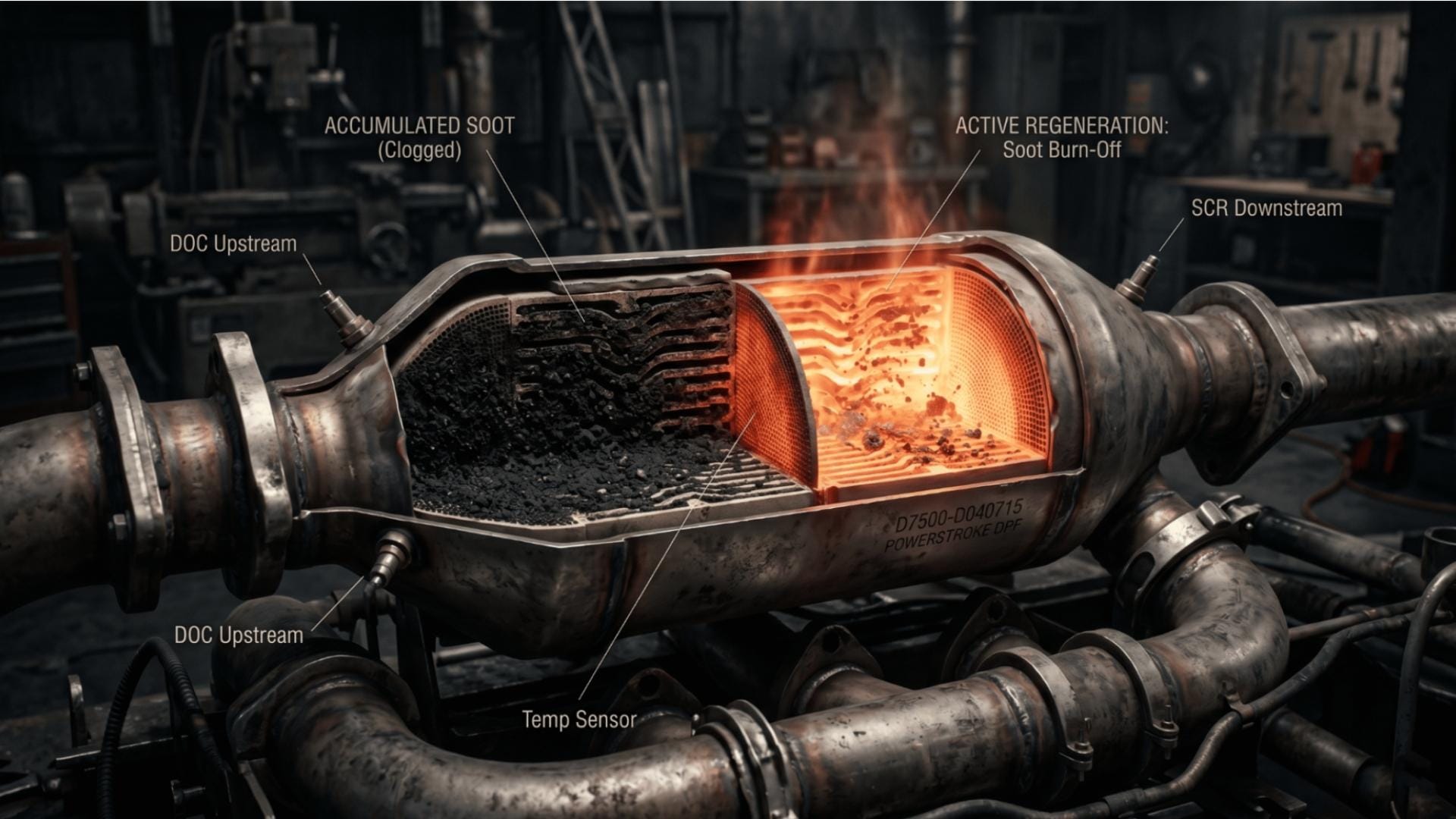
The Diesel Particulate Filter is an emissions control device installed in your truck’s exhaust system, typically downstream of the turbocharger and diesel oxidation catalyst (DOC). Its job is to capture soot and fine particulate matter (PM) produced during diesel combustion before those particles reach the atmosphere
The U.S. EPA began mandating DPFs on new diesel trucks starting in the 2007 model year, as part of a sweeping tightening of particulate matter standards that cut allowable PM emissions by over 90% compared to pre-2007 limits. Every Powerstroke, Cummins, and Duramax produced since then ships with one from the factory.
Here’s the basic flow of your diesel exhaust system:
Exhaust Manifold → Turbocharger → Up-Pipe → DOC → DPF → SCR → Muffler → Tip
The DPF sits in the middle of this chain, acting as a wall-flow filter. Exhaust gas enters through one end, passes through a porous ceramic substrate with alternating plugged channels, and the soot particles get trapped in the walls. Clean exhaust exits the other end. It is simple in theory but complicated in practice.
How the DPF Cleans Itself: Active and Passive Regeneration
Because the DPF is constantly collecting soot, it has to clean itself periodically or it will clog and restrict exhaust flow entirely. This cleaning process is called regeneration, and it happens in two ways:
Passive Regeneration
During normal highway driving, exhaust temperatures naturally rise high enough (around 550–600°C / 1,000–1,100°F) to oxidize the trapped soot into carbon dioxide. This happens automatically without any driver input. Trucks that spend a lot of time at highway speed rarely have DPF problems because the filter cleans itself continuously.
Active Regeneration
When a truck spends most of its time at low speeds, idling, or making short trips, exhaust temperatures never get high enough for passive regeneration to do the job. The ECU detects rising backpressure and initiates an active regen cycle by injecting extra fuel either into the exhaust stream or as a late post-injection in the cylinder to artificially raise exhaust temperatures and burn off the accumulated soot.
Active regen cycles typically run 20–40 minutes and can occur every 300–500 miles depending on duty cycle. You may notice your truck idling a little rough, a slight fuel smell, or a minor drop in fuel economy when it’s happening.
The problem starts when active regen can’t keep up.
Why DPFs Fail: The Most Common Causes
For trucks used in towing, hauling, construction, agriculture, or heavy city driving, the DPF is a recurring maintenance headache. Here’s why:
1. Soot Overloading
If active regen cycles are interrupted repeatedly (by turning the truck off mid-cycle, for example), soot accumulates faster than it burns off. Over time, the filter loads up to a point where even forced regen can’t clear it. At that stage, the only fix is professional cleaning or full replacement.
2. Ash Accumulation
Soot burns off during regen. Ash does not. Ash is a byproduct of engine oil additives that enters the exhaust via the combustion process and gradually builds up inside the DPF substrate with no way to be burned off. Ash accumulation is normal and unavoidable, but it progressively reduces filter capacity. The EPA’s original design expectation for DPF service life was around 150,000 miles, though real-world conditions often cut that significantly shorter.
3. Oil Contamination (CCV Issues)
On engines like the 6.7L Powerstroke, the Closed Crankcase Ventilation (CCV) system routes blow-by gases (which contain oil vapor) back into the intake. Over time, that oil mist coats the intake, intercooler, and eventually contributes to DPF contamination. Addressing the CCV system is often a prerequisite before dealing with a DPF problem.
4. Coolant or Fuel Contamination
A failing EGR cooler leaking coolant into the exhaust stream (very common on the 6.0L and 6.4L Powerstroke) can rapidly destroy a DPF by coating the substrate with deposits that prevent proper regeneration.
5. Extended Idling
Work trucks that idle for hours, such as construction equipment operators, service trucks running A/C, and agricultural equipment, produce low exhaust temps and high soot loads. These are the exact conditions the DPF hates most.
Symptoms of a Failing or Clogged DPF
Knowing what to watch for can save you from an expensive tow. Common signs include:
- Check engine light with DPF-related fault codes (P2002, P244A, P246C on Powerstroke; similar codes on Cummins and Duramax platforms)
- Reduced power / limp mode — the ECU limits engine output to protect the exhaust system
- Frequent active regen cycles — if your truck seems to be regenerating constantly, the filter is struggling
- Increased fuel consumption — regen cycles consume additional fuel, and a clogged DPF also increases exhaust backpressure, forcing the engine to work harder
- Excessive black smoke during regen or under load
- Loud exhaust note with reduced power — a cracked or damaged DPF substrate can partially collapse, causing both a restriction and an exhaust leak
If you’re seeing any of these on a Powerstroke, Cummins, or Duramax, it’s time to pull codes and investigate the DPF first.
The Real Cost of DPF Maintenance
This is where things get expensive fast. Here’s a realistic breakdown of what you’re looking at:
| Service | Estimated Cost |
|---|---|
| DPF cleaning (professional) | $300–$600 |
| DPF replacement (OEM or aftermarket) | $1,500–$3,500+ |
| Labor for DPF-related repairs | $150–$200/hr |
| DPF replacement on 6.4L Powerstroke | Often $2,000–$4,000 all-in |
And this isn’t a one-time expense. A work truck operating in tough conditions may need DPF service every 50,000–80,000 miles, meaning lifetime DPF costs can easily exceed the truck’s residual value over a full working life.
What Diesel Owners Are Doing About It: The Delete Option
For trucks used exclusively for off-road, agricultural, competition, or closed-course use, a growing number of diesel owners choose to address DPF problems permanently with a delete kit rather than continuing to repair or replace the factory emissions hardware.
A DPF delete pipe physically removes the filter from the exhaust path, replacing it with a straight section of mandrel-bent stainless steel pipe that maintains proper exhaust flow diameter. On most platforms, this is paired with a custom tune to eliminate DPF-related fault codes, disable the regen cycle, and recalibrate fueling and boost maps to take advantage of the reduced backpressure.
The results most owners report after going this route:
- Lower exhaust backpressure — the engine breathes more freely under load
- Eliminated regen cycles — no more interrupted work shifts or fuel penalty
- Improved throttle response — especially noticeable during hard pulls
- No more DPF-related fault codes — no more limp mode events triggered by filter status
For 6.7L Powerstroke owners, a purpose-built DPF delete pipe for 6.7L Powerstroke is available in both 4″ and 5″ diameter configurations, in downpipe-back and turbo-back configurations to match your specific setup.
Duramax owners dealing with chronic L5P or LML filter issues have similar options — a properly fitted Duramax DPF delete kit covers most GM diesel platforms from the LB7 all the way through the current L5P generation.
For those looking at a comprehensive solution that addresses the DPF, EGR, and DEF systems together, premium packages like the EngineGo diesel delete kits bundle the hardware needed for each system in a single package, matched to your specific engine platform and model year.
Important: DPF delete modifications are intended for off-road, agricultural, racing, and competition use only. Operating a modified diesel vehicle on public roads may violate federal and state emissions regulations. Always verify compliance with applicable laws before installing aftermarket emissions components.
DPF vs. the Full Emissions System: Understanding the Bigger Picture
The DPF doesn’t operate in isolation. It’s part of a tightly integrated emissions system that includes:
- EGR (Exhaust Gas Recirculation) — recirculates a portion of exhaust gas back into the intake to reduce NOx. EGR problems often contribute to DPF problems, since a leaking EGR cooler or stuck EGR valve sends contaminated exhaust into the filter.
- DEF / SCR (Selective Catalytic Reduction) — injects urea-based diesel exhaust fluid into the exhaust stream downstream of the DPF to reduce NOx further. A DPF failure upstream will damage SCR components over time.
- CCV (Closed Crankcase Ventilation) — as mentioned above, a poorly performing CCV system introduces oil vapor upstream of the DPF, accelerating contamination.
If you’re dealing with DPF problems and your EGR cooler is known to be weak on your platform, address the EGR system at the same time.
Experts at EngineGo frequently remind diesel owners that band-aiding the DPF on an engine with a failing EGR cooler is simply burning money. Address the whole system at once.
Bottom Line
The DPF was an engineering compromise, functioning as a device designed to reduce on-road emissions under a regulatory framework, not to maximize diesel engine performance or longevity in demanding work environments. For trucks used lightly and maintained meticulously, it functions as intended for many years. For work trucks that idle heavily, tow constantly, or operate in dusty and agricultural environments, the DPF is often a persistent and expensive maintenance item.
Understanding how it works, what kills it, and what your options are when it fails puts you in a much better position to make an informed decision, whether that’s cleaning the filter, replacing it, or choosing a purpose-built hardware solution from trusted names like EngineGo for your specific use case.