
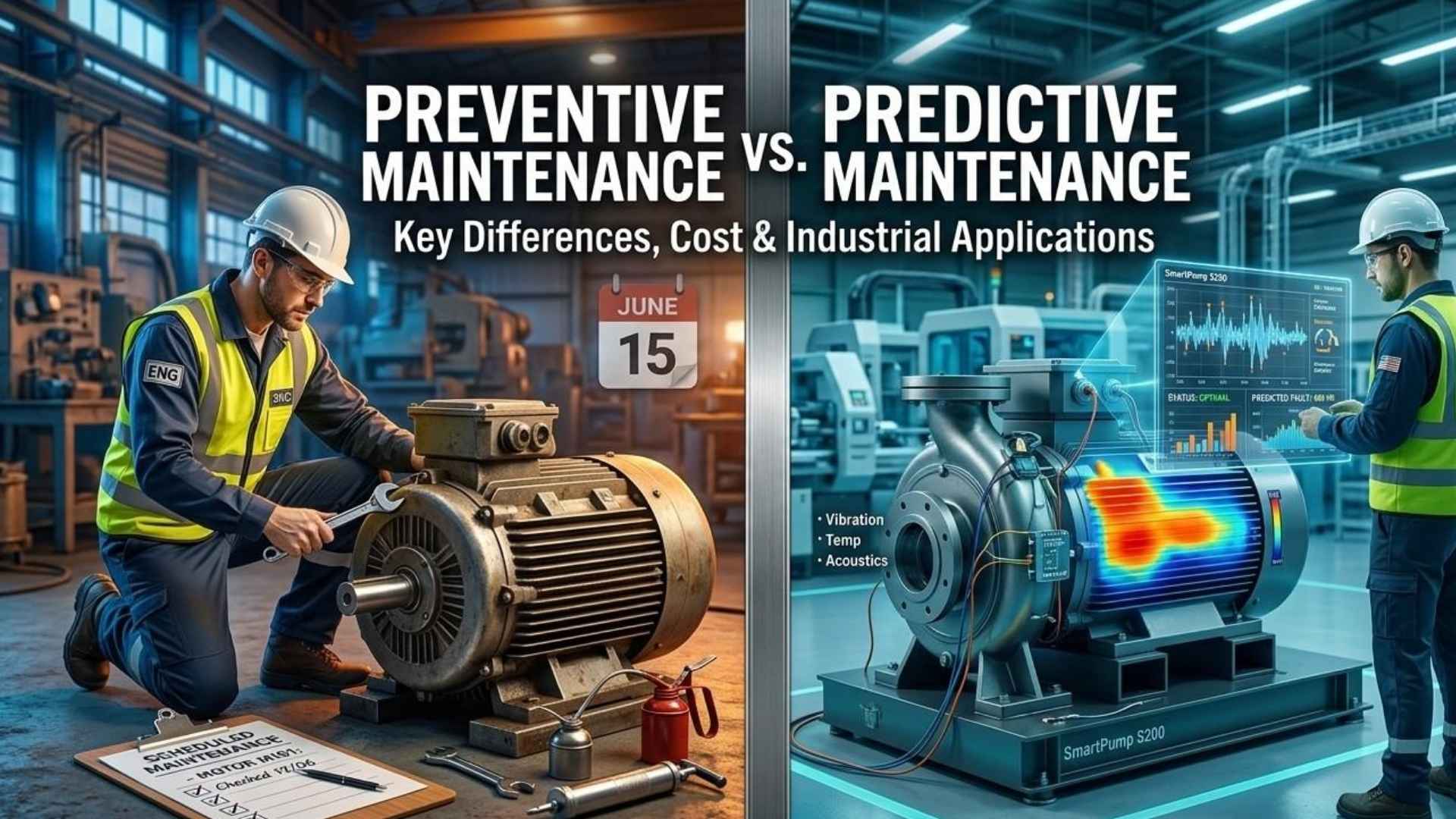
Maintenance strategy directly impacts equipment reliability, production uptime, and operational cost. Two of the most widely used industrial maintenance approaches are Preventive Maintenance (PM) and Predictive Maintenance (PdM).
In this detailed guide, we’ll compare:
- Definitions
- Working principles
- Technologies used
- Cost implications
- Real-world industrial applications
- Which strategy is best for your plant
What Is Preventive Maintenance?

Definition
Preventive Maintenance (PM) is a time-based or usage-based maintenance strategy where equipment servicing is performed at predetermined intervals — regardless of current machine condition.
How Preventive Maintenance Works
Maintenance activities are scheduled based on:
- Operating hours (e.g., every 500 hours)
- Calendar intervals (monthly, quarterly, annually)
- Production cycles
- Manufacturer recommendations
Common Preventive Maintenance Activities
- Lubrication of bearings
- Filter replacements
- Belt tension adjustments
- Oil changes
- Calibration of instruments
- Safety inspections
Example
In automotive engines like those used in the Toyota Corolla, engine oil replacement every 5,000–10,000 miles is a preventive maintenance activity.
What Is Predictive Maintenance?

Definition
Predictive Maintenance (PdM) is a condition-based maintenance strategy that uses real-time data and advanced diagnostics to predict equipment failure before it occurs.
Instead of servicing machines at fixed intervals, maintenance is performed only when indicators show deterioration.
How Predictive Maintenance Works
PdM uses:
- Vibration analysis
- Thermal imaging
- Oil analysis
- Ultrasonic testing
- IoT sensors
- AI-driven analytics
Example
In a wind turbine, vibration sensors detect bearing imbalance. When vibration exceeds threshold values, maintenance is scheduled — preventing catastrophic failure.
Preventive Maintenance vs Predictive Maintenance: Key Differences
| Feature | Preventive Maintenance | Predictive Maintenance |
| Basis | Time/usage-based | Condition-based |
| Data Required | Minimal | Real-time sensor data |
| Technology Level | Low to Moderate | High (IoT, AI, analytics) |
| Downtime | Scheduled | Minimal & optimized |
| Cost | Lower initial cost | Higher initial investment |
| Risk of Over-Maintenance | High | Low |
| Failure Prevention | Moderate | High |
Advantages of Preventive Maintenance
- Easy to implement
- Lower initial investment
- Suitable for small industries
- Reduces sudden failures compared to reactive maintenance
- Compliance with OEM guidelines
Disadvantages
- May cause unnecessary part replacement
- Higher long-term maintenance cost
- Does not eliminate unexpected failures
- Requires planned downtime
Advantages of Predictive Maintenance
- Minimizes unplanned downtime
- Extends equipment life
- Reduces spare parts inventory
- Optimizes maintenance scheduling
- Higher equipment reliability
Disadvantages
- High initial setup cost
- Requires skilled personnel
- Needs advanced software and sensors
- Complex implementation
Cost Comparison: Preventive vs Predictive Maintenance
Preventive Maintenance Cost Structure
- Labor (scheduled)
- Spare parts (periodic replacement)
- Downtime losses
- Administrative planning
Predictive Maintenance Cost Structure
- IoT sensors
- Monitoring software
- Data analytics platform
- Training
- Integration with CMMS systems
Studies show that predictive maintenance can reduce maintenance costs by 10–40% and downtime by 30–50% in large industrial facilities.
Applications in Different Industries
Manufacturing Industry
- CNC machines → Predictive vibration monitoring
- Hydraulic presses → Preventive lubrication schedules
Automotive Industry
Vehicles like the Ford F-150 use onboard diagnostics (OBD systems) for predictive alerts such as engine faults.
Power Plants
Gas turbines often use predictive maintenance through thermal and vibration analysis to avoid catastrophic failure.
Aviation Industry
Aircraft engines are monitored using real-time performance tracking — a predictive strategy essential for safety.
When Should You Choose Preventive Maintenance?
Choose PM if:
- Equipment is low-cost
- Failure consequences are minimal
- No advanced monitoring infrastructure exists
- You operate a small or medium-scale plant
When Should You Choose Predictive Maintenance?
Choose PdM if:
- Downtime is extremely costly
- Equipment is mission-critical
- You operate heavy industrial systems
- You want Industry 4.0 integration
- Data infrastructure is available
Hybrid Maintenance Strategy (Best Practice)
Modern industries often adopt a hybrid approach:
- Preventive maintenance for low-critical assets
- Predictive maintenance for critical equipment
This provides the best balance between cost and reliability.
Future of Maintenance: Industry 4.0 & AI
With the rise of:
- Industrial IoT (IIoT)
- Machine learning
- Digital twins
- Cloud analytics
Predictive maintenance is becoming more accessible and cost-effective.
Smart factories now integrate sensors and AI dashboards to continuously monitor equipment health.
Conclusion
Both Preventive Maintenance and Predictive Maintenance aim to reduce equipment failure — but they differ significantly in approach.
- Preventive Maintenance is schedule-based and simpler
- Predictive Maintenance is data-driven and advanced
For small industries, preventive maintenance remains practical. For high-value, mission-critical systems, predictive maintenance delivers superior long-term ROI.
Frequently Asked Questions (FAQs)
Not always. Predictive maintenance is better for critical equipment, but preventive maintenance is cost-effective for simpler systems.
PM is time-based; PdM is condition-based.
Yes, with affordable IoT sensors and cloud-based monitoring platforms.
Predictive maintenance reduces downtime the most.