
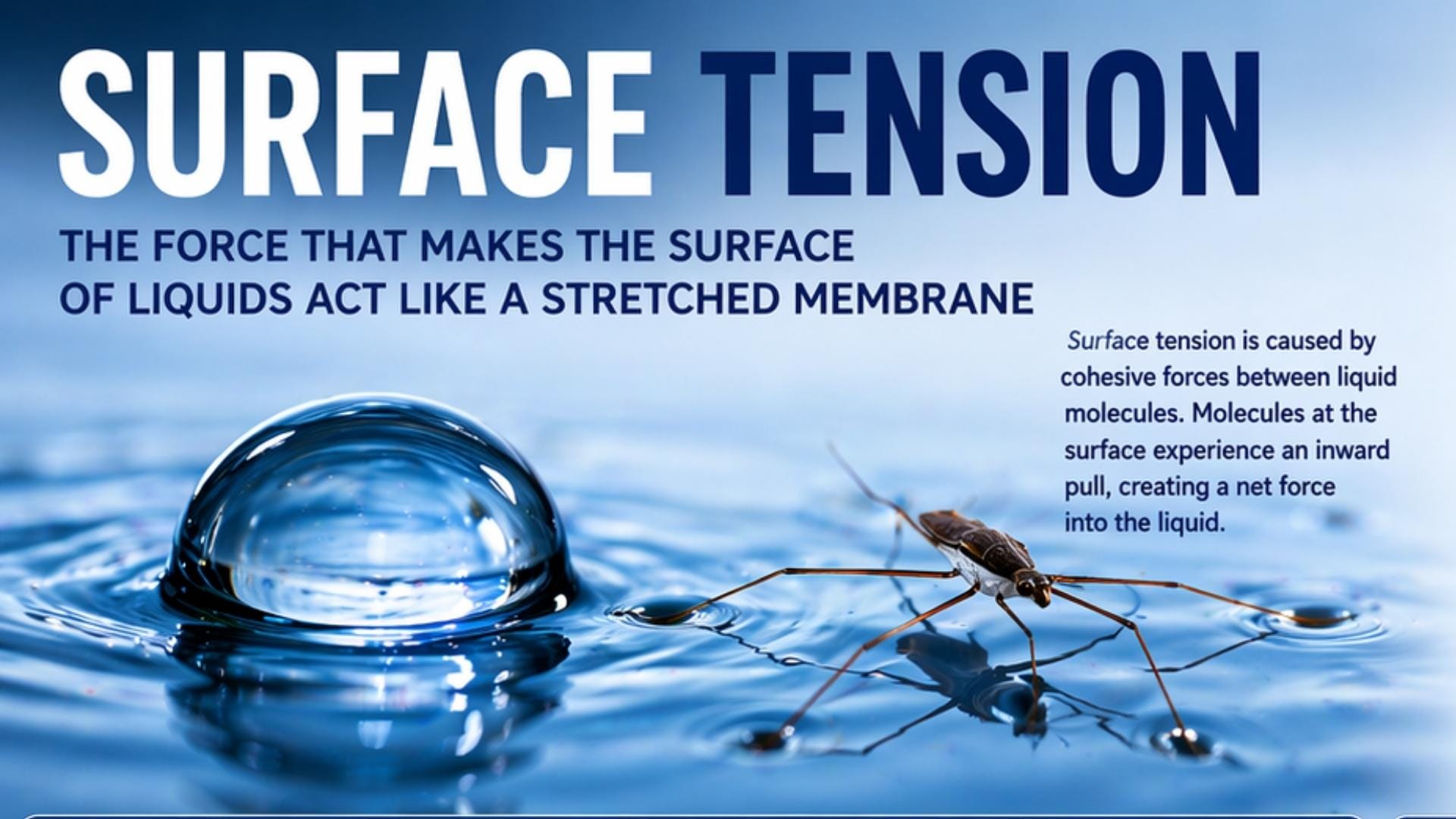
Surface tension is a fundamental property of liquids that explains why small insects can walk on water, why droplets form spherical shapes, and why liquids resist external force at their surface. In simple terms, surface tension is the tendency of a liquid surface to behave like a stretched elastic membrane. This phenomenon occurs due to intermolecular forces between liquid molecules, especially at the surface where molecules experience unequal attraction.
Surface tension plays a critical role in engineering, fluid mechanics, heat transfer, and many real-world applications such as lubrication, coating processes, and fuel injection systems. Understanding it helps engineers design efficient systems involving liquids, from pipelines to microfluidic devices.
What is Surface Tension? (Definition)

Surface tension is defined as:
“The force per unit length acting along the surface of a liquid, perpendicular to an imaginary line drawn on the surface.”
It can also be described as:
“The energy required to increase the surface area of a liquid by a unit amount.”
Why Surface Tension Occurs
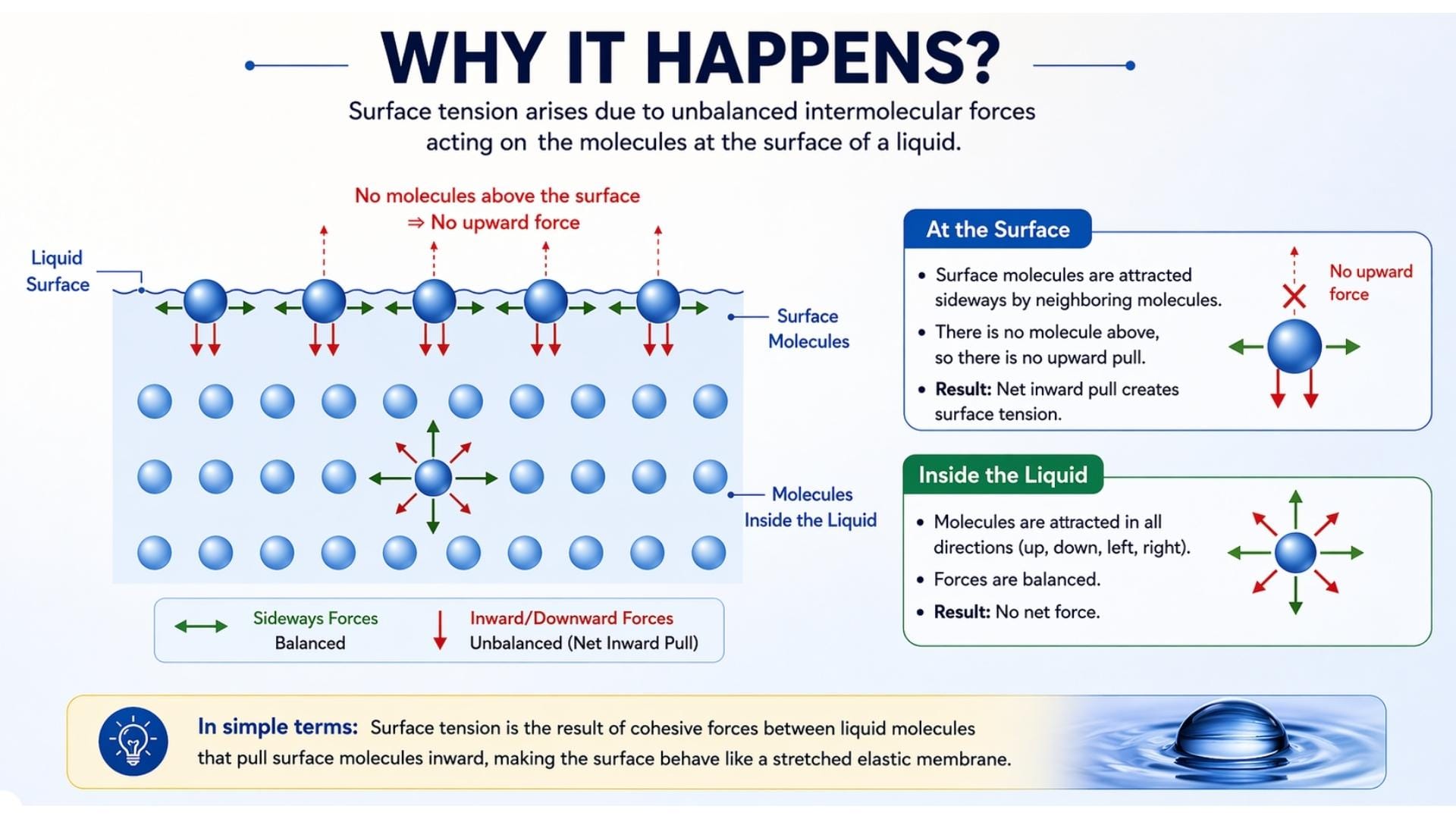
Surface tension arises due to cohesive forces between liquid molecules.
Key Concept:
- Molecules inside the liquid → experience equal attraction in all directions
- Molecules at the surface → experience inward pull only
This imbalance creates a net inward force, making the surface behave like a stretched film.
Formula of Surface Tension
When the tensile force acting on the free surface of the
liquid is calculated on unit length than the quantity we get is called surface
tension. It is also equal to the surface energy per unit area.
- It is denoted by the Greek letter σ
(sigma) - Its SI unit is N/m.
Mathematically,

Where,
σ = Surface tension (N/m)
F = Tensile Force acting along the surface (N)
l = lLength over which tensile force acts (m)
- The ST of water in contact with air at 20 degree celsius is 0.0725 N/m. and
- The ST of mercury in contact with air at 20 degree celsius is 0.52 N/m.
Units of Surface Tension
- SI Unit: Newton per meter (N/m)
- CGS Unit: Dyne/cm
Examples of Surface Tension in Daily Life
Common Observations:
- Water droplets form spherical shapes
- Insects walk on water (e.g., water strider)
- A needle can float on water surface
- Soap bubbles maintain shape
Also Read:
- What is Viscosity in Fluid Mechanics?
- What is Capillarity or Capillary Action?
- Types of Fluids In Fluid Mechanics
Factors Affecting Surface Tension
1. Temperature
- Increasing temperature → decreases surface tension
- Reason: Molecular attraction weakens
2. Impurities
- Some impurities (like soap) reduce surface tension
- Others may increase it depending on interaction
3. Nature of Liquid
- Strong intermolecular forces → high surface tension
- Example: Water has higher surface tension than alcohol
Surface Tension in Engineering Applications
1. Capillary Action
Surface tension enables liquids to move through narrow spaces without external force, which is essential in many fluid systems.
- Used in fuel systems, ink pens, and cooling devices
- Helps liquid rise in small tubes
- Ensures continuous fluid flow in compact systems
2. Lubrication
Surface tension controls how lubricants spread over surfaces, ensuring proper coverage and protection.
- Forms a thin film between moving parts
- Reduces friction and wear
- Improves machine efficiency and lifespan
3. Spray and Atomization
Surface tension affects how liquids break into droplets, influencing spray quality and performance.
- Important in fuel injectors and combustion systems
- Used in paint spraying and agriculture
- Ensures fine and uniform droplet formation
4. Heat Transfer
Surface tension plays a key role in boiling and condensation, directly affecting heat exchange processes.
- Influences liquid spreading on heated surfaces
- Affects cooling efficiency
- Used in heat exchangers and thermal systems
Surface Tension vs Cohesion and Adhesion
| Property | Description |
| Cohesion | Attraction between same molecules |
| Adhesion | Attraction between different molecules |
| Surface Tension | Result of cohesive forces at surface |
Advantages of Surface Tension
- Helps in droplet formation
- Enables capillary rise
- Important for biological processes
Disadvantages
- Causes resistance in fluid flow in small tubes
- Can create unwanted bubbles in systems
Conclusion
Surface tension is a powerful yet often unnoticed property of liquids that governs many natural and engineering phenomena. From the formation of droplets to the functioning of fuel systems and cooling technologies, its role is both practical and essential. By understanding how molecular forces create this effect, engineers can better design systems involving fluid flow, heat transfer, and material interaction. Whether in everyday observations or advanced mechanical applications, surface tension remains a key concept that bridges physics with real-world engineering solutions.