
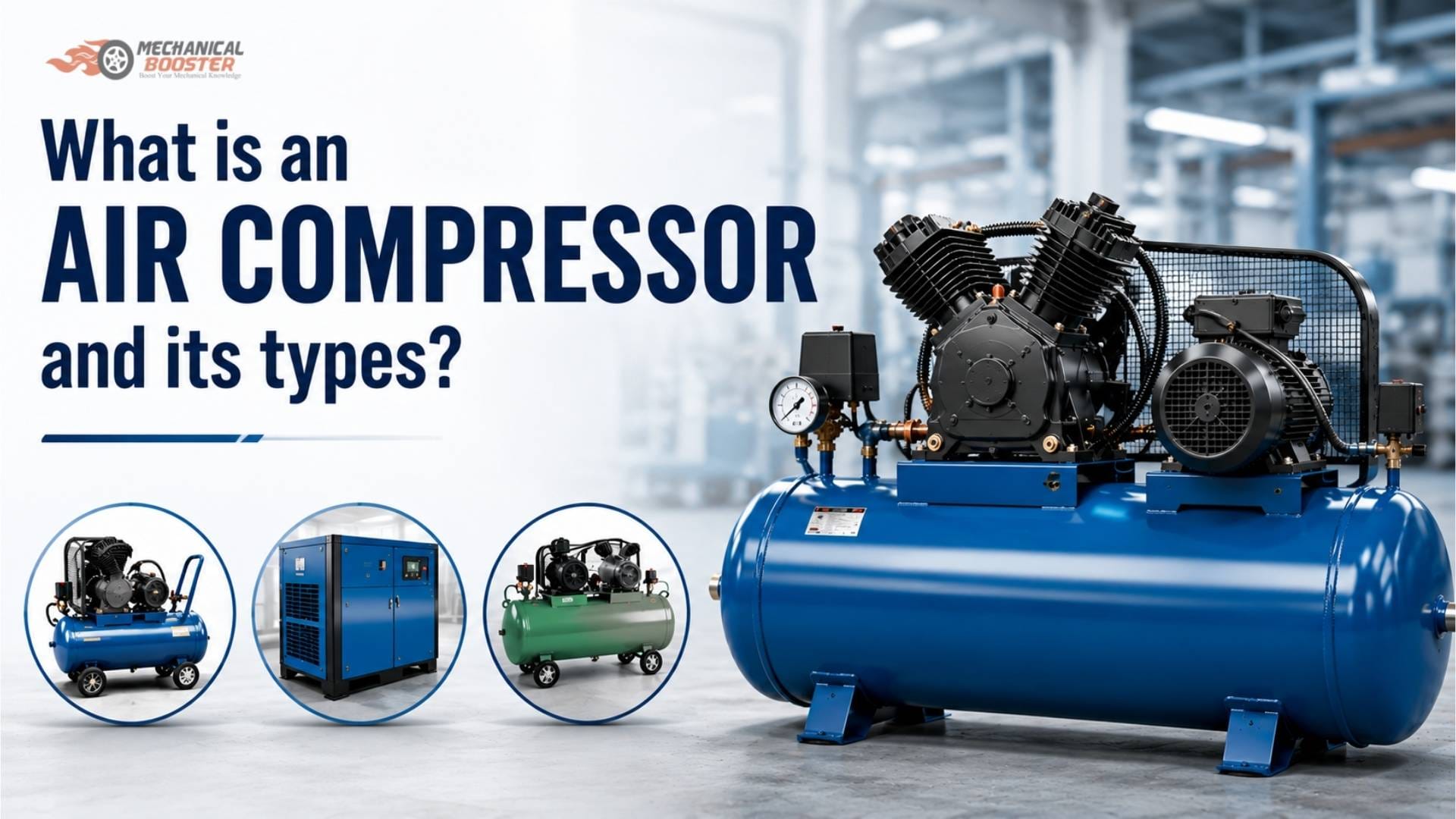
An air compressor is a mechanical device that converts power from an electric motor, diesel engine, or gasoline engine into compressed air energy. Have you ever noticed how we fill the air in the tires of our vehicles? This is possible with the help of an air compressor, which compresses atmospheric air and delivers it at high pressure. It works by drawing atmospheric air, reducing its volume, and increasing its pressure. The compressed air is then stored in a tank and used for various industrial, automotive, construction, and household applications.
Air compressors are widely used in pneumatic tools, spray painting, refrigeration systems, manufacturing plants, mining, and HVAC systems. They play an important role in modern industries because compressed air is considered one of the safest and most versatile forms of energy transmission.
Different types of air compressors are designed for different pressure ranges, flow requirements, and industrial purposes. Understanding their working principles and classifications helps in selecting the right compressor for a specific application.
What is an Air Compressor?
An air compressor is a machine that compresses air by decreasing its volume and increasing its pressure. The compressed air contains stored energy that can be released when needed to perform mechanical work.
The basic working process involves:
- Suction of atmospheric air
- Compression of air
- Storage of compressed air
- Delivery of compressed air to the system
Air compressors are commonly used where continuous power transmission or high-pressure air supply is required.
Main Components of an Air Compressor
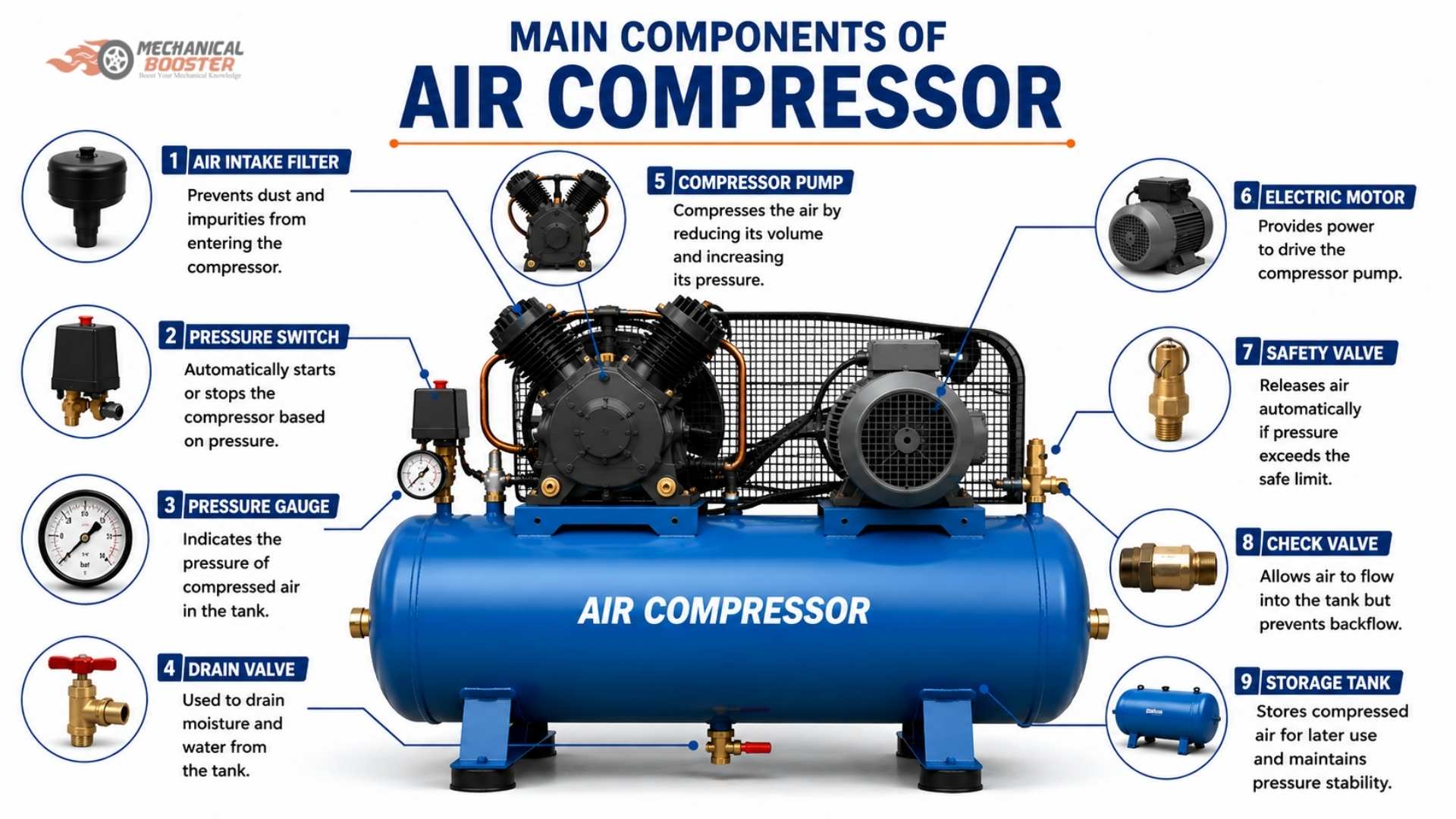
- Air Intake Valve: It allows atmospheric air to enter the compressor cylinder or chamber.
- Compression Chamber: This is the area where air gets compressed.
- Piston or Rotor: It compresses the air by reducing its volume.
- Delivery Valve: It releases compressed air into the storage tank.
- Storage Tank: Stores compressed air for future use.
- Motor or Engine: Provides mechanical power to run the compressor.
Working Principle of Air Compressor
The air compressor operates on the principle of reducing air volume to increase pressure.
When air enters the compression chamber, mechanical components such as pistons, screws, or vanes reduce the available volume. According to gas laws, decreasing the volume increases the pressure of air.
The compressed air is then discharged into a receiver tank for use in pneumatic systems and industrial applications. There are so many brands of air compressor are available like craftsman air compressor, PORTER-CABLE Air Compressor etc. They all work on the same principle discussed above.
Classification of Air Compressors
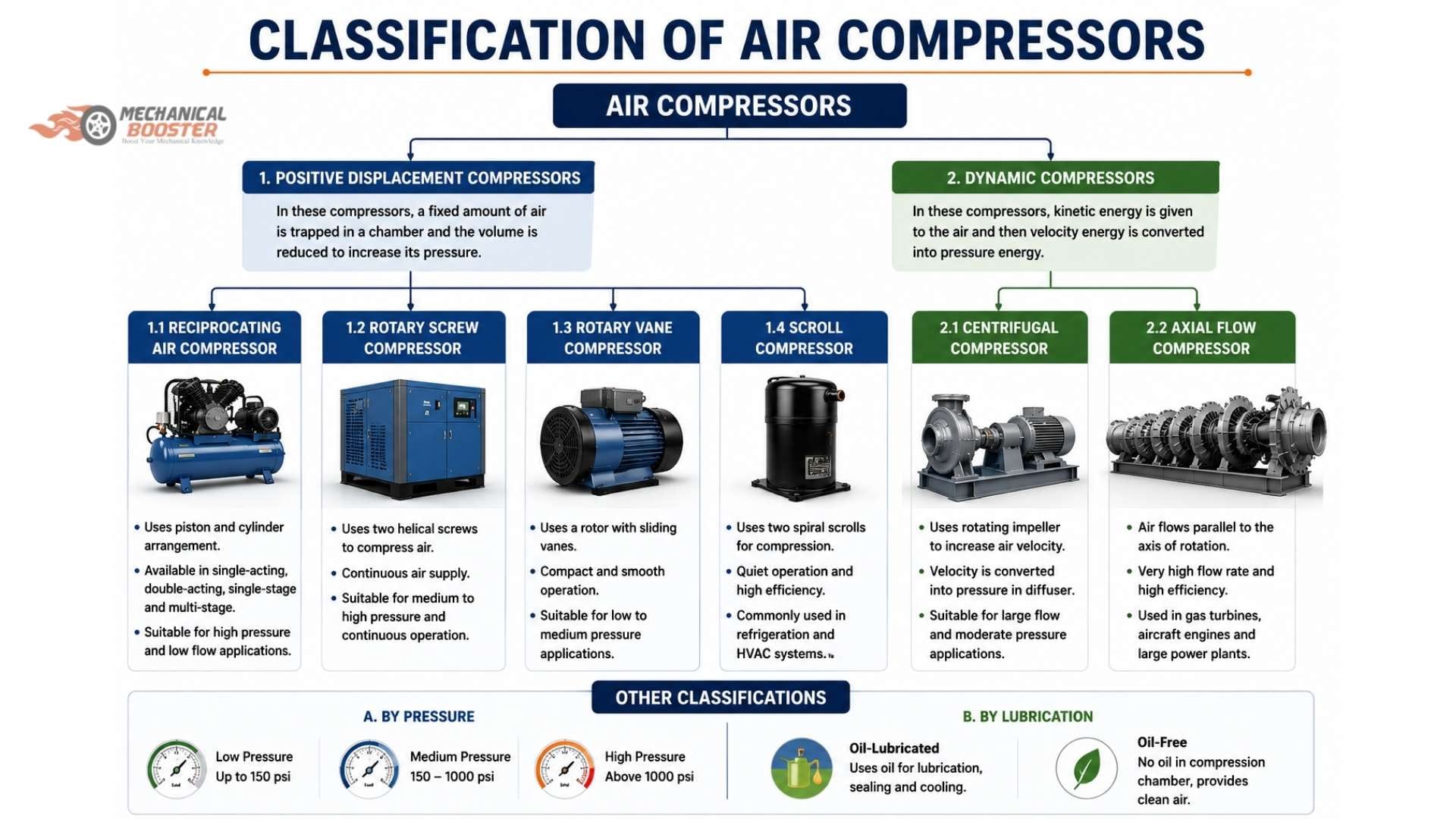
Air compressors are mainly classified into two categories:
- Positive Displacement Compressors
- Dynamic Compressors
1. Positive Displacement Compressors
In positive displacement compressors, air is trapped inside a chamber and mechanically compressed by reducing the chamber volume.
These compressors are suitable for high-pressure and low-flow applications.
Types of Positive Displacement Compressors
A. Reciprocating Air Compressor
A reciprocating compressor uses a piston-cylinder arrangement for air compression.
Working
- Air enters the cylinder during the suction stroke.
- The piston compresses the air during the compression stroke.
- Compressed air is delivered during the delivery stroke.
Types of Reciprocating Compressors
i) Single-Acting Compressor
Compression occurs on one side of the piston only.
ii) Double-Acting Compressor
Compression occurs on both sides of the piston.
iii) Single-Stage Compressor
Air is compressed in one cylinder only.
iv) Multi-Stage Compressor
Air is compressed in multiple stages for higher pressure output.
Advantages
- High pressure capability
- Better efficiency at low flow rates
- Suitable for intermittent operations
Disadvantages
- Noisy operation
- Higher maintenance
- Vibrations during operation
Applications
- Workshops
- Automobile garages
- Pneumatic tools
- Small industries
B. Rotary Screw Compressor
A rotary screw compressor uses two intermeshing helical rotors to compress air continuously.
Working
Air enters between rotating screws. As the screws rotate, the trapped air volume decreases and pressure increases.
Advantages
- Continuous air supply
- Low noise
- Compact design
- High reliability
Disadvantages
- Higher initial cost
- Complex maintenance
Applications
- Manufacturing plants
- Food processing industries
- HVAC systems
- Textile industries
C. Rotary Vane Compressor
This compressor uses a rotor with sliding vanes mounted eccentrically inside a casing.
Working
As the rotor rotates, vanes move outward due to centrifugal force and compress the trapped air.
Advantages
- Smooth airflow
- Compact size
- Low vibration
Disadvantages
- Wear of vanes
- Limited pressure range
Applications
- Printing machines
- Packaging industries
- Automotive systems
D. Scroll Compressor
A scroll compressor uses two spiral-shaped scrolls, where one remains stationary and the other moves eccentrically.
Advantages
- Quiet operation
- High efficiency
- Low maintenance
Applications
- Refrigeration systems
- Air conditioners
- Medical equipment
2. Dynamic Compressors
Dynamic compressors increase air pressure by increasing air velocity and converting kinetic energy into pressure energy.
These compressors are suitable for high-flow applications.
Types of Dynamic Compressors
A. Centrifugal Compressor
A centrifugal compressor uses a rotating impeller to accelerate air radially outward.
Working
- Air enters through the center of the impeller.
- The impeller increases air velocity.
- A diffuser converts velocity energy into pressure energy.
Advantages
- Continuous airflow
- High capacity
- Low maintenance
Disadvantages
- Lower efficiency at partial load
- Expensive installation
Applications
- Power plants
- Chemical industries
- Large HVAC systems
B. Axial Flow Compressor
In an axial compressor, air flows parallel to the shaft axis through multiple rotor and stator blades.
Advantages
- Very high flow rate
- Compact for large capacities
- High efficiency in gas turbines
Disadvantages
- Complex design
- Expensive manufacturing
Applications
- Jet engines
- Gas turbine plants
- Aircraft propulsion systems
Types of Air Compressors Based on Pressure
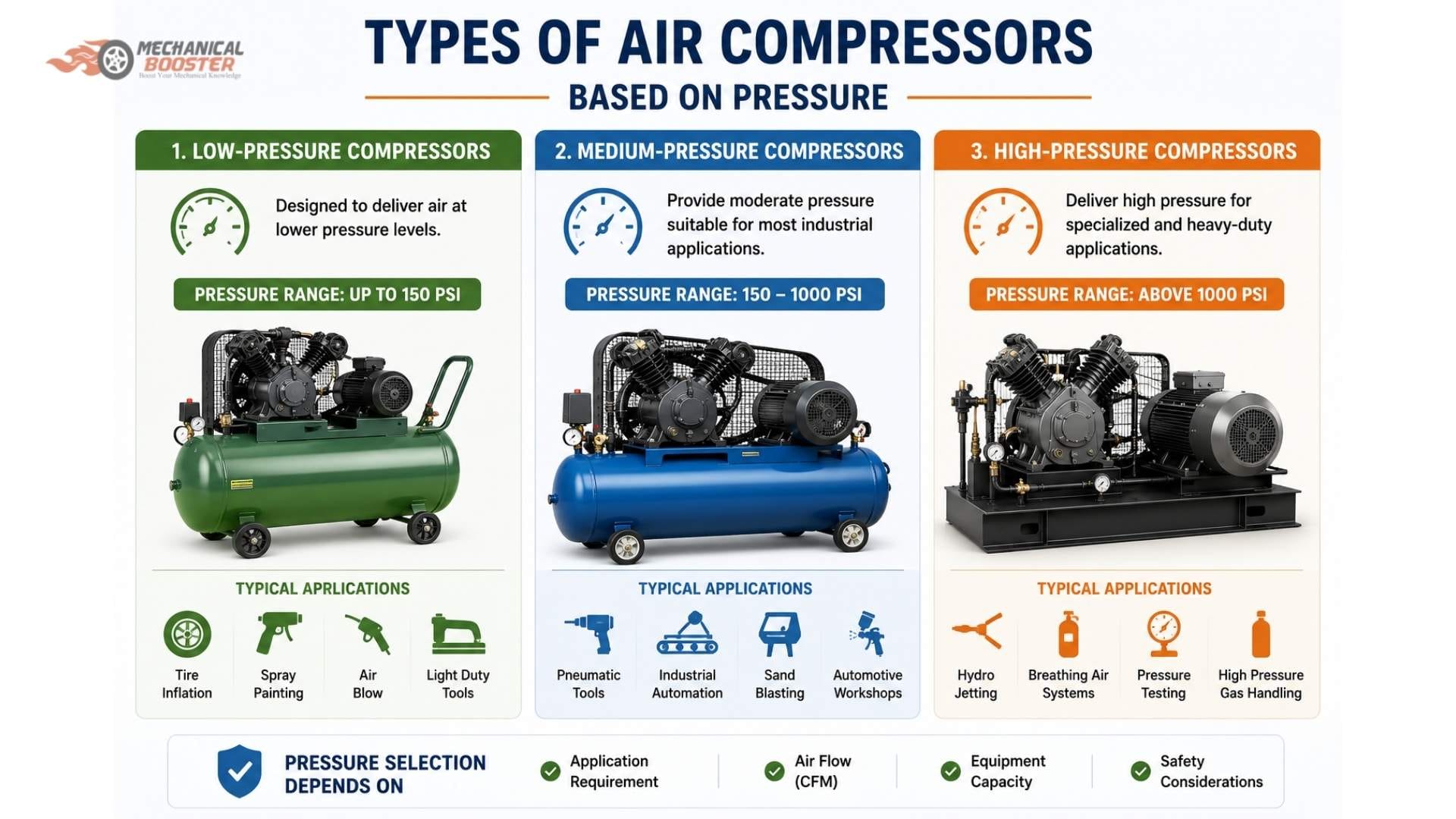
- Low-Pressure Compressors: Deliver air pressure up to 150 psi.
- Medium-Pressure Compressors: Deliver pressure between 150 psi and 1000 psi.
- High-Pressure Compressors: Deliver pressure above 1000 psi.
Types of Air Compressors Based on Lubrication
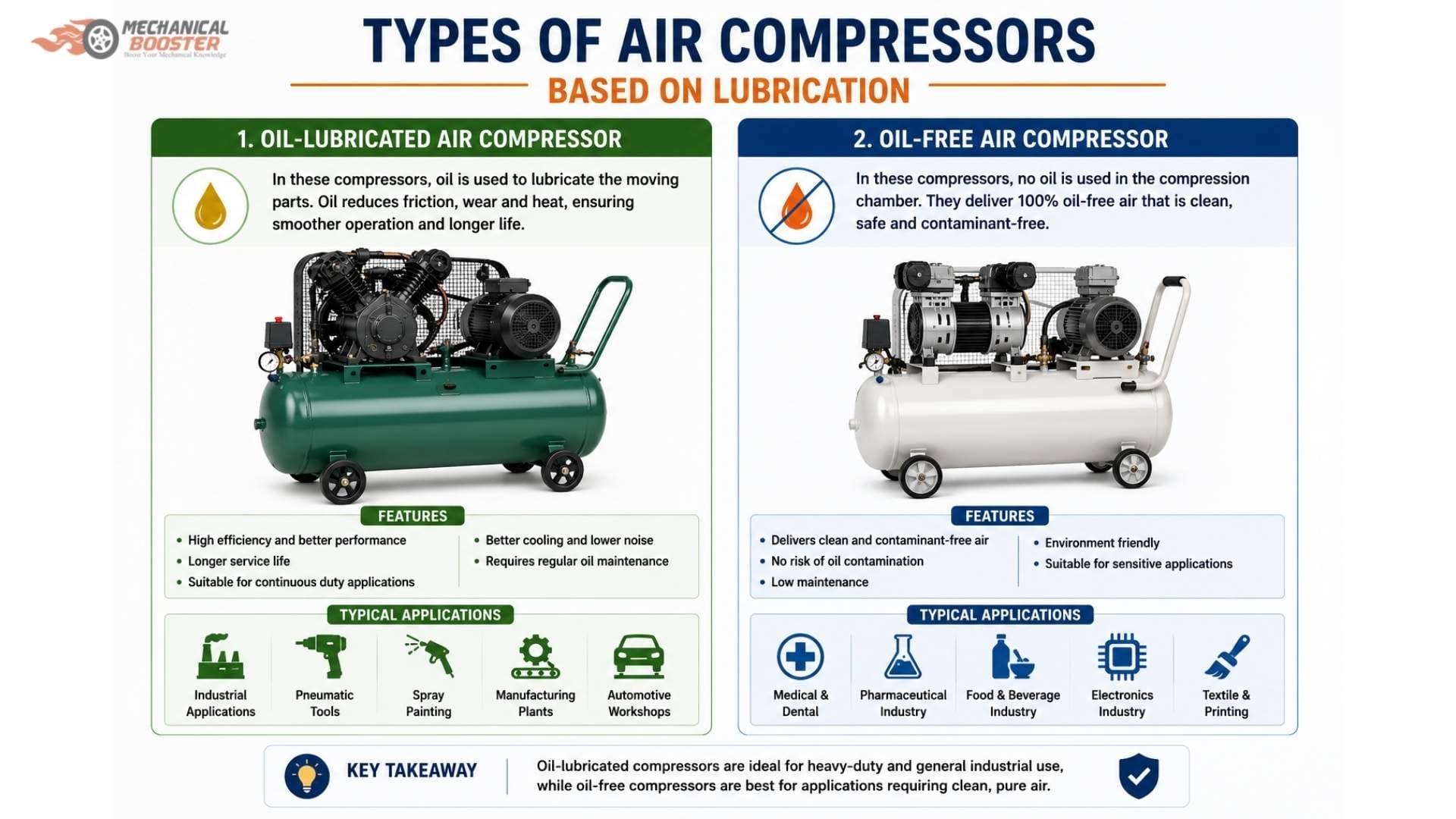
1. Oil-Lubricated Compressors
Use lubricating oil for cooling and reducing wear.
Advantages
- Better durability
- Efficient cooling
Applications
- Industrial machinery
- Heavy-duty operations
2. Oil-Free Compressors
Do not use oil inside the compression chamber.
Advantages
- Clean compressed air
- Low contamination
Applications
- Food industry
- Pharmaceutical industry
- Medical systems
Advantages of Air Compressors
- Easy power transmission
- Safe operation
- Versatile applications
- High reliability
- Simple maintenance
- Continuous air supply
Disadvantages of Air Compressors
- Energy losses during compression
- Noise generation
- Heat production
- Moisture formation in compressed air
Applications of Air Compressors
- Industrial Applications: Pneumatic tools, Automation systems, Material handling
- Automotive Applications: Tire inflation, Spray painting, Engine cleaning
- Construction Applications: Jackhammers, Drilling machines, Concrete spraying
- Domestic Applications: Air pumps, Refrigerators, Air conditioners
Difference Between Positive Displacement and Dynamic Compressors
| Feature | Positive Displacement | Dynamic Compressor |
| Working Principle | Traps and compresses air | Converts velocity into pressure |
| Pressure Output | High | Moderate |
| Flow Rate | Low to medium | Very high |
| Efficiency | Better at low flow | Better at high flow |
| Examples | Reciprocating, Screw | Centrifugal, Axial |
How to Select the Right Air Compressor
Choosing the correct air compressor depends on several factors:
- Pressure Requirement: Select according to required operating pressure.
- Air Flow Rate: Measured in CFM (Cubic Feet per Minute).
- Duty Cycle: Determine whether continuous or intermittent operation is needed.
- Maintenance Requirements: Consider maintenance cost and ease of servicing.
- Air Quality: Oil-free compressors are preferred for clean-air applications.
Conclusion
Air compressors are essential machines used for converting atmospheric air into high-pressure compressed air for industrial, automotive, construction, and domestic applications. Different compressor types such as reciprocating, rotary screw, centrifugal, and axial compressors are designed for specific pressure and airflow requirements. Understanding their working principles, classifications, advantages, and applications helps industries choose the most efficient system for their operations. As automation and pneumatic systems continue to grow worldwide, air compressors remain one of the most important power sources in modern engineering and manufacturing industries.