
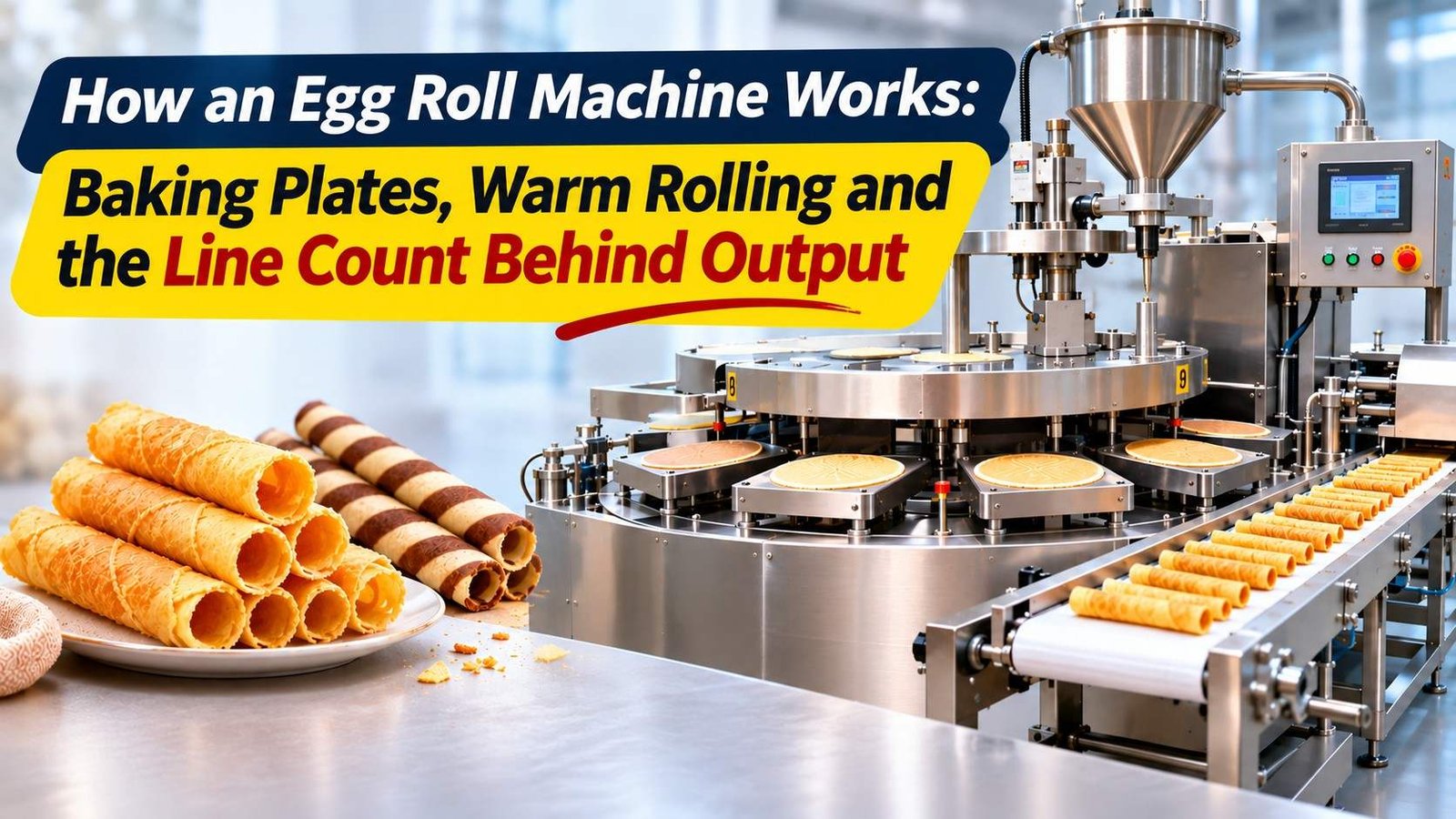
Crisp egg rolls and wafer sticks look like simple snacks, but the machine that makes them solves a tight mechanical timing problem. A thin batter sheet has to be baked, lifted and rolled in the few seconds while it is still flexible. Miss that window and the sheet cracks instead of forming a tube. Every design choice in an egg roll machine, from heater layout to the number of baking lines, follows from that constraint.
This article explains the mechanism and the way output scales, using the published model data of UDTECH, a manufacturer of wafer and egg roll machines in Xinyu, Jiangxi. Hygienic design points draw on ISO 14159, the international standard for hygiene requirements in machinery design.
The Basic Cycle: Deposit, Bake, Roll While Warm
At its core, the machine bakes thin batter sheets and rolls them while warm into crisp wafer sticks. The sequence has four mechanical stages: metering a controlled amount of batter onto a heated surface, baking it to a set colour, rolling the warm sheet around a forming tool, and cutting it to length before discharge.
Two variables dominate the result. Sheet thickness depends on deposit weight and plate temperature, and roll quality depends on how quickly the forming station picks up the sheet after baking. Uneven heat across a plate gives uneven thickness and colour, which then shows up as breakage at the rolling station.
Design rule: treat the baking plate and the rolling tool as one subsystem. Changing either one without retesting the other is the most common cause of cracked rolls after a product change.
Compact Electric Machines
Small production starts with compact electric units. In the UDTECH range, the YT-06 is published at approximately 300 pieces/h, heated by two 2.5 kW elements with a 0.8 kW transmission and air at 0.2 m³/min. Its bigger sibling, the YT-12, carries four 2.5 kW heating units for approximately 600 pieces/h in a 2200 × 900 × 1480 mm frame.
Doubling the heating units roughly doubles output here, which is a useful sign that heat input, not the rolling mechanism, is the limiting stage on compact designs. Electric heat also keeps installation simple: both compact models run on 380 V ±10% and take compressed air at or above 0.6 MPa, so a standard three-phase supply and a small compressor are enough.
Where it stops: compact machines suit bakeries, retail display baking and lower-volume runs. Beyond a few hundred pieces per hour, adding more compact units multiplies operators and floor space faster than it adds output.
Rotary Multi-Station Designs
A rotary layout takes a different approach. On the YT-02DJ, nine independently heated baking pans rotate through batter deposition, baking, rolling, product removal and automatic cutting, producing approximately 500-600 sticks/h. Each pan carries 2.5 kW of heat, and the machine weighs 900 kg in a 2700 × 2100 × 1500 mm footprint.
Mechanically, independent pan heating is the key advantage. Each pan can be held at its own set point, so pattern, stripe and roll length can be changed without one cold pan dragging down the whole cycle. The cost is more heating circuits, more temperature sensors and more parts to clean.
Choose rotary when: shape and pattern flexibility matter more than raw throughput, or when the product range changes often.
Multi-line Gas-Heated Machines
Industrial volumes come from parallel baking lines. UDTECH’s YT05-2 runs dual-line baking, core injection and roll forming at approximately 220 pieces/min, or 600 kg per 8 hours. The three-line YT05-3 reaches approximately 330 pieces/min and 900 kg per 8 hours in the same published 15.5 m² footprint, using 12 kW and LPG at about 8 kg/h or natural gas at about 10 m³/h.
That is the interesting mechanical result. Adding a third line raises output by half without enlarging the footprint, because the lines share the frame, drive and discharge path. Gas heating carries the larger thermal load, leaving the electrical service mostly for drives and controls.
Core injection changes the design further. Filled sticks need a nozzle that doses filling at the right temperature and position as the tube closes, and that nozzle then needs its own cleaning route and its own leakage check.
Output: Nameplate Versus Saleable
Engineers comparing machines should not rank brochure rates directly. Saleable sustained output equals nominal output multiplied by availability, performance and first-pass quality. Availability loses time to cleaning and changeover, performance loses it to slow cycles and jams, and first-pass quality loses broken rolls, under-baked pieces and fill leakage.
Because the three factors multiply, small losses at each stage compound into a noticeably lower saleable figure than the nameplate suggests. Compare suppliers on that saleable figure, counted at an agreed point downstream and measured on the approved product rather than an easier demonstration piece.
Hygienic Design And Maintenance Access
ISO 14159 specifies hygiene requirements for machines used where hygiene risks to the consumer can occur, and it covers the information the manufacturer must supply for intended use. For an egg roll machine, that translates into practical questions: can the baking plates be reached for cleaning, are there crevices where batter collects, and how is the filling nozzle stripped down?
Maintenance access deserves the same attention. Heating elements, thermocouples and the rolling tool are wear items, and a machine that must be partly dismantled to reach them will spend more time stopped than its rated output suggests.
Machine or Complete Line
One boundary trips up many projects. A machine-only quotation and a complete egg roll production line are different deliverables, even when they share the same baking and rolling core. Batter preparation, cooling conveyors, transfer and the packing interface either appear in the scope or remain the buyer’s responsibility.
Specify that boundary before comparing prices. Write down roll length, outside diameter, wall thickness, hollow or filled format, target output and the available heat source. With those inputs, the published models of an egg roll machine range can be narrowed to one candidate and a defined acceptance test, which is a far better basis for a decision than a speed figure alone.