
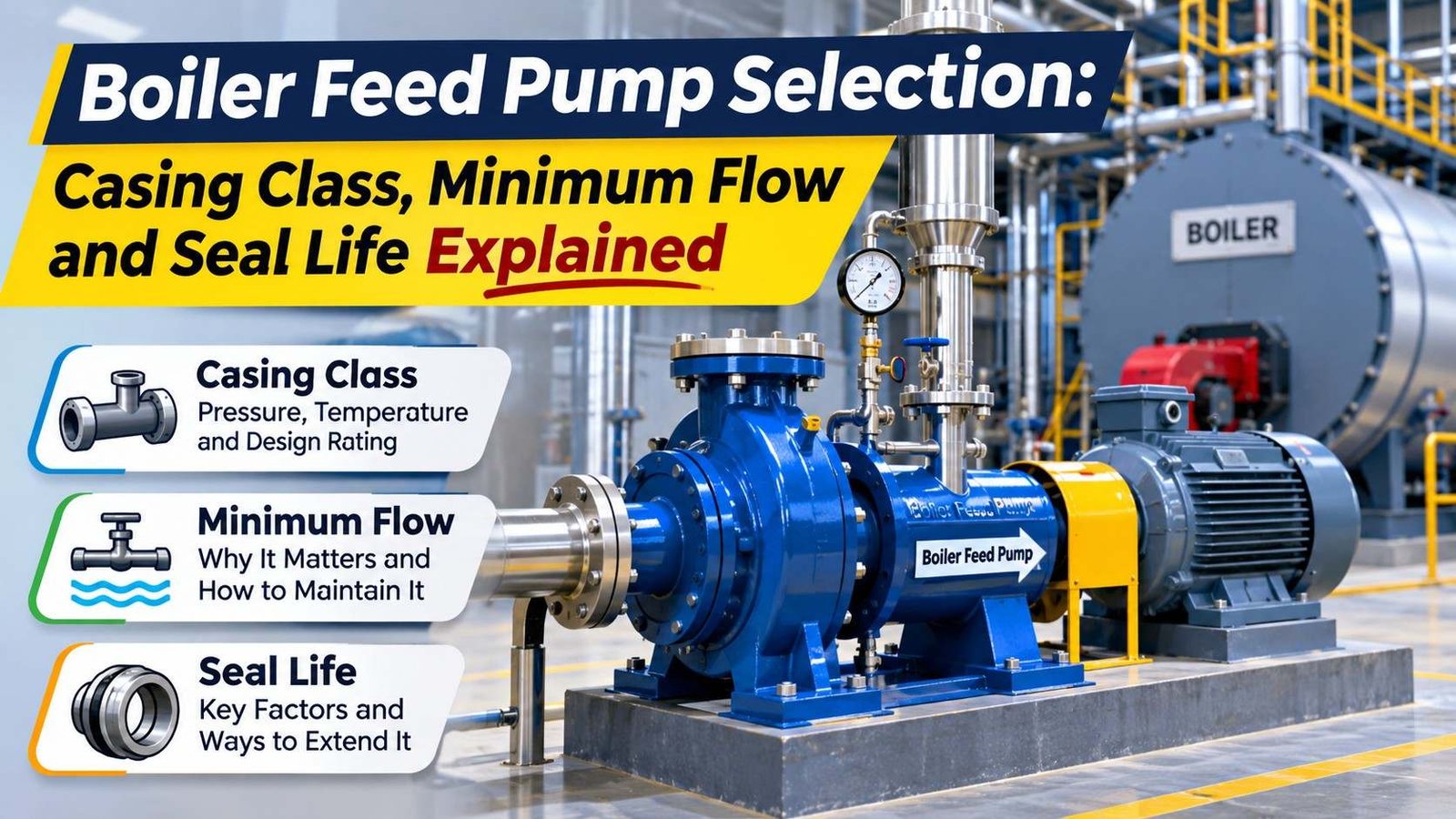
A steam boiler is only as reliable as the pump that keeps it full. Every kilogram of steam that leaves the drum has to be replaced by feedwater pushed in against boiler pressure, and that job falls to the boiler feed pump. It runs hot, it runs at high pressure, and in many plants it runs around the clock. When it trips, the boiler follows within minutes.
This article looks at the machine from the mechanical side: why feed pumps are built as multistage units, how casing construction is chosen, why minimum flow protection is not optional, and what wears out first. General background comes from the Wikipedia entry on boiler feedwater pumps. Application ranges and construction data come from BBP, a pump manufacturer that publishes its feed pump selection matrix in detail.
What a Feed Pump Has To Overcome
Feedwater is either fresh make-up water or condensate returning from the steam system. To force it into the boiler, the pump must generate enough pressure to overcome the steam pressure inside, plus the losses in valves, the economiser and the piping. Most units do this with a centrifugal design. Positive displacement pumps also appear, mainly on small boilers or where exact flow metering matters.
A single impeller cannot add that much pressure economically. Feed pumps therefore stack impellers in series on one shaft, and each stage adds its share of head. That is the mechanical reason almost every industrial boiler feed pump is a multistage machine.
Stacking stages has a cost. Axial forces from consecutive stages add up, so the rotor needs a balance drum, a balance disc or an opposed-impeller layout plus a thrust bearing sized for the remainder. Getting that balance wrong shows up first as bearing temperature, then as rubbing at the wear rings.
Limit: more stages raise head but also lengthen the shaft, so very high-pressure duties push designers toward stiffer barrel constructions rather than simply adding impellers.
Choosing the Casing Construction
Casing type follows pressure and temperature more than flow. BBP’s selection matrix gives a clear ladder that matches the API 610 casing classes:
- Vertical multistage ring-section: 30–200 m³/h, up to 40 bar and 150 °C, for small packaged boilers.
- Horizontal ring-section: 100–600 m³/h, 40–100 bar, up to 180 °C, for process and heating boilers.
- Axially split BB3: 200–1,200 m³/h, 80–170 bar, up to 200 °C, where quick overhaul matters.
- Radially split BB5 barrel: 500–2,500 m³/h, 170–500 bar, up to 220 °C, for utility and supercritical service.
Ring-section pumps are compact and economical, but every stage joint is a potential leak path under thermal cycling. An axially split casing opens along the shaft, so the whole rotor can be lifted out without disturbing the piping. A barrel casing places the stage bundle inside a forged outer shell, which handles the highest pressure and thermal shock best and lets the internal cartridge be swapped as a unit.
Trade-off: the barrel is the strongest option and the most expensive. According to the same source, BB5 barrel castings alone add 30–50 % to base pump cost, so a barrel only earns its place once pressure and temperature demand it.
Minimum Flow Protection on a Boiler Feed Pump
Boilers rarely run at full load. When steam demand falls, the feed control valve closes and the pump is asked to deliver very little water while still producing full head. A common answer, described in the Wikipedia entry, is a pump that runs constantly with a minimum flow device that returns part of the flow to the tank or deaerator.
The reason is heat. Almost all of the shaft power goes into the water, and at low flow there is too little water to carry that heat away. BBP warns that running a feed pump below 25% of best efficiency point leads to overheating, and states that every one of its feed pumps includes an automatic minimum-flow recirculation loop back to the deaerator.
Mechanical engineers should treat the recirculation line as part of the pump, not as an optional pipe. Size its control valve for the full differential pressure, protect it against cavitation damage, and make sure the trip logic cannot shut it while the pump is running.
Limit: recirculation keeps the pump alive at low load but wastes energy, so plants with long periods at partial load often add variable speed drives as well.
Seal Failure and Electrical Corrosion
Feed pump seals have an unusual enemy. Boiler water is extremely pure, with conductivity below one micro-Siemens per centimetre. Static charge produced by the sliding seal faces has nowhere to go, and electrical corrosion can break fingertip-sized pieces from the rings within a few hundred operating hours. Diamond-like carbon (DLC) coated faces are the documented remedy.
BBP offers DLC seal face upgrades and reports that they passed endurance testing for 27,000 hours, matching the endurance figure cited in the encyclopedia reference. For baseline material, it lists 12 % chrome steel for standard feedwater, with higher alloys reserved for corrosive upsets from the deaerator.
Risk: a seal that keeps failing on a feed pump is often diagnosed as a workmanship problem. Checking feedwater conductivity first can save several rounds of replacing parts that were never the cause.
Efficiency, Drives and Running Cost
Motor-driven multistage centrifugal feed pumps reach 78 – 85 % hydraulic efficiency at their best efficiency point in BBP’s comparison table. Reciprocating pumps score higher on paper, yet their installed cost index is 1.8 – 2.4 times that of a centrifugal unit, and turbine drives sit higher still because they need extraction steam.
Load profile is what decides the drive. On variable-load duty, pairing the motor with a variable-frequency drive typically cuts electricity use by 20–50 %, according to the same source, because the pump slows down instead of throttling against a closed valve. On a boiler that runs flat out all year, the gain is small and the extra electronics may not pay.
A Practical Selection Checklist
Before requesting quotations, collect the data that actually decides the design. List rated and minimum steam flow, drum pressure and the margin you need above it, feedwater temperature at the pump suction, available NPSH from the deaerator, and the load pattern over a typical year. Add the feedwater chemistry, including conductivity, because it changes the seal choice.
Ask every supplier for the casing class proposed and why, the minimum continuous stable flow, the seal arrangement and face material, and the lead time. For catalogue ring-section sizes, BBP quotes 6-10 weeks ex-works, which is a useful benchmark when the project schedule is tight. Engineers who want to compare a published selection matrix against their own duty can review a boiler feed pump range before writing the specification. Choose the casing for pressure and temperature, protect the pump at low flow, and match the seal to the water, and the feed pump will stop being the reason the boiler trips.