
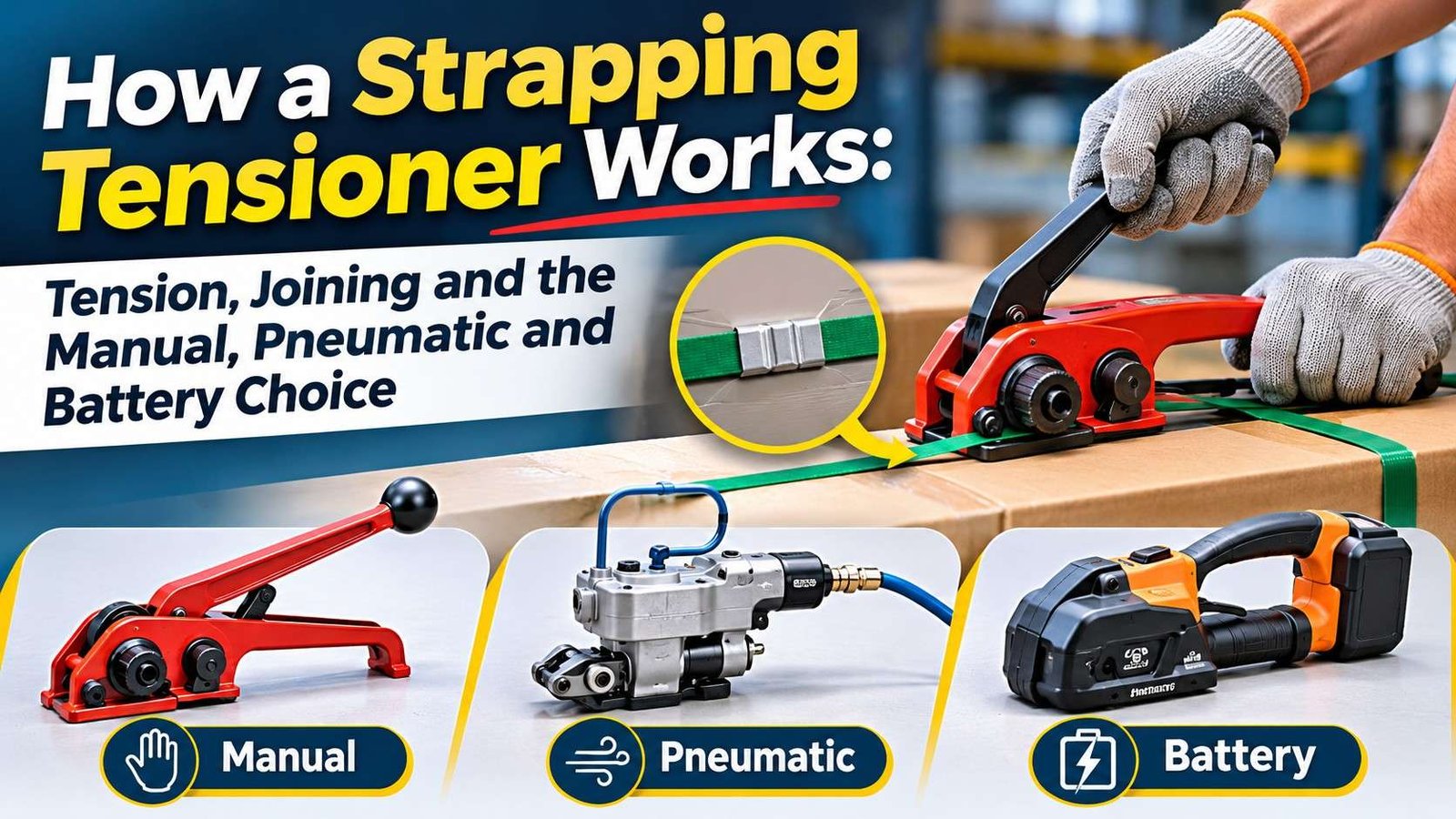
Polyester and polypropylene strapping hold together everything from brick packs to export cartons, and the tool that pulls the strap tight is easy to overlook. Yet the strapping tensioner decides how much of the strap’s rated strength actually reaches the load. Too little tension and the pack loosens as it settles; too much and the strap cuts into corners or the product deforms. Understanding the mechanism makes the tool choice far less of a guess.
This article explains how tensioning tools work and how to choose between manual, pneumatic and battery types. Specifications come from UD Packaging, a polyester strap manufacturer in Jiangyin, China that also supplies strapping tools. Testing references are taken from ASTM standards for strapping and unit loads.
Tensioning and joining are separate functions
The first mechanical point is a division of labour. A tensioner applies force to the strap, while a sealer, buckle or weld process forms the joint. Some combination tools do both, but only when their documentation says so. Treating a tensioner as a complete strapping tool is the most common mistake on a new packing station.
Mechanically, a tensioner grips the lower strap end, then drives a toothed wheel or feed gripper against the upper end to pull slack out of the loop. Once the set tension is reached, the joint is formed and the strap is cut. Each of those steps can fail independently, so each needs its own check.
The joint often sets the real limit. UD Packaging notes that seal strength is expressed as a percentage of a reference break load, not as an absolute force, which means a strong strap with a weak joint behaves like a weak strap.
Manual tools: the operator is part of the mechanism
With a manual tool, the operator supplies the force through a lever or ratchet. As UD Packaging notes, hand application depends on the operator holding consistent tension and forming a repeatable closure, so results vary with fatigue, posture and experience.
Manual tools need no air or power supply and go anywhere around the load, which makes them a good fit for mixed warehouse work. The engineering questions are about people: operator force, reach around the pack, repetition per shift and how consistently the joint is formed.
Pneumatic tools: controlled tension from the air supply
Powered tools change the picture. A powered tool applies tension under control and forms the joint on a fixed cycle, so the result depends far less on the person holding it.
Pneumatic tools bring their own system requirements. The available pressure and air quality must be reviewed against the identified manual, along with hose routing, couplings, noise, vibration and maintenance access. A tool that is starved of air at the end of a long hose will under-tension without any obvious warning.
Where it fits: fixed stations with compressed air already available and high, steady strapping volumes.
Maintenance on air tools is mostly about the air. Water and oil carried in from a poorly drained compressor line wear the motor and seals, and a leaking coupling quietly lowers the pressure at the tool. A filter and regulator at the drop point, checked on a schedule, keeps the delivered tension where the setting says it should be.
Battery tools: mobility with charging discipline
Battery-powered tools combine controlled tension with mobility. In return they need a review of battery and charger identity, duty pattern, charging location, spare strategy, inspection, thermal protection and service support. A charging point and spare packs become part of the station design.
Where it fits: large yards or outdoor staging where hoses are impractical but repeatable tension still matters, such as lumber or steel bundles.
Choosing a strapping tensioner for the station
Putting the three categories side by side makes the choice clearer. Manual tools win on cost and portability but depend on the operator. Pneumatic tools give the most consistent tension at fixed stations that already have clean air. Battery tools bring controlled tension to places where air hoses cannot follow, at the price of charging discipline and spare packs.
Volume decides a lot. A station applying a few dozen straps a shift rarely justifies a powered tool, while a dispatch line strapping hundreds of bundles will feel operator fatigue within days. Write down straps per shift, the load positions the operator must reach and the available utilities before comparing models.
Matching the tool to the strap
Strap material changes how a tensioner behaves. Wikipedia’s overview of strapping describes steel as the oldest and highest tensile strength option, used where high strength and minimal stretch are needed, while oriented polypropylene suits light to medium duty but tends to take on irrecoverable dead stretch under constant stress. Polyester sits between them, which is why it now dominates many medium and heavy-duty stations.
Tools are built for a strap width and thickness range. The manufacturer publishes six polyester strap models from 12 to 19 mm wide, with tensile force from 2,600 to 6,800 N. A tool designed for a 12 mm strap will not grip a 19 mm strap correctly, and one designed for thick strap may slip on thin strap.
A mid-range example shows what to record. Model 1608 is 16 × 0.8 mm at 16.6 g/m, with 1,200 m on a 20 kg roll. The tool specification should state the exact width and thickness it accepts, and the strap order should match it.
Surface finish also affects grip. Smooth and embossed polyester strapping can behave differently in feeding and joining equipment, so test the tool with the strap you will actually buy.
Tension figures need the same caution. Any model range or tension value should be treated as product-specific, because the same nominal setting can deliver different force on a different strap or wheel.
Safety: stored energy in a tight strap
Every tensioned strap stores energy. Shared risks across all tool types include stored energy and recoil after strap release or breakage, sharp strap ends and cutting surfaces, pinch points near moving parts, and load movement when the package is unstable. Eye protection and controlled cutting are basic requirements, not extras.
Verifying the packed load
A tool that tensions and seals correctly on the bench still has to be judged on the shipped load. ASTM D4169-23e1 can frame a distribution-cycle test plan that reflects the intended route and handling sequence, combining stacking, vibration, shock and environmental conditioning in a realistic order.
Record the strap, the joint, the tool and its setting with every test so the result can be repeated. Engineers specifying a new station can compare manual, pneumatic and battery options for a given strap and load on this strapping tensioner page before choosing a model.