
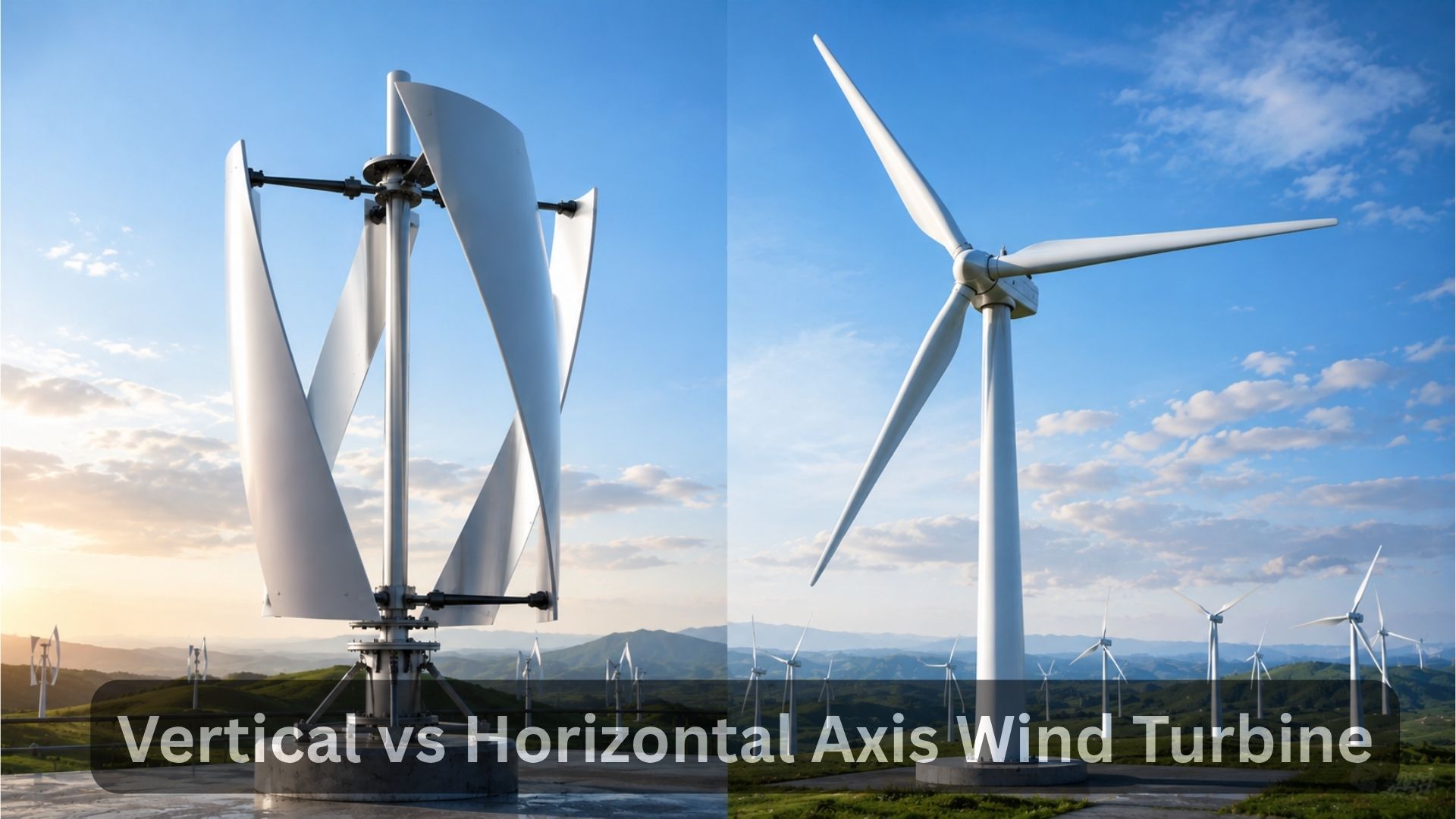
Horizontal axis wind turbines (HAWTs) convert wind energy more efficiently, typically reaching a power coefficient of 0.40 to 0.50, compared to 0.30 to 0.42 for Darrieus-style vertical axis wind turbines (VAWTs). HAWTs dominate utility-scale wind farms because of this higher output and lower cost per kilowatt-hour. VAWTs trade some efficiency for the ability to capture wind from any direction without a yaw system, which makes them better suited to turbulent, low-height environments like rooftops, urban lots, and off-grid sites. Neither design is “better” in absolute terms; the right choice depends on wind conditions, available space, and project scale.
How Each Turbine Design Actually Works
The core difference between these two turbine families comes down to one thing: the orientation of the rotor shaft relative to the ground and the wind.
Horizontal Axis Wind Turbine
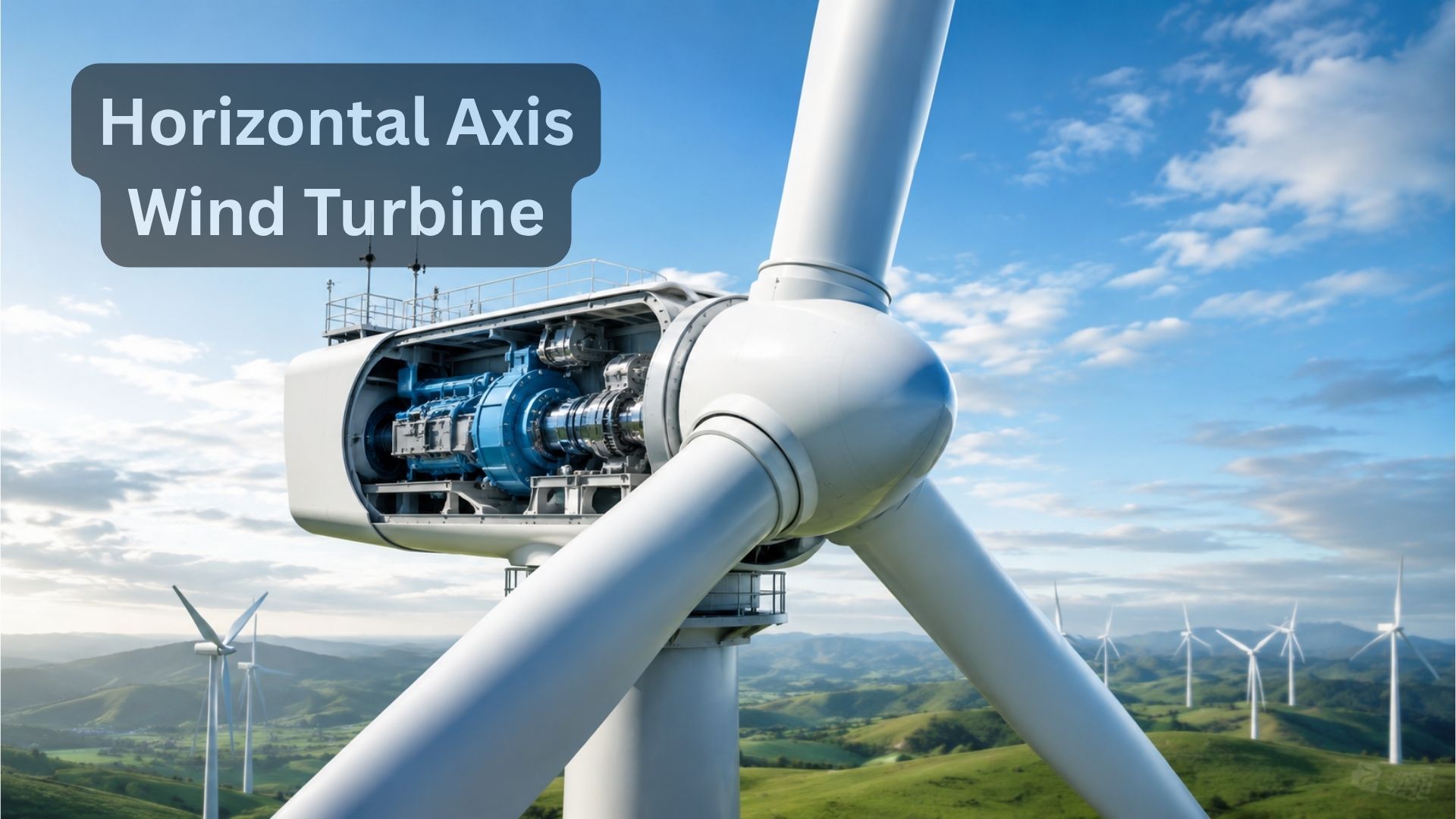
A horizontal axis wind turbine spins around a shaft that runs parallel to the ground and parallel to the wind direction. This is the classic three-blade design you see on wind farms across Texas, Iowa, and offshore New England. The blades use airfoil-shaped cross-sections, similar to an airplane wing, to generate lift as wind passes over them. Because the rotor has to face directly into the wind to work efficiently, HAWTs use a yaw drive and wind vane sensor to rotate the nacelle and keep the blades pointed correctly.
Vertical Axis Wind Turbine
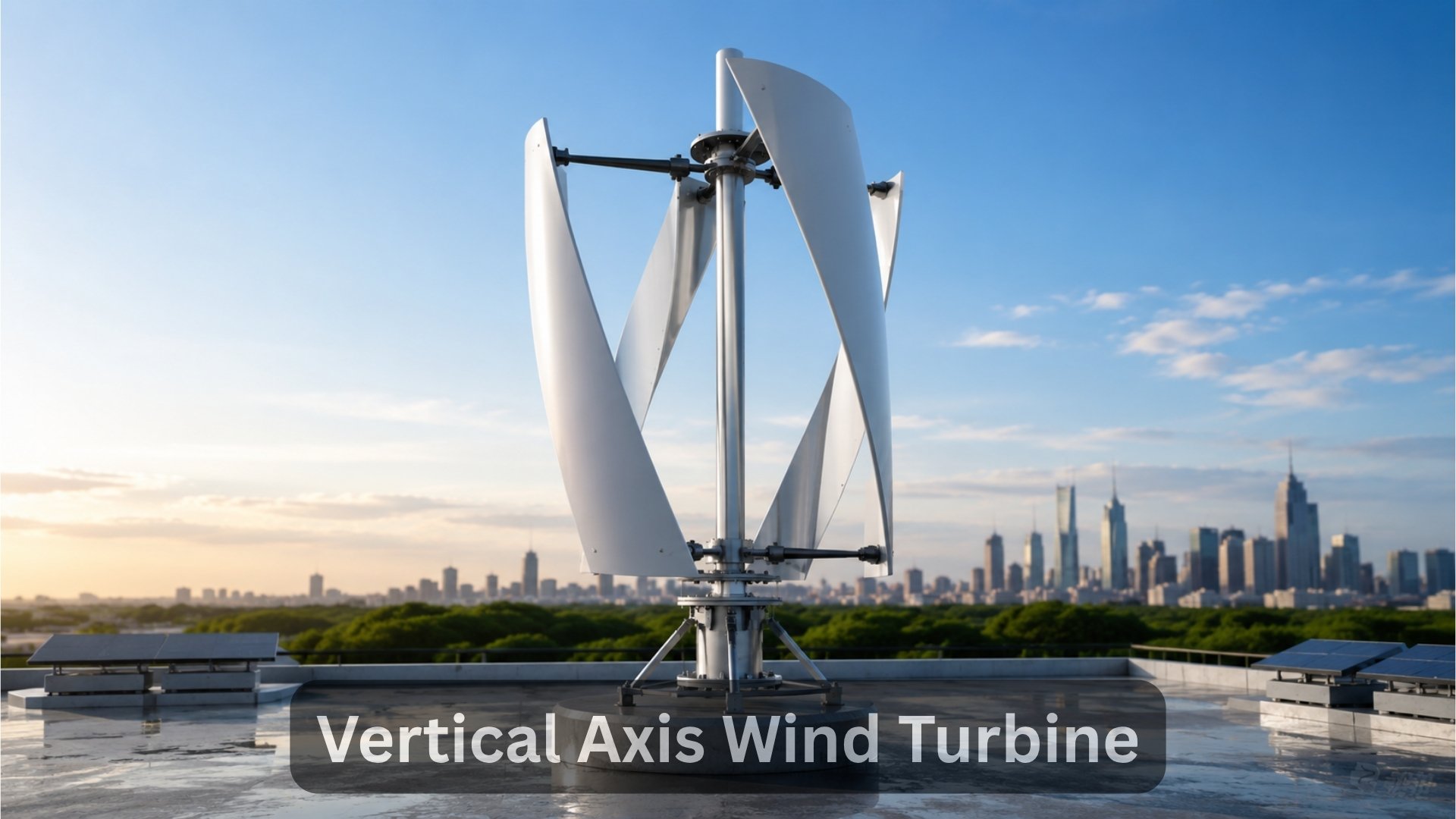
A vertical axis wind turbine spins around a shaft that stands upright, perpendicular to the wind. There are two main subtypes worth knowing as an engineer or buyer:
- Darrieus turbines use curved, airfoil-shaped blades and generate power through lift, similar to HAWTs, but the lift direction constantly changes as the blade rotates through the wind.
- Savonius turbines use scoop-shaped blades and rely on drag rather than lift. They are simpler and start spinning in lighter wind, but they top out at lower efficiency.
Because a VAWT’s rotor accepts wind from any compass direction, it never needs a yaw mechanism. That single design choice removes a major source of mechanical complexity and cost, but it also means only part of the blade is producing useful torque at any given moment while the rest of the swept area is doing little or even working against rotation.
Key Engineering Concepts You Should Know
A handful of technical terms come up constantly in HAWT vs VAWT discussions, and understanding them helps you read spec sheets correctly instead of relying on marketing claims.
1. Tip Speed Ratio (TSR)
Tip Speed Ratio (TSR) is the ratio of blade tip speed to wind speed. HAWTs typically operate at TSRs of 6 to 8, while Darrieus VAWTs often run lower. A turbine’s Cp is not a fixed number; it varies with TSR, peaking at one specific ratio and dropping off on either side.
2. Solidity
Solidity describes how much of the swept area is physically covered by blade material. High-solidity rotors, common in Savonius VAWTs, produce strong starting torque but lower peak efficiency. Low-solidity rotors, like a typical three-blade HAWT, sacrifice starting torque for higher peak Cp.
3. Starting torque and self-starting capability
Starting torque and self-starting capability matter more than most buyers realize. Savonius VAWTs self-start in very light wind because their drag-based design generates torque at almost any rotor position. Darrieus VAWTs, by contrast, often struggle to self-start and may need a small motor-assist or hybrid Savonius starter stage. HAWTs generally self-start at moderate wind speeds once correctly yawed into the wind, though some require pitch control assistance.
4. Cyclic fatigue loading and dynamic stall
Cyclic fatigue loading and dynamic stall are structural engineering concerns specific to Darrieus VAWTs. Because blade angle of attack changes every revolution, the blades experience repeated load reversals, which increases fatigue stress over the turbine’s lifespan and requires careful material and joint design. Dynamic stall, a temporary flow separation at certain rotor angles, further reduces efficiency at specific points in the rotation.
5. Gearbox vs. direct-drive systems
Gearbox vs. direct-drive systems affect maintenance cost for both designs. Geared systems step up rotor speed to match generator requirements but add a mechanical component prone to wear. Direct-drive systems eliminate the gearbox, reducing maintenance but typically requiring a larger, heavier generator.
6. Cut-in, rated, and cut-out wind speeds
Cut-in, rated, and cut-out wind speeds define a turbine’s operating envelope. Cut-in is the minimum wind speed needed to generate usable power, rated speed is where the turbine reaches its maximum rated output, and cut-out is the speed at which the turbine shuts down to prevent mechanical damage. Always compare these three figures, not just the headline rated capacity, when evaluating any turbine.
7. Capacity factor
Capacity factor is the ratio of actual energy produced over a year to the theoretical maximum if the turbine ran at rated output continuously. Utility-scale HAWTs in good wind sites often achieve capacity factors of 35 to 45 percent. Small VAWTs in turbulent urban settings typically range between 10 and 30 percent, depending on wind resource and installation specifics, which is an important number for any realistic payback calculation.
| Factor | Horizontal Axis (HAWT) | Vertical Axis (VAWT) |
| Typical efficiency (Cp) | 0.40 to 0.50 | 0.30 to 0.42 (Darrieus), 0.15 to 0.30 (Savonius) |
| Yaw system required | Yes | No |
| Wind direction sensitivity | High, must face wind | Very low, near-omnidirectional |
| Best wind speed range | Steady, moderate to high | Turbulent, gusty, variable |
| Typical install height | Tall tower (30 to 90+ meters utility-scale) | Low to moderate height |
| Noise level | Moderate to higher at tip speed | Generally lower |
| Maintenance access | Gearbox/generator high in nacelle | Many designs place generator near ground level |
| Self-starting capability | Moderate, often needs pitch/start assist | Savonius: excellent; Darrieus: poor without assist |
| Footprint | Larger spacing needed for wind farms | Compact, good for tight urban lots |
| Startup wind speed | Higher cut-in speed | Often lower cut-in speed |
| Common applications | Utility wind farms, offshore | Rooftop, residential, off-grid, urban |
| Manufacturing cost at scale | Lower cost per kW at large scale | Higher cost per kW at small scale |
Also Read:
- Pelton Turbine: Working, Main Parts, Applications (Complete Guide)
- Difference Between Gas Turbine and Steam Turbine
- Difference Between Impulse and Reaction Turbine
Vertical Axis vs Horizontal Axis Wind Turbine: Pros and Cons
HAWT Advantages
- Higher aerodynamic efficiency
- Higher capacity factor at well-sited locations
- Mature, widely standardized technology
- Better suited for utility-scale and offshore projects
HAWT Disadvantages
- Requires a yaw system to track wind direction
- Higher tower and installation cost
- More difficult, higher-altitude maintenance access
- Higher cut-in wind speed before generating useful power
VAWT Advantages
- Omnidirectional, no yaw system needed
- Often easier and cheaper ground-level maintenance
- Performs better in turbulent, gusty wind
- Lower installation height, suited to rooftops and urban lots
VAWT Disadvantages
- Lower aerodynamic efficiency than HAWTs
- Lower typical capacity factor
- Greater cyclic fatigue loading on blades, especially Darrieus designs
- More limited commercial and utility-scale adoption
This is where most buyers get misled by marketing copy, so let’s stick to the engineering numbers.
The theoretical maximum for any wind turbine is the Betz limit, which caps energy extraction at 59.3% of the wind’s kinetic energy. The Betz limit applies equally to both HAWTs and VAWTs because it’s a theoretical limit on extracting energy from moving air, not a limit specific to a particular turbine design. No real turbine reaches that ceiling because of mechanical losses, blade drag, and generator inefficiency.
In practice, well-engineered three-blade HAWTs reach a power coefficient (Cp) around 0.45, with some advanced designs approaching 0.50 under ideal tip speed ratios near 7 to 8. Darrieus-style VAWTs generally operate in the 0.30 to 0.42 range, while drag-based Savonius turbines are usually lower still, typically 0.15 to 0.30, because they rely on drag rather than lift to generate torque.
One frequently cited comparative test used matched swept areas of 3.14 square meters and found a Cp of 0.54 for the HAWT versus 0.34 for the VAWT, with the HAWT capturing about 1,364 watts compared to roughly 506 watts for the VAWT. It’s worth noting that test was run at a specific elevated wind speed chosen to push both rotors near their rated output, so the absolute wattage figures are higher than what you’d see at the more moderate 12 mph wind speed used in the sample calculation later in this guide. The relative efficiency gap, HAWT outperforming VAWT by roughly 25 to 30 percent, holds consistent across both data sets even though the raw wattage differs.
Multiple engineering reviews report that HAWTs outperform VAWTs in efficiency by a meaningful margin. The reason isn’t simply that “part of the blade does nothing.” As a VAWT rotor blade travels through a full revolution, its angle of attack relative to the oncoming wind changes continuously. Some rotor positions generate strong positive torque, others generate much weaker torque, and at certain points in the rotation a blade can briefly produce negative torque that works against the turbine’s spin. This cyclic variation, combined with dynamic stall effects on Darrieus blades at certain tip speed ratios, is the real mechanical driver behind the lower average Cp.
That said, VAWTs are not inefficient by a wide margin in theory. Engineering comparisons note that vertical axis turbines are not dramatically worse in theoretical performance, and their ability to accept wind from any direction eliminates the need for a yaw mechanism entirely. The Darrieus subtype in particular closes much of the efficiency gap compared to the drag-based Savonius design, especially once tip speed ratio climbs past a certain threshold.
Engineering Takeaway:
if your site has consistent, unidirectional wind and you have the budget and tower clearance, a HAWT will produce more kilowatt-hours per dollar of swept area. If your site has shifting, gusty wind, like a rooftop surrounded by buildings, a VAWT’s omnidirectional capture can outperform a HAWT that spends part of its time yawing to catch up with wind shifts.
Cost Comparison
Upfront cost and lifetime cost rarely tell the same story, and that’s especially true here.
Horizontal Axis Turbines
Horizontal axis turbines benefit from decades of mass production and standardized supply chains. At utility scale, this drives down the cost per installed kilowatt significantly compared to vertical designs. However, HAWTs require a yaw motor, pitch control system, and a tall tower, all of which add complexity and maintenance cost. Servicing the gearbox and generator means working at height inside the nacelle, often requiring cranes for major repairs on utility-scale units.
Vertical Axis Turbines
Vertical axis turbines have a structural advantage that’s easy to overlook: many designs place the generator and gearbox near or at ground level since the entire rotor shaft is vertical, which simplifies maintenance considerably. Not every VAWT is built this way, so it’s worth confirming generator placement on the specific model you’re evaluating. The tradeoff is that, at small residential scale, VAWTs are currently more expensive per kilowatt of capacity because manufacturing volume is lower and designs are less standardized industry-wide. It’s also worth noting that VAWTs, particularly Darrieus designs, often experience greater cyclic fatigue loading due to the constantly changing angle of attack discussed earlier, which can offset some of the maintenance savings over the system’s lifespan depending on build quality and materials used.
For a typical US homeowner evaluating a small wind system, the real cost driver usually isn’t axis orientation at all, it’s whether the site has enough average wind speed (most residential wind projects need at least 10 mph average annual wind speed to pencil out financially) to justify either system.
Noise, Wildlife, and Visual Impact
Noise and environmental impact frequently swing buying decisions, especially for installations near homes or in suburban zoning districts.
HAWTs generate more aerodynamic noise as tip speed increases, since blade tips on utility-scale turbines can move at speeds exceeding 150 mph even in moderate wind. This is one reason utility-scale wind farms are sited away from dense population centers. VAWTs generally produce lower noise in small-scale applications because they typically operate at lower tip speeds for a given wind condition, although high-speed Darrieus designs can still generate noticeable aerodynamic noise, so this isn’t a universal rule. It’s part of why VAWTs remain popular for rooftop and urban deployments where neighbors are close by, but noise specs should always be checked per model rather than assumed by design type.
On wildlife impact, the picture is more nuanced than most articles let on. HAWTs’ large swept area and tall hub height put them in the flight path of migratory birds and bats more often, which has driven significant research into blade coatings, radar-based shutdown systems, and siting studies. VAWTs’ lower height and slower blade tip speeds are generally considered less hazardous to birds, though comprehensive long-term data is still more limited simply because fewer VAWTs are deployed at scale.
Where Each Type Makes Engineering Sense
Choose a horizontal axis wind turbine when:
- You’re developing a utility-scale wind farm or commercial energy project
- The site has steady, unidirectional prevailing winds (common across the Great Plains, West Texas, and offshore corridors)
- You have tower clearance and zoning approval for height
- Lowest cost per kilowatt-hour is the top priority
Choose a vertical axis wind turbine when:
- The site is urban, suburban, or surrounded by structures that create turbulent, shifting wind
- You need a low-noise, low-height system, such as for a rooftop or backyard install (rooftop installations should only proceed after a structural analysis, since building-induced turbulence and vibration loads can both stress the structure and significantly reduce turbine performance)
- Easier ground-level maintenance access matters
- You’re pairing wind with solar in a hybrid off-grid or grid-supplement system
Sample Power Output Calculation
Here’s a simplified calculation an engineer would run to compare theoretical output for both designs at the same site.
Given:
- Wind speed: 12 mph (5.36 m/s)
- Air density: 1.225 kg/m³
- Swept area: 3.14 m² (matching the IEEE comparative test referenced above)
Formula: Power = 0.5 × air density × swept area × wind speed³ × Cp
Available wind power (before Cp applied): 0.5 × 1.225 × 3.14 × (5.36)³ = approximately 297 watts of raw wind power available
Applying typical Cp values:
- HAWT at Cp 0.45: 297 × 0.45 ≈ 134 watts
- VAWT at Cp 0.35: 297 × 0.35 ≈ 104 watts
This roughly 25 to 30 percent efficiency gap matches what independent comparative testing has found, and it’s the single most important number to keep in mind when comparing rated capacities on a spec sheet. A VAWT and HAWT with identical “rated” wattage on paper will rarely deliver identical real-world output at the same site.
Common Mistakes Buyers Make
- Comparing rated capacity instead of real-world Cp. Manufacturers often rate turbines at an ideal wind speed that your site may rarely experience.
- Ignoring average annual wind speed data. Always pull NREL wind resource data or a local wind speed log before buying either type.
- Assuming VAWTs are always quieter or always cheaper. It depends on scale and specific model; always compare spec sheets directly.
- Underestimating tower height requirements for HAWTs. Local height ordinances can disqualify a HAWT install before you even compare efficiency.
- Skipping a structural engineer review for rooftop VAWT installs. Vibration loads on roof structures need proper analysis, not assumptions.
Key Takeaways
- HAWTs convert wind energy more efficiently in steady wind, with real-world testing showing roughly a 25 to 30 percent power output advantage over VAWTs at matched swept area.
- VAWTs eliminate the yaw system entirely and handle turbulent, multi-directional wind better, making them a strong fit for rooftops and urban sites.
- Maintenance access favors VAWTs since the generator can sit at ground level, while HAWT repairs often require working at height.
- Noise levels are generally lower for VAWTs due to lower blade tip speeds.
- The right choice depends on site wind data, available space, height restrictions, and budget, not on which design sounds more modern.
Conclusion
There’s no universal winner between vertical axis and horizontal axis wind turbines. From a pure engineering standpoint, horizontal axis turbines extract more energy from steady, unidirectional wind, which is exactly why they dominate utility-scale wind farms across the country. Vertical axis turbines give up some of that raw efficiency in exchange for mechanical simplicity, lower noise, easier maintenance, and the ability to handle the chaotic, shifting wind patterns found around buildings and rooftops. For utility-scale electricity generation, HAWTs remain the industry standard. For distributed generation in urban or turbulent environments, VAWTs can be a practical alternative despite their lower aerodynamic efficiency. Before choosing either system, pull real wind speed data for your specific site, check local height and zoning restrictions, and run the numbers using your actual swept area and expected Cp rather than relying on a manufacturer’s best-case rating.
FAQs
Horizontal axis wind turbines are more efficient in most real-world conditions, typically reaching a power coefficient of 0.40 to 0.50 versus 0.30 to 0.42 for Darrieus-style vertical axis designs, because more of the HAWT’s blade area produces useful torque continuously.
They can be, especially on turbulent or space-limited sites like rooftops and tight urban lots, where their omnidirectional design and lower noise outweigh the efficiency gap versus a HAWT.
Utility-scale projects prioritize maximum energy capture per dollar of swept area, and HAWTs deliver higher efficiency and decades of proven, standardized manufacturing that keeps cost per kilowatt-hour lower.
Often yes, because the generator and gearbox can be mounted near ground level instead of high inside a nacelle, which reduces the labor and equipment needed for repairs.
Most engineers recommend at least 10 mph average annual wind speed at hub height before a residential wind system, vertical or horizontal, becomes financially worthwhile.
Yes, that’s actually its core advantage: the rotor captures wind equally well from any direction without needing to rotate or yaw, unlike a horizontal axis design.
References
- National Renewable Energy Laboratory (NREL), wind resource assessment and turbine performance data
- International Electrotechnical Commission, IEC 61400 series standards for wind turbine design requirements
- American Society of Mechanical Engineers, wind energy engineering guidance
- IEEE Xplore, comparative testing of HAWT and VAWT power coefficients
- Peer-reviewed research published in journals including Renewable Energy and Energy Conversion and Management