
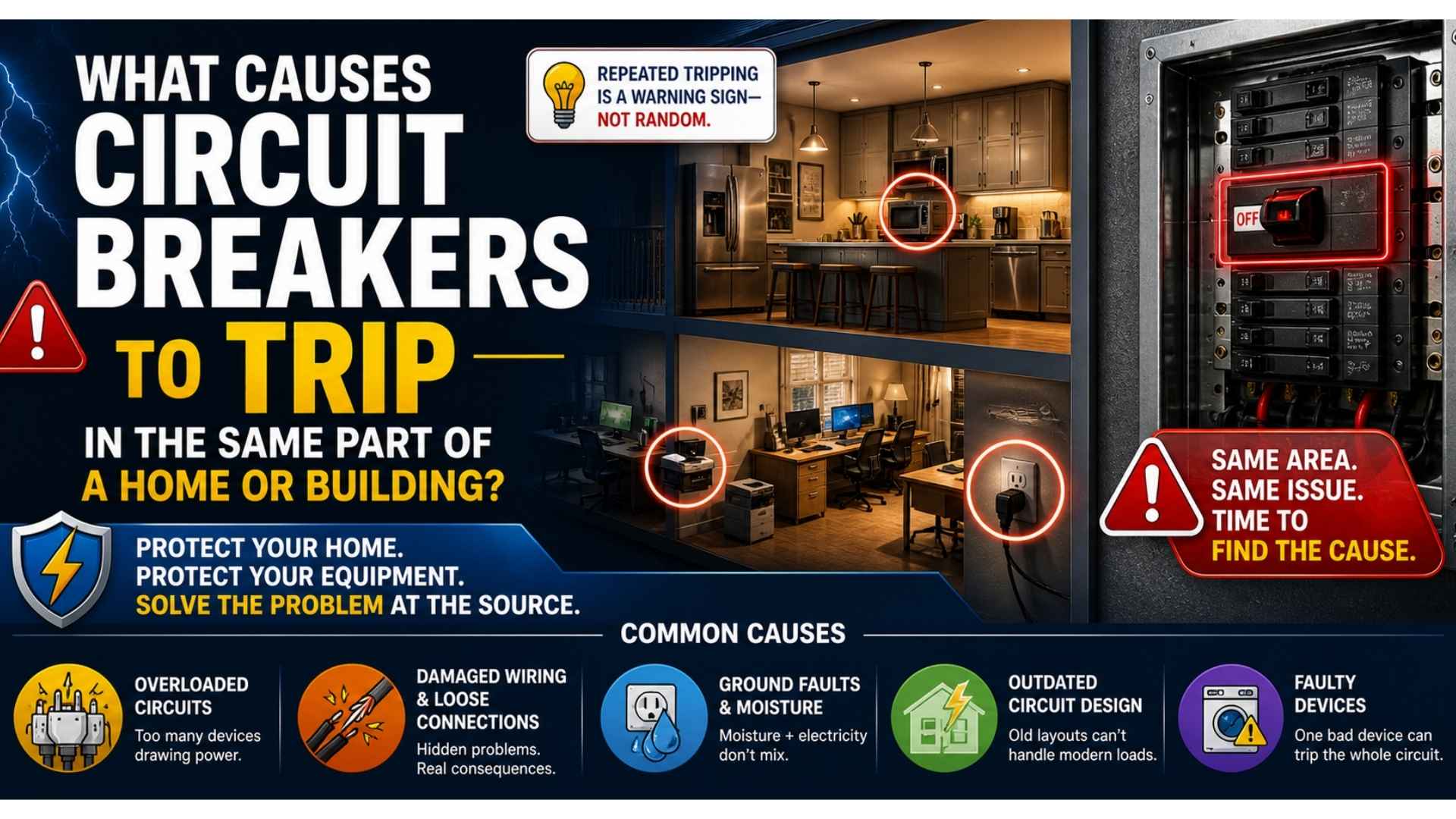
When circuit breakers trip repeatedly in the same part of a home or building, the pattern usually indicates a localized electrical problem rather than a random event. A kitchen wall, office wing, upstairs bedroom row, or workshop corner may keep going dark because the same circuit is being overloaded beyond its safe capacity. Breakers are designed to shut off power before wires overheat, insulation breaks down, or equipment damage becomes more severe. Repeated tripping in one area is a warning sign that something in that section needs attention, whether the issue comes from connected devices, damaged wiring, or the circuit design itself.
Common causes in one zone
Overloaded Circuits in High-Demand Areas
One of the most common reasons breakers trip in the same section of a building is simple overload. Certain parts of a property draw more electricity than others, especially kitchens, laundry rooms, garages, server rooms, and workspaces filled with plug-in equipment. When several appliances or tools operate simultaneously on the same branch circuit, the electrical demand can exceed the breaker’s rated capacity. The result is a shutoff that may seem sudden but is actually a protective response. In older homes, this problem often appears after years of changing usage patterns. A room that once powered a lamp and a television may now support space heaters, gaming systems, multiple chargers, and office equipment. In commercial settings, the same thing happens when extra printers, microwaves, refrigerators, or workstations are added without redistributing the load. If the same breaker trips whenever activity rises in one area, that circuit may be carrying more than it was originally intended to support, even if no individual device seems unusually large by itself.
Damaged Wiring and Loose Connections Behind the Walls
Repeated tripping in one area of a property can also indicate damaged conductors or failing connections hidden inside walls, ceilings, junction boxes, or outlets. Electricity depends on stable, low-resistance paths, and when those paths become loose or deteriorate, heat begins to build up. A wire that has been pinched, nicked, overheated, or weakened over time can cause intermittent issues that only show up when a particular room or branch is heavily used. Loose terminations at outlets, switches, breakers, or splices may also cause arcing, which can make a breaker trip even when the electrical load does not appear excessive. In some cases, the affected zone may show signs such as flickering lights, warm cover plates, buzzing sounds, or a faint burning smell before the breaker trips. Trade discussions in Electrical Contractor Magazine often highlight how recurring trips in one section can trace back to unnoticed connection failures rather than a faulty breaker alone. Because these issues are hidden, the same hallway, room cluster, or equipment area may continue to experience shutdowns until the point of damage is identified and corrected.
Ground Faults and Moisture Around Specific Locations
Some localized breaker problems are caused by ground faults, particularly in areas where wiring and moisture are more likely to meet. Bathrooms, kitchens, basements, exterior walls, utility rooms, and outdoor receptacles are all more exposed to humidity, condensation, leaks, or direct water contact. When electricity strays from its intended path and moves toward ground, the breaker or protective device may trip to reduce the risk of shock, overheating, or equipment damage. This is why one part of a home may repeatedly lose power after rain, during humid weather, or when a particular appliance turns on. A dishwasher, sump pump, outdoor lighting circuit, or bathroom receptacle may seem to work at times, only to suddenly trip because insulation has degraded or moisture has entered a box, cable run, or connected device. The location pattern matters here. If the same side of a building, the same floor, or the same utility area keeps experiencing interruptions, the problem may be tied less to total demand and more to environmental conditions that affect that electrical section consistently.
Outdated Circuit Design and Changes in Building Use
A circuit breaker that trips repeatedly in one area may also indicate a mismatch between the building’s original electrical layout and how the space is used today. Many residential and commercial systems were designed for past habits, not modern equipment density. An older bedroom circuit may now support office electronics, portable climate control units, and entertainment systems. A storefront back room may now contain refrigeration, charging stations, and task lighting that were never part of the original plan. Even if the wiring is intact, repeated trips can occur because one breaker serves too many outlets or too broad an area for present-day demands. Renovations can make this worse if additions are tied into existing circuits without enough evaluation of load distribution. In some cases, the repeated tripping is not caused by a failure at all but by a circuit doing its job in a layout that no longer fits the property. When one section of a building consistently shuts down under normal use, the electrical design may need to be updated to bring capacity and usage back into alignment.
Faulty Devices Can Trigger the Same Breaker
Another reason a breaker keeps tripping in the same part of a home or building is that the problem may one caused by a single connected device rather than the fixed wiring alone. A worn appliance motor, a damaged power cord, a failing compressor, or an internal short in a piece of equipment can place irregular stress on the circuit every time it starts up. This is why a breaker may seem fine for hours and then trip the moment a microwave begins heating, a copier starts cycling, a vacuum is plugged in, or a portable heater is switched on. In mixed-use spaces, the same outlet group may serve several devices, making it easy to blame the whole circuit when one faulty item is actually creating the trouble. Repeated trips at a particular time of day or during a particular activity often point in this direction. If the breaker trips whenever the same machine, appliance, or tool is used in that area, the electrical issue may be with the load itself. Isolating equipment one by one can reveal whether the real cause is a malfunctioning device forcing the breaker to trip repeatedly.
Why the Pattern Should Not Be Ignored
A breaker that trips in the same part of a home or building is more than an inconvenience. It is a visible signal that the electrical system is responding to a recurring condition at a defined location. That condition may involve overloading, wiring damage, loose connections, moisture-related faults, or an outdated circuit layout that no longer matches the property’s current use. The important detail is the pattern itself. When the same zone keeps losing power, the issue is usually concentrated there, not spread randomly across the entire building. Identifying the exact cause early can help prevent overheating, equipment damage, and a growing strain on the system.