
Packaging is a critical step between a product and the conditions it will face during storage, transit, and handling. A box that collapses under stacking pressure, a corrugated sheet that gives way during transport, or a carton that fails at the seam does not just damage the product inside. It damages the trust a customer places in the business that shipped it. For packaging manufacturers and businesses that depend on packaging quality, the ability to verify material strength before it reaches that critical moment is not a luxury. It is a fundamental requirement.
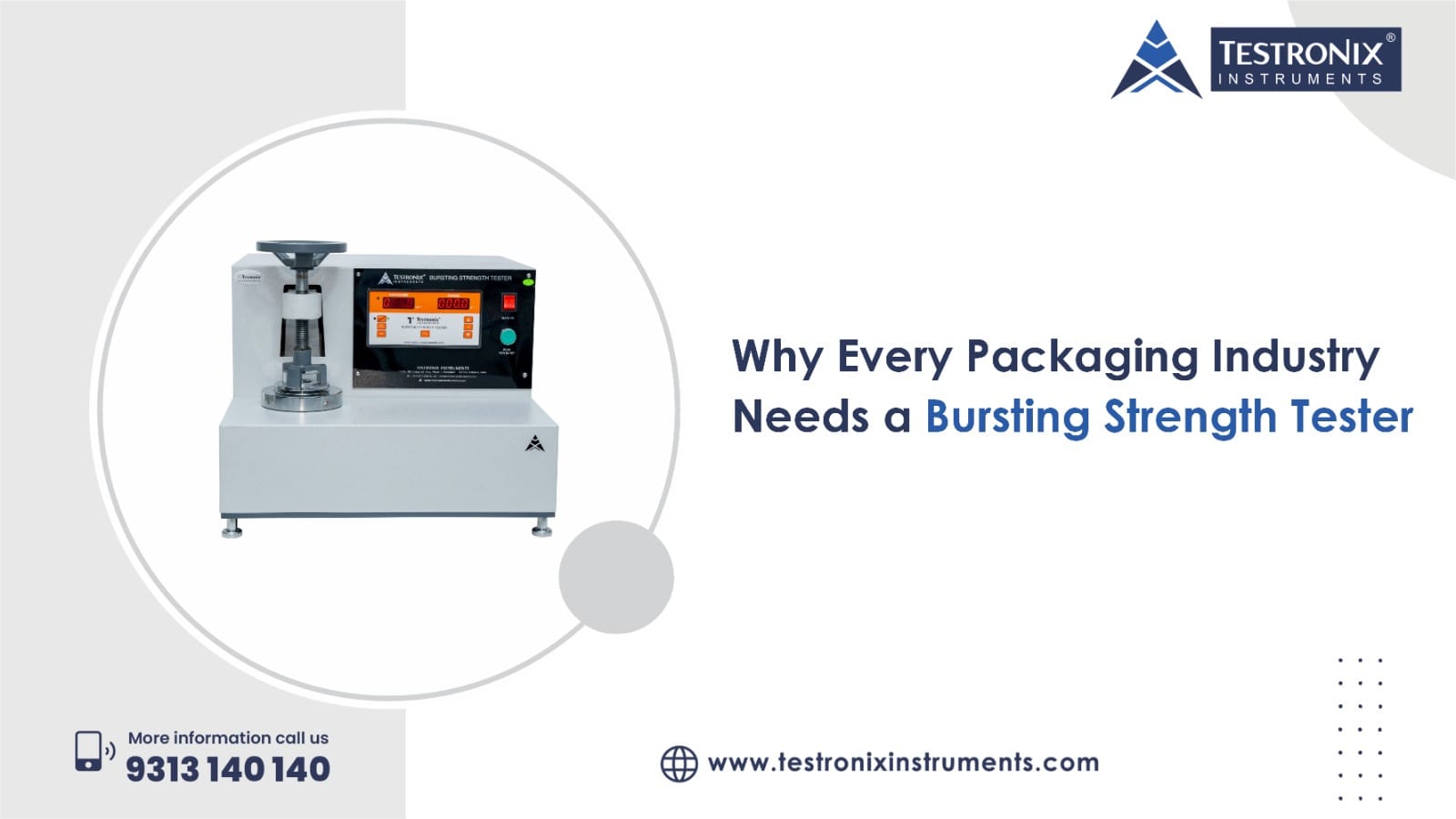
Bursting strength tester measures exactly how much pressure a packaging material can withstand before it ruptures. This single value, known as the bursting strength, tells a quality team whether the material being used is capable of handling the real-world demands placed on it. It is one of the most relevant indicators of packaging performance, and for businesses operating in this space, having reliable access to this measurement is what separates consistent quality from recurring failure.
The Real Cost of Packaging That Cannot Handle Pressure
Packaging failures rarely happen in isolation. When a corrugated box gives way during transit, it is usually not just one box. It is a pallet, a shipment, or an entire batch that has been produced from the same material lot. The direct cost involves damaged goods, replacement shipments, and customer complaints. The indirect cost involves production time lost to investigation, supplier disputes that stretch over weeks, and the reputational impact of delivering products in poor condition.
For packaging manufacturers supplying to retail, e-commerce, pharmaceutical, or industrial clients, the consequences extend further. Clients who experience repeated packaging failures do not stay. They move to suppliers who can demonstrate consistent material quality. In a competitive market where packaging performance is increasingly tied to brand perception, the ability to verify and guarantee bursting strength before dispatch is a genuine business differentiator.
What a Bursting Strength Tester Actually Measures
A bursting strength tester works by applying hydraulic or pneumatic pressure to a material sample through a rubber diaphragm until the material ruptures. The pressure at which rupture occurs is recorded as the bursting strength value. For paper and paperboard, this is expressed in kilopascals. For corrugated boards and cartons, it serves as a direct indicator of how well the packaging will hold up under compression, impact, and stacking loads.
This measurement is relevant across a wide range of packaging materials including kraft paper, duplex boards, multilayer cartons, corrugated sheets, and woven sacks. Each of these materials serves a different application, and each has a defined bursting strength requirement that must be met for the packaging to perform reliably. A bursting strength tester gives quality teams a fast, objective, and repeatable way to verify these requirements at any stage of the production or procurement process.
Testronix Instruments, a pioneering manufacturer and supplier of bursting strength testers, develops equipment that addresses the complete spectrum of packaging material testing requirements. Their testers are built for ease of use on the production floor while delivering the measurement accuracy that quality-focused businesses depend on.
Also Read:
- Automatic Capping Machine: The Complete Guide
- How Engineering Principles Influence Smarter Used Vehicle Purchases
- What is Computer Aided Manufacturing – CAM?
Where Bursting Strength Testing Fits in the Production Workflow
For the packaging industry, bursting strength testing is most effective when it is built into three stages of the workflow. By using reliable paper packaging testing instruments, manufacturers can evaluate the strength and durability of paper rolls, boards, or sheets during incoming raw material inspection. This first proactive testing approach prevents situations where a full production run is completed using material that was never strong enough to begin with.
The second stage is in-process testing, where samples from ongoing production are tested at defined intervals to ensure that the converted material continues to meet the required bursting strength. The third is finished product inspection, where final packaging units are verified before they leave the facility. Together, these three checkpoints create a quality control structure that leaves very little room for a packaging failure to reach the customer.
Businesses that rely on external laboratories for this testing face a fundamental limitation: turnaround time. Production decisions cannot wait for lab reports that arrive days later. Having a bursting strength tester in-house removes this bottleneck entirely and puts quality decisions where they belong, in the hands of the team managing the production floor.
Builds Customer Confidence Through Verified Quality
Packaging clients, particularly in sectors like food and beverage, pharmaceuticals, and consumer goods, are increasingly asking their suppliers to demonstrate quality through data rather than simply providing material certificates. When a packaging manufacturer can present bursting strength test results for each production batch, it signals a level of quality seriousness that most clients actively value.
This kind of documented quality assurance strengthens existing client relationships and makes it easier to win new ones. It also provides a practical basis for resolving any quality dispute that may arise, since the test data serves as an objective reference point rather than leaving both parties to rely on claims and counterclaims.
Testronix Instruments supports packaging industries in building this kind of credibility. Known as a trusted manufacturer of bursting strength testers aligned with international quality benchmarks, their equipment generates consistent and documented results. With Testronix Instruments, businesses can confidently share with clients and use them to support their quality records.
Why Businesses Should Invest in Bursting Strength Tester
Some packaging businesses hesitate to invest in testing equipment because they view it as an added operational cost. This perspective changes quickly when the cost of a single large-scale packaging failure is calculated against the cost of the tester itself. The equipment pays for itself not by producing anything but by preventing the kind of failures that are far more expensive than any testing investment.
Beyond cost prevention, an in-house bursting strength tester also improves procurement decisions. When a manufacturer tests material from multiple suppliers and tracks performance over time, they develop a clear picture of which suppliers consistently deliver quality and which ones require tighter monitoring. This data-driven approach to supplier management reduces the unpredictability that often drives rejection rates and production disruptions.
For businesses looking for reliable equipment to support this process, Testronix Instruments offers bursting strength testers built for the operational demands of active manufacturing environments. Their solutions are trusted by packaging manufacturers who treat quality control as a core part of how they run their business rather than an afterthought.
Conclusion
The packaging industry runs on trust. Clients trust that the boxes, cartons, and sheets they receive will do the job they were designed for. That trust is built through consistent quality, and consistent quality does not happen by chance. It is the result of deliberate testing, reliable equipment, and a quality team that has the tools to catch problems before they leave the facility.
A bursting strength tester is not a complex addition to a packaging operation. It is a straightforward, high-value tool that gives businesses control over one of the most critical performance characteristics of their product. For any packaging business that takes its quality commitments seriously, having one is simply part of doing the job right.