
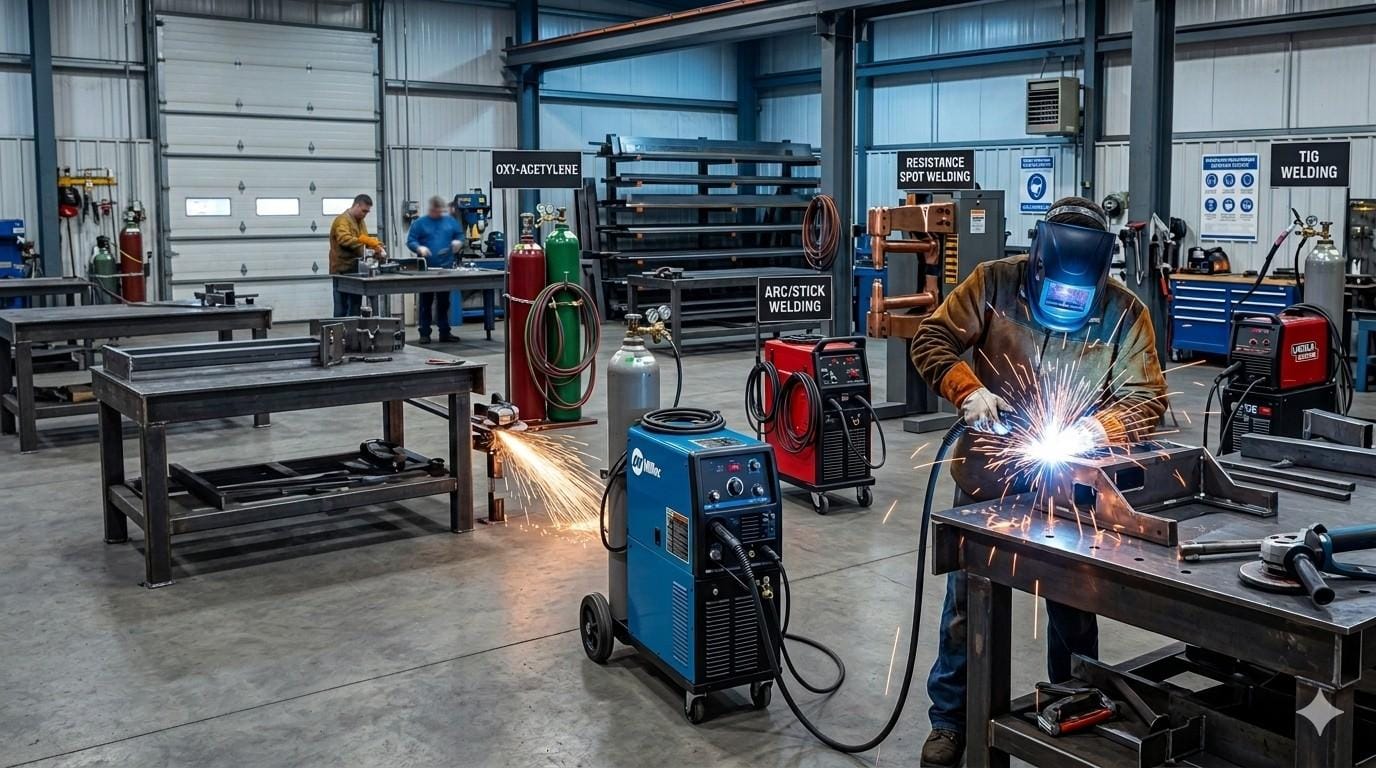
A welding machine is a crucial device used to join two or more metal parts by applying heat, pressure, or both. The process involves melting the base metal and, in some cases, a filler material to create a strong and durable joint. Welding is essential in industries like construction, automotive, shipbuilding, and manufacturing, where precision and strength are critical. Modern machines provide precise control over voltage, current, and speed, allowing high-quality welds for a variety of applications.
Types of Welding Machines
Welding machines are classified based on the welding process they support. Each type has specific applications, advantages, and limitations. Choosing the right machine is essential for efficiency and quality in industrial work.
1. Arc Welding Machines
Arc welding machines use an electric arc to generate heat for melting metals. Main types include:
Shielded Metal Arc Welding (SMAW) Machines: Also called stick welders, they use consumable electrodes coated with flux. They are ideal for heavy construction and repair work.
Gas Metal Arc Welding (GMAW / MIG) Machines: MIG welders use a continuous wire electrode and shielding gas to produce clean, strong welds.
Flux-Cored Arc Welding (FCAW) Machines: Similar to MIG welding but with a flux-cored wire, suitable for thick metals and outdoor conditions.
For factories and large-scale projects, a welding machine for industrial use usually refers to robust arc welding machines that can handle heavy workloads and continuous operation. These machines are designed to provide consistent performance and durability in demanding industrial environments.
2. TIG Welding Machines (Tungsten Inert Gas)
TIG welding machines use a non-consumable tungsten electrode with inert gas shielding. They produce precise, clean welds on thin metals, stainless steel, and aluminum.
3. Plasma Arc Welding Machines
These machines generate a high-velocity jet of ionized gas, called plasma, to melt metal. Plasma arc welding provides high precision and is commonly used in aerospace and advanced manufacturing.
4. Resistance Welding Machines
These machines generate heat through electrical resistance at the joint. Types include:
Spot Welding Machines: Join sheet metals at discrete points and are widely used in automotive production.
Seam Welding Machines: Produce continuous welds along seams and are often used in tanks and pipe fabrication.
5. Oxy-Acetylene Welding Machines
These machines use a flame from burning acetylene with oxygen to melt metals. They are used for cutting, brazing, and welding, especially in repair work where electric welding is not practical.
Conclusion
Welding machines are indispensable tools in modern metalworking and fabrication. Understanding the different types: arc, TIG, MIG, plasma, resistance, and oxy-acetylene helps industries select the right equipment for specific applications. A welding machine ensures reliable, efficient, and high-quality welds, making it an essential investment for construction, manufacturing, and heavy engineering projects.