
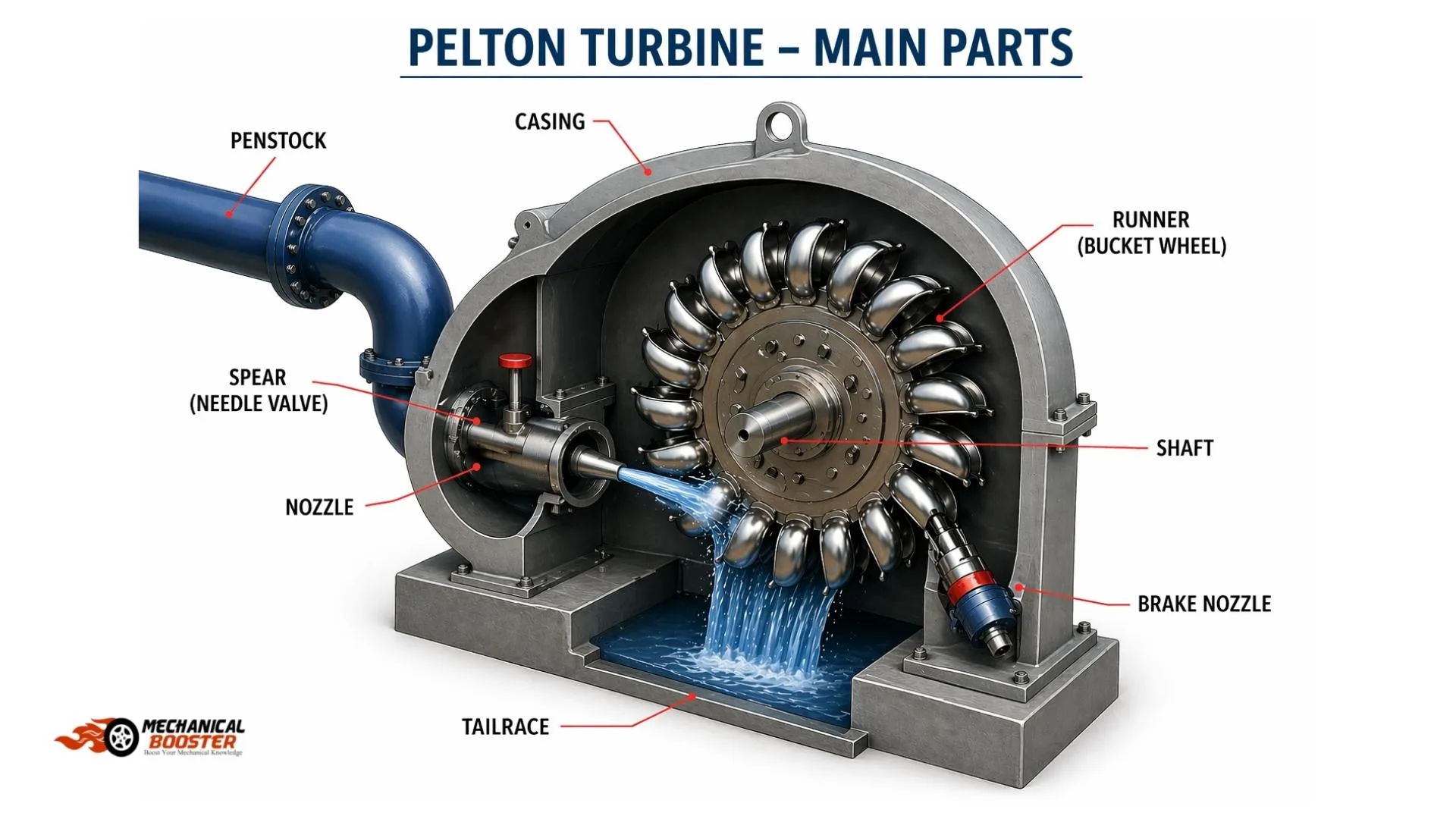
A Pelton turbine is a type of impulse turbine used to generate power from high-head water sources. It is widely used in hydroelectric power plants where water is available at a high elevation but with relatively low flow rates. Unlike reaction turbines, the Pelton turbine converts the entire kinetic energy of a high-speed water jet into mechanical energy using specially designed buckets.
This turbine plays a crucial role in mountainous regions and dams, where it efficiently harnesses water energy to produce electricity. Its simple design, high efficiency, and reliability make it one of the most important turbines in modern power generation systems.
What is a Pelton Turbine?
A Pelton turbine is an impulse-type hydraulic turbine in which water strikes the runner buckets in the form of high-velocity jets. The pressure of water remains atmospheric throughout the process, and only kinetic energy is utilized.
Working Principle of Pelton Turbine
The Pelton turbine works on the principle of Newton’s second law of motion (change in momentum).
Step-by-Step Working:
- Water stored at a height (reservoir) flows through a penstock.
- The water is converted into a high-speed jet using a nozzle.
- This jet strikes the buckets (vanes) mounted on the runner.
- The shape of the buckets splits the jet into two streams and changes its direction by nearly 180°.
- Due to the change in momentum, force is exerted on the buckets.
- This force rotates the runner connected to a shaft.
- The shaft drives a generator to produce electricity.
Key Insight:
- No pressure change occurs in the runner.
- Only kinetic energy is converted into mechanical energy.
Main Parts of Pelton Turbine
1. Nozzle
- Converts pressure energy into kinetic energy.
- Produces a high-velocity jet of water.
2. Runner and Buckets
- Runner is mounted on a shaft.
- Buckets are double-cup shaped with a splitter.
- They efficiently deflect water jet.
3. Casing
- Prevents water splashing.
- Guides water to the tailrace.
4. Spear (Needle Valve)
- Controls flow rate of water.
- Moves forward/backward to regulate jet.
5. Brake Nozzle
- Stops the turbine quickly by directing water on the backside of buckets.
6. Penstock
- Pipe that carries water from reservoir to turbine.
Also Read:
- Difference Between Gas Turbine and Steam Turbine
- What is Gas Turbine Power Plant?
- Difference Between Impulse and Reaction Turbine
Efficiency of Pelton Turbine
Pelton turbines are highly efficient, with efficiencies reaching up to 85–90% under ideal conditions.
Factors Affecting Efficiency:
- Jet Velocity: Higher jet velocity increases the kinetic energy available to strike the buckets. It ensures maximum force transfer and improves turbine efficiency.
- Bucket Design: Properly shaped double-cup buckets split and deflect the jet efficiently. This minimizes energy loss and enhances performance.
- Flow Rate: An optimum flow rate ensures smooth and continuous turbine operation. Too high or too low flow reduces efficiency.
- Head of Water: Higher water head produces greater jet velocity and pressure. This directly increases power output and overall efficiency.
Advantages of Pelton Turbine
- High efficiency at high heads
- Simple construction and easy maintenance
- Suitable for low discharge conditions
- No cavitation problem
- Long operational life
Disadvantages of Pelton Turbine
- Not suitable for low head applications
- Requires high initial installation cost
- Limited to specific site conditions (mountainous regions)
Applications of Pelton Turbine
Major Uses:
- Hydroelectric power plants in hilly areas
- Small-scale hydroelectric systems
- Renewable energy projects in remote locations
- Industrial power generation using water sources
Pelton Turbine vs Other Turbines
| Feature | Pelton Turbine | Francis Turbine | Kaplan Turbine |
| Type | Impulse | Reaction | Reaction |
| Head | High | Medium | Low |
| Flow Rate | Low | Medium | High |
| Efficiency | High | High | High |
Conclusion
The Pelton turbine is one of the most efficient and reliable hydraulic turbines used for high-head power generation. Its ability to convert kinetic energy of water into mechanical energy with minimal losses makes it ideal for mountainous and high-altitude regions. Understanding its working, components, and applications helps in grasping how modern hydroelectric systems operate. As renewable energy demand continues to grow, Pelton turbines will remain a key technology in sustainable power generation systems.