
A positive displacement pump (PDP) is a type of pump that moves fluid by trapping a fixed volume and forcing (displacing) it into the discharge pipe. Unlike centrifugal pumps, it delivers a constant flow rate regardless of pressure variations, making it highly reliable for precise fluid handling. These pumps are widely used in industries such as oil & gas, chemical processing, food production, and hydraulic systems where accurate flow control is essential.
The working principle is simple: fluid enters an expanding cavity at the suction side and is pushed out as the cavity decreases. Common mechanisms include pistons, plungers, diaphragms, and rotating elements. Understanding PDPs is important for selecting the right pump for high-pressure, viscous, or metered flow applications.
What is a Positive Displacement Pump?
A positive displacement pump works by:
- Capturing a fixed quantity of fluid
- Physically displacing it from inlet to outlet
- Delivering nearly constant flow per cycle
Simple Example: Syringe
Think of a syringe:
- Pulling the piston → cavity expands → fluid enters
- Pushing the piston → cavity shrinks → fluid exits
This same principle is used in all PDPs.
Working Principle of Positive Displacement Pump

The operation involves two main stages:
1. Suction Stage
- Cavity expands
- Pressure inside decreases
- Fluid is drawn into the pump
2. Discharge Stage
- Cavity contracts
- Pressure increases
- Fluid is pushed out
This continuous cycle ensures steady and controlled flow.
Types of Positive Displacement Pumps
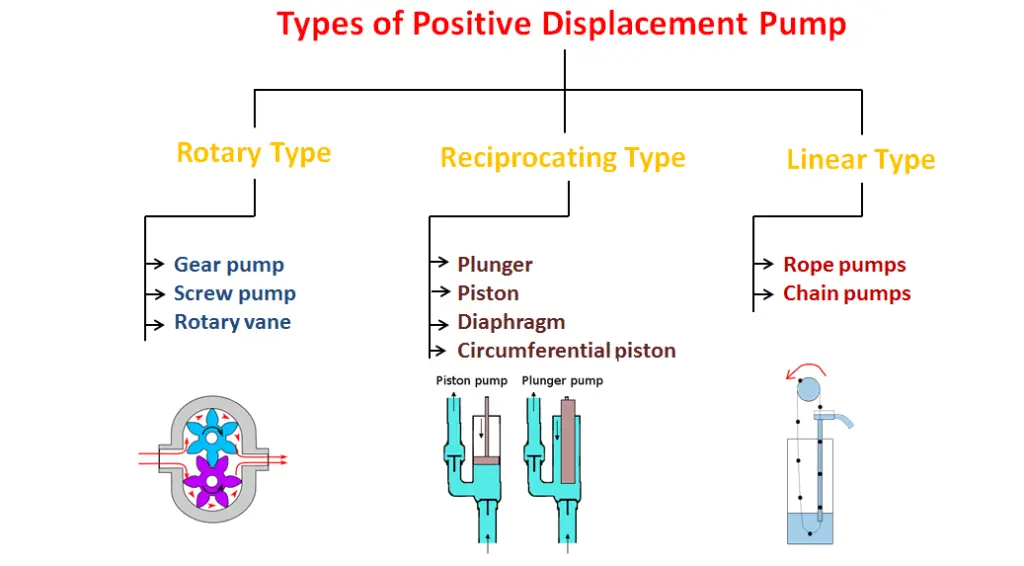
Positive displacement pumps are mainly classified based on their working mechanism:
1. Rotary Type Positive Displacement Pump
A rotary type positive displacement pump is a pump in which fluid is moved using rotating components that trap and transfer a fixed volume of liquid from the suction side to the discharge side. Unlike reciprocating pumps, these pumps provide a smooth, continuous, and pulse-free flow, making them ideal for handling viscous fluids like oils, chemicals, and syrups.
They are widely used in industries such as lubrication systems, fuel transfer, food processing, and hydraulics. Their compact design, high efficiency, and ability to operate at moderate pressures make them one of the most commonly used positive displacement pumps.
These pumps use rotating components to move fluid.
Working
- Rotating parts trap fluid
- Fluid is carried from inlet to outlet
- Continuous flow is achieved
Main Types
1. Gear Pump
- Uses two rotating gears
- Fluid is trapped between gear teeth and casing
- Suitable for oils and lubricants
2. Screw Pump
- Uses intermeshing screws
- Smooth, pulse-free flow
- Ideal for viscous fluids
3. Rotary Vane Pump
- Rotor with sliding vanes
- Vanes trap and move fluid
- Used in vacuum systems and fuel transfer
Common Applications
- Fuel systems
- Lubrication systems
- Hydraulic machinery
Also Read:
- Different Types of Pumps Used in the World
- What is Reaction Turbine – Principle, Working, Main Components and Application
- Types of Wind Turbines – Horizontal Axis and Vertical Axis Wind Turbines
2. Reciprocating Type Positive Displacement Pump
A reciprocating type positive displacement pump is a pump that moves fluid using a back-and-forth (reciprocating) motion of a piston, plunger, or diaphragm. It delivers a fixed amount of fluid per cycle, making it highly accurate and suitable for high-pressure, low-flow applications.
These pumps are widely used in industries such as boiler feed systems, oil & gas, chemical dosing, and hydraulic systems where precise flow control and high pressure are required. Unlike rotary pumps, reciprocating pumps operate in strokes, which may produce a pulsating flow but offer excellent efficiency.
These pumps use a back-and-forth (reciprocating) motion.
Working
- Piston/plunger moves forward and backward
- Valves control suction and discharge
Types
1. Single Acting Pump
- Suction in one stroke
- Discharge in another
2. Double Acting Pump

- Suction and discharge occur in both strokes
- Higher efficiency
Based on Mechanism
- Plunger Pump – High pressure applications
- Piston Pump – General fluid transfer
- Diaphragm Pump – Leak-proof, ideal for hazardous fluids
Key Features
- High pressure capability
- Low flow rate
- Precise fluid delivery
Applications
- Boiler feed systems
- Oil pipelines
- Chemical dosing
3. Linear Type Positive Displacement Pump
A linear type positive displacement pump is a pump in which fluid is moved in a straight-line (linear) motion rather than by rotation or reciprocation. It works by continuously lifting or displacing a fixed quantity of fluid through mechanical elements like ropes, chains, or buckets moving along a linear path.
These pumps are simple, reliable, and often used in low-cost water lifting applications, especially in rural or agricultural areas. Unlike rotary and reciprocating pumps, linear pumps are designed for low flow rate and low-pressure systems, making them ideal for manual or semi-mechanical operations.
Working Principle of Linear Pump
The working can be understood in simple steps:
1. Fluid Capture
- Moving element (rope or chain) enters the fluid source
- Fluid gets trapped in pockets or between discs/buckets
2. Linear Movement
- The element moves upward or forward
- Fluid is carried along with it
3. Discharge
- Fluid reaches the outlet
- It is released into a storage tank or channel
These pumps move fluid in a straight line.
Examples
- Rope pumps
- Chain pumps
Applications
- Water lifting in rural areas
- Low-cost irrigation systems
List of Common Positive Displacement Pumps
- Gear pump
- Screw pump
- Piston pump
- Diaphragm pump
- Rotary vane pump
- Progressive cavity pump
- Peristaltic pump
- Hydraulic pump
- Flexible impeller pump
Advantages of Positive Displacement Pumps
- Constant flow rate
- High efficiency at high pressure
- Suitable for viscous fluids
- Self-priming capability
- Accurate metering
Disadvantages of Positive Displacement Pumps
- Not suitable for very high flow rates
- Requires safety relief valves
- More maintenance than centrifugal pumps
- Pulsating flow (in reciprocating types)
Applications of Positive Displacement Pumps
- Oil and gas industry
- Chemical processing
- Food and beverage industry
- Hydraulic systems
- Pharmaceuticals
- Water treatment
Positive Displacement Pump vs Centrifugal Pump
| Feature | Positive Displacement Pump | Centrifugal Pump |
| Flow Rate | Constant | Varies with pressure |
| Pressure | High | Moderate |
| Fluid Type | Viscous fluids | Low-viscosity fluids |
| Efficiency | High | Moderate |
| Operation | Mechanical displacement | Rotational energy |
Conclusion
Positive displacement pumps play a critical role in applications requiring precise, consistent, and high-pressure fluid delivery. Their ability to handle viscous fluids and maintain constant flow makes them indispensable across industries. From rotary pumps in lubrication systems to reciprocating pumps in high-pressure applications, each type serves a specific purpose.
Understanding their working principle and types helps in selecting the right pump for efficiency and reliability. For deeper learning, explore related topics like centrifugal pumps and hydraulic systems to build a complete understanding of fluid machinery.