
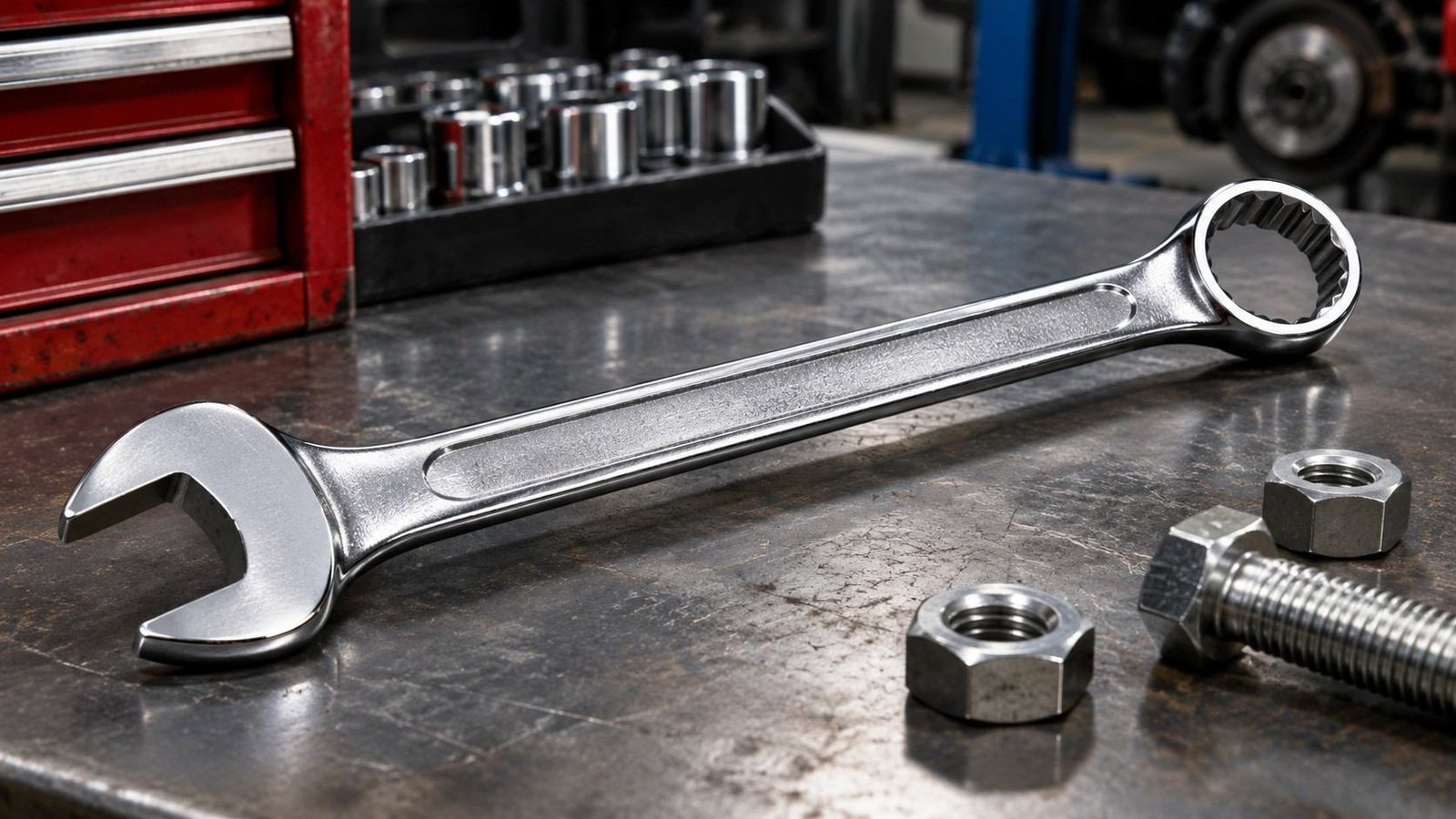
If you’ve ever opened a toolbox, you’ve almost certainly seen a combination wrench. It’s one of the most common hand tools in the world, found in home garages, workshops, and professional mechanics’ kits. But what exactly is a combination wrench, and why is it so popular?
This guide covers what a combination wrench is, how it works, its main types, and how to pick the right one.
What Is a Combination Wrench?
A combination wrench (also called a combination spanner in the UK and India) is a hand tool with two different heads on opposite ends of a single shaft. Both heads fit the same size of nut or bolt:
- One end is an open end, a U-shaped jaw that slides onto a fastener from the side.
- The other end is a box end, a closed ring that wraps fully around the fastener.
Because both ends are the same size, one wrench gives you two ways to work on a single fastener. That is where the name “combination” comes from.
Parts of a Combination Wrench
Open end: The open jaw is usually set at an angle of about 15 degrees to the shaft. This lets you turn a nut in tight spaces by flipping the wrench over and swinging it a short distance each time.
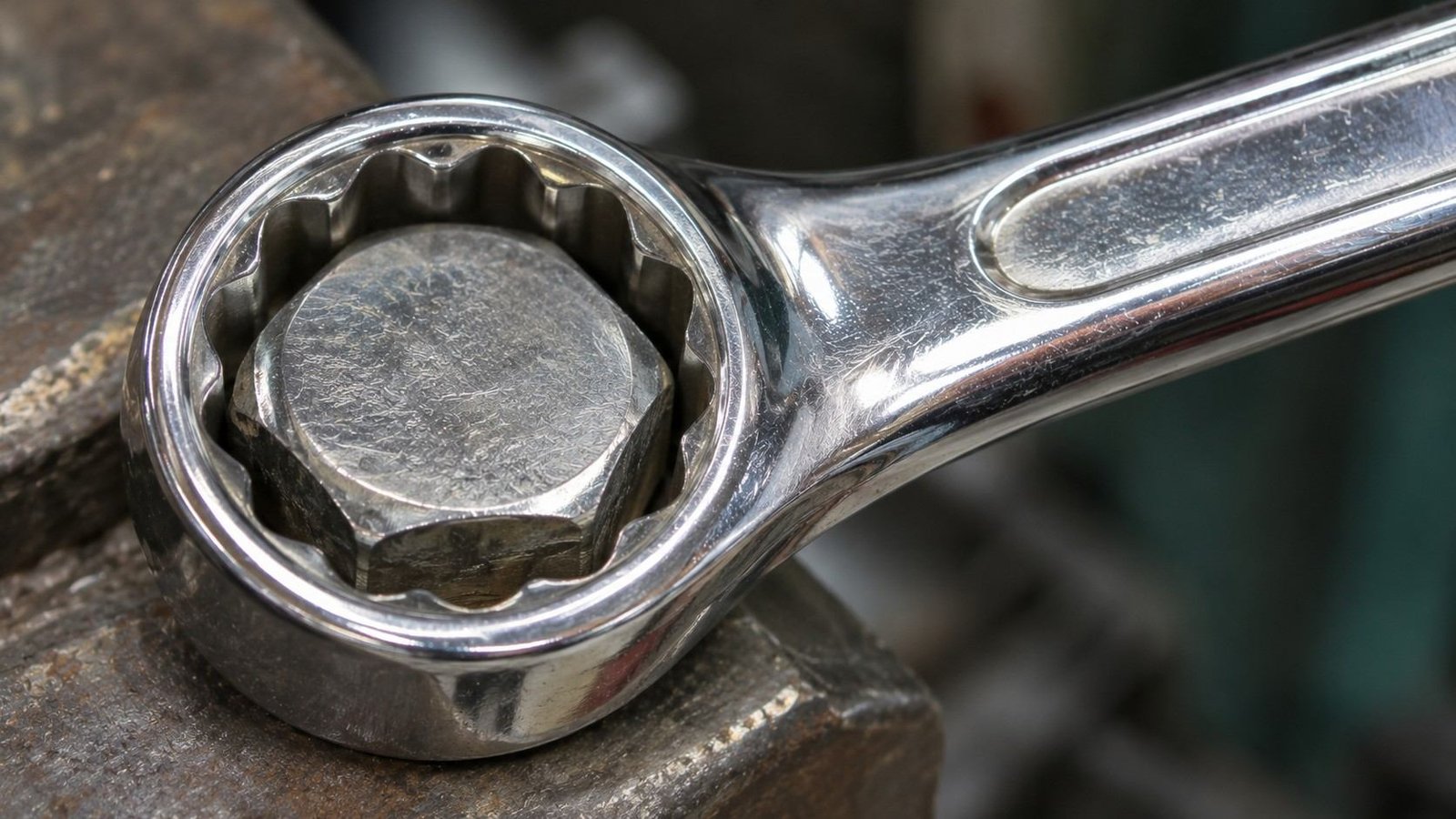
Box end: The closed ring usually has 12 points (a 12-point design), though 6-point versions exist. A 12-point box end can engage a fastener from more positions, which helps in cramped areas. The ring is also offset slightly from the handle to clear nearby obstructions.
Shaft (handle): The long middle section provides leverage. Longer wrenches give more torque but need more room to swing.
How Does a Combination Wrench Work?
The two ends are meant to be used in sequence:
- Use the open end first to quickly spin a fastener that is already loose, or to reach a nut on a long threaded rod or pipe fitting where the box end can’t slide on from above.
- Switch to the box end to break a tight fastener loose or to give a final tightening. The ring grips all sides of the nut or bolt head, so it is less likely to slip or round off the corners.
As a rule of thumb, use the box end whenever you need real force and the open end whenever you need speed or access.
Types of Combination Wrenches
Standard combination wrench
The classic fixed design with an open end and a box end. It’s inexpensive, durable, and works for most jobs.
Ratcheting combination wrench
The box end contains a ratcheting mechanism, so you can turn a fastener without lifting and repositioning the tool. It’s much faster for repetitive work, though the ratcheting end is usually slightly thicker.
Flex-head combination wrench
The ratcheting box end pivots, which helps you reach fasteners at awkward angles.
Stubby combination wrench
A shorter version designed for very tight spaces where a full-length wrench won’t fit.
Long-pattern wrench
A longer handle for extra leverage on stubborn fasteners.
Also Read:
- 24 Most Common Types of Pliers and Their Uses (With Pictures)
- What is a Wrench? Types, Uses, Definition & Working
- 37 Different Types of Hammers and Their Uses (With Pictures)
Combination Wrench Sizes: Metric vs. SAE
Combination wrenches come in two measurement systems:
- Metric: Sized in millimetres (for example, 8 mm, 10 mm, 13 mm, 17 mm). Common in most of the world and on newer vehicles and machinery.
- SAE (imperial): Sized in fractions of an inch (for example, 1/4″, 3/8″, 9/16″). Common on older American equipment.
Always match the wrench to the fastener exactly. A wrench that is even slightly too large can slip and round off the corners of a bolt head.
A combination wrench set is usually the best starting point. Typical metric sets cover roughly 6 mm to 24 mm, which handles most household, automotive, and bicycle repairs.
Combination Wrench vs. Other Wrenches
| Wrench type | Key feature | Best for |
| Combination wrench | Open end + box end, same size | General-purpose work |
| Open-end wrench | Open jaws on both ends (usually different sizes) | Quick access, limited clearance |
| Box-end wrench | Closed rings on both ends | High torque, secure grip |
| Adjustable wrench | Movable jaw fits many sizes | Occasional use, odd sizes |
| Socket wrench | Interchangeable sockets with a ratchet handle | Fast, repetitive turning |
| Flare nut wrench | Box end with a small opening | Brake and fuel lines |
What Is a Combination Wrench Used For?
- Automotive repair: Battery terminals, brackets, exhaust fittings, and engine components
- Bicycle maintenance: Axle nuts, pedals, and accessories
- Plumbing: Compression fittings and supply line connections
- Home DIY: Assembling furniture, equipment, and appliances
- Industrial and machinery work: General maintenance on equipment
How to Choose a Good Combination Wrench
- Material: Look for chrome vanadium (Cr-V) steel. It is strong, resists wear, and handles high torque without bending.
- Finish: A polished or satin chrome finish resists rust and is easy to wipe clean.
- Fit and tolerance: Quality wrenches fit snugly. A loose fit is the main cause of rounded fasteners.
- Markings: Clear, stamped size markings save time, especially when you have a full set.
- Comfort: A well-shaped handle with smooth edges makes extended use easier on your hands.
- Set vs. single: A set is more economical and covers most needs. Buy single wrenches only to fill specific gaps.
Tips for Using a Combination Wrench Safely
- Pull, don’t push. Pulling the wrench toward you gives better control and reduces the risk of injury if it slips.
- Make sure the wrench is fully seated on the fastener before applying force.
- Use the correct size. Never use shims or makeshift packing to make a wrench fit.
- Don’t add a pipe to the handle. Extending the handle can overload and damage the tool.
- Don’t use it as a hammer. Combination wrenches are not designed for striking.
- Keep wrenches clean and dry to prevent corrosion and keep your grip secure.
Frequently Asked Questions
It is a general-purpose tool for tightening and loosening nuts and bolts. The open end is quick and easy to position, while the box end provides a stronger, more secure grip.
They are essentially the same tool. “Spanner” is the common term in the UK and India, while “wrench” is used in North America. A combination spanner and a combination wrench are the same thing.
Yes. Unlike double open-end or double box-end wrenches, both ends of a combination wrench fit the same size of fastener.
A 12-point design lets the wrench engage the fastener at more angles, so you need less swing room. A 6-point box end grips the flats of a hex head more firmly and is less likely to round off damaged fasteners.
For most jobs, yes. A fixed-size combination wrench fits more precisely, grips more securely, and is less likely to slip than an adjustable wrench. An adjustable wrench is handy as a backup for odd sizes.
Final Thoughts
A combination wrench pairs an open end and a box end in a single, versatile tool. It handles everything from quick loosening to high-torque work, which is why it belongs in nearly every toolbox. Whether you’re a beginner building a basic kit or a seasoned mechanic upgrading your tools, a good set of combination wrenches in both metric and SAE sizes is a smart investment.