
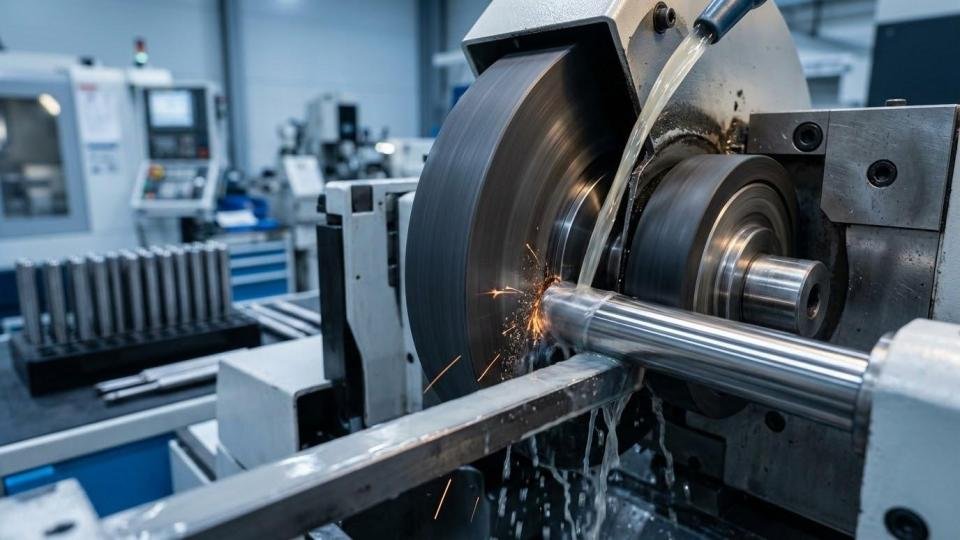
Centerless grinding is a manufacturing process used to finish the outside diameter of cylindrical parts without holding them between centers or gripping them in a chuck. Instead, the workpiece is supported between a grinding wheel, a regulating wheel, and a work rest blade.
The method is widely used for rods, pins, shafts, rollers, bushings, and other cylindrical components. It is especially useful when diameter, roundness, straightness, and surface finish need to remain consistent across a production run. For hard materials such as tungsten carbide, it also provides an effective way to bring parts close to final size without relying on conventional cutting alone.
1. What Centerless Grinding Is and Why It Matters
Centerless grinding removes material from a cylindrical workpiece without locating the part between fixed centers. The workpiece rests on a support blade between two rotating wheels. The grinding wheel performs the cutting action, while the regulating wheel controls rotation and feed.
For manufacturers working with hard, wear resistant materials, centerless grinding is often an important part of tungsten carbide machining services because carbide responds well to abrasive finishing when close dimensional control is required. The process is particularly useful for straight rods, precision pins, and similar components where conventional workholding would slow production.
Its main advantage is repeatability. Once the machine is correctly set, many parts can be processed with consistent outside diameter and less handling.
2. The Three Main Components of the Process
The basic operating principle depends on three main components.
- Grinding wheel. The abrasive wheel removes material from the workpiece.
- Regulating wheel. This wheel controls part rotation and, during throughfeed grinding, helps move the workpiece through the grinding zone.
- Work rest blade. The blade supports and positions the workpiece between the wheels.
Wheel speed, blade height, regulating wheel angle, abrasive selection, and feed rate all affect the finished diameter and surface condition. Because the workpiece is not clamped at its ends, loading is faster and suitable parts can pass continuously through the machine.
3. How the Centerless Grinding Process Works
The workpiece sits on the work rest blade between the grinding wheel and regulating wheel. The two wheels rotate at different speeds.
The faster grinding wheel removes material. The slower regulating wheel controls how quickly the workpiece rotates. In throughfeed grinding, the regulating wheel is set at a slight angle so the part travels through the grinding zone while turning.
Material is removed gradually. Proper setup helps control diameter, roundness, and finish. Incorrect wheel alignment, work height, or feed conditions can create taper, chatter, poor roundness, or an inconsistent surface.
When grinding tungsten carbide, wheel selection is especially important. Diamond abrasives are commonly used for carbide because of the material’s extreme hardness.
4. The Three Common Types of Centerless Grinding
Centerless grinding is generally divided into three methods.
Throughfeed Grinding
Throughfeed grinding is used for straight cylindrical parts without shoulders or major diameter changes. The workpiece enters one side, passes between the wheels, and exits the other. The method suits continuous production of rods, pins, rollers, and simple shafts.
Infeed Grinding
Infeed grinding is used when a part has a shape that prevents it from passing completely through the wheels. The workpiece is placed in the grinding area and the grinding wheel moves into the part. It works well for components with shoulders, multiple diameters, or formed features.
End Feed Grinding
End feed grinding is commonly used for tapered workpieces. The part enters the grinding zone from one end and advances until it reaches the required position.
Each method uses the same centerless principle, but the feeding strategy changes to suit part geometry.
5. Why Centerless Grinding Works Well for Tungsten Carbide
Tungsten carbide combines high hardness with strong wear resistance. Those properties make it valuable for tooling and wear parts, but they also make conventional machining more demanding.
Grinding offers a controlled way to finish carbide after earlier shaping operations. In tungsten carbide machining, centerless grinding can bring cylindrical parts to final outside diameter while improving surface consistency. Common carbide parts that suit the process include:
- Precision rods
- Locating and guide pins
- Tool blanks
- Wear pins
- Punch components
- Cylindrical inserts
When a material is difficult to turn efficiently after sintering, abrasive grinding becomes an important finishing route.
6. Seven Practical Advantages of Centerless Grinding
Centerless grinding remains widely used because it combines precision with production efficiency.
1. Fast Part Loading
Parts do not need to be mounted between centers or clamped in a chuck, reducing handling time.
2. Consistent Outside Diameters
A stable setup can maintain diameter and roundness across repeated parts, which is valuable for components that must fit mating assemblies.
3. Good Support During Grinding
The workpiece is supported close to the point of material removal. Long, slender parts often benefit from this arrangement.
4. Strong Production Efficiency
Throughfeed grinding allows one part to follow another through the machine, making it suitable for medium and high volume work.
5. Fine Surface Finishes
Correct wheel selection, dressing, coolant, and setup can produce smooth, consistent surfaces with little additional finishing.
6. Useful for Hard Materials
The process handles hardened steels, carbide, and other materials that are difficult to finish with ordinary cutting tools. This is one reason it fits naturally into precision tungsten carbide machining.
7. Reduced Fixturing Requirements
Because the part is not held between centers, specialized fixtures are often unnecessary, simplifying repeat production.
7. Important Process Variables That Affect Quality
Centerless grinding is efficient, but setup matters. Several variables deserve close attention.
- Wheel condition. Grinding and regulating wheels need proper dressing and surface condition.
- Work rest blade height. Part position relative to the wheel centers affects roundness and stability.
- Feed rate. Excessive feed can reduce finish quality, while unnecessarily slow feed lowers productivity.
- Coolant delivery. Coolant controls heat and removes grinding debris.
- Abrasive selection. Wheel material and bond need to suit the workpiece.
- Guide alignment. Entry and exit guides need to support smooth travel through the grinding zone.
A sound machine can still produce poor parts if these relationships are wrong. Experienced operators evaluate the whole setup rather than one setting.
8. Where Centerless Grinding Is Commonly Used
The process appears wherever manufacturers need accurate cylindrical components in repeated quantities.
Automotive production uses centerless grinding for shafts, pins, and transmission related components. Tool and die operations use it for punches, guide pins, and tool blanks. Medical manufacturing relies on precision ground rods and small cylindrical parts. Aerospace and energy applications use it for wear components made from demanding materials.
It is also common in carbide production. A shop handling tungsten carbide machining can use centerless grinding as one stage in a broader process that includes material selection, rough shaping, EDM, cylindrical grinding, surface grinding, inspection, and finishing.
9. When Centerless Grinding Is the Right Choice
Centerless grinding is most effective when a part is cylindrical, outside diameter control is important, and production consistency matters. Straight parts are natural candidates for throughfeed grinding. Parts with shoulders or changing profiles usually require infeed methods or another grinding process.
Manufacturers also consider part length, diameter, material, tolerance, surface finish, and quantity. Complex geometries, interrupted surfaces, deep shoulders, or features requiring precise axial location can favor cylindrical grinding or other methods.
The best process plan often combines operations. A carbide component can be shaped by EDM, brought close to size through grinding, and then inspected against final print requirements.
Centerless Grinding as Part of Precision Manufacturing
Centerless grinding solves a common manufacturing problem by producing accurate cylindrical surfaces without complicated workholding. Its grinding wheel, regulating wheel, and work rest blade work together to control material removal, part rotation, and support.
For ordinary steels and demanding carbide components, the process offers repeatability, surface quality, and efficient production. When setup, abrasive selection, feed conditions, and inspection are matched to the part, centerless grinding becomes a dependable step in a broader precision manufacturing strategy.