
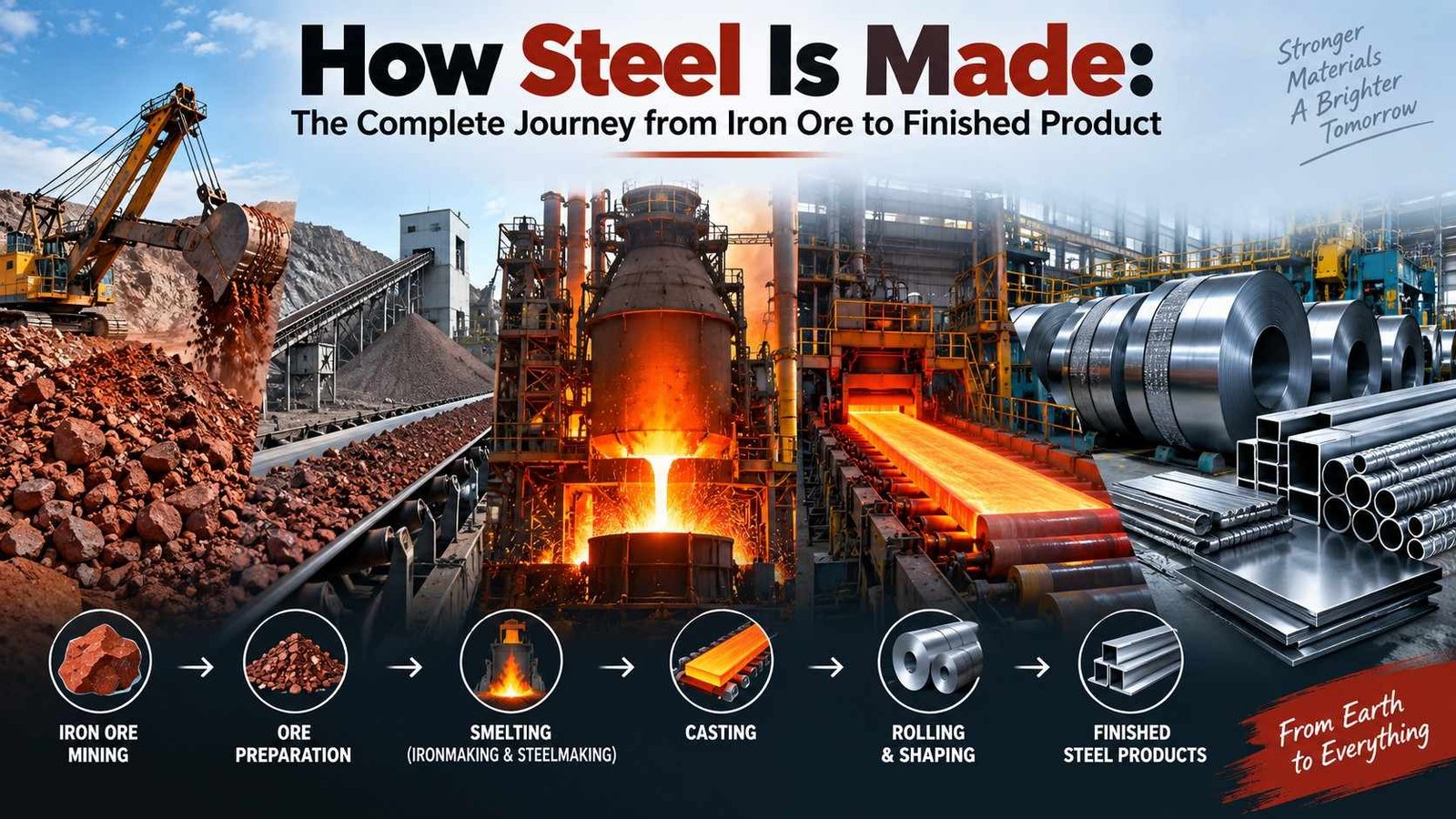
Steel touches almost every part of modern life. It holds up our skyscrapers, forms the frames of our cars, and shows up in the cutlery we use every day. Few materials have shaped civilization as profoundly, with roots stretching back thousands of years to early ironworking cultures in regions like Anatolia and Sri Lanka. Today, steel production is a multi-billion-dollar global industry, but how does a lump of raw rock become the strong, versatile metal we rely on? Let’s break down the entire steel manufacturing process, step by step.
1. Sourcing the Raw Materials
Every batch of steel starts with three essential ingredients:
- Iron ore – reddish-brown rock rich in iron oxide, mined in large quantities in countries such as Australia, Brazil, and China. Depending on its mineral makeup, it can range in color from dark gray to deep red or purple.
- Coking coal – a high-carbon fuel mined primarily in places like the Appalachian region of the United States and parts of Australia.
- Limestone – a widely available mineral used later in the process to help remove impurities.
Together, these three materials form the foundation of virtually all steel produced worldwide.
2. Preparing the Raw Materials
Before iron ore can be turned into steel, it needs to be refined. This preparation stage involves two parallel processes:
Beneficiation of iron ore: The raw ore is crushed into a fine powder and mixed with water to create a slurry. Magnetic separation and flotation techniques are then used to pull out the valuable iron particles and discard non-magnetic waste material, boosting the ore’s overall iron content.
Coking of coal: Coal is heated in special ovens with no oxygen present, a process known as coking. This drives off impurities and increases the coal’s carbon concentration, transforming it into coke, a hard, porous material that plays a critical dual role later in the process.
3. The Blast Furnace: Turning Ore into Molten Iron
This is where the real transformation begins. Inside a blast furnace (a massive structure that can tower more than 30 meters high), iron ore, coke, and limestone are combined and exposed to extreme heat, often exceeding 2,000°C (3,600°F).
Inside this intense heat:
- Coke acts as both fuel and a chemical reducing agent, stripping oxygen atoms away from the iron oxide.
- Limestone acts as a flux, bonding with impurities to form a byproduct called slag, which floats above the molten iron for easy removal.
The result is pig iron, molten iron with a high carbon content. While it’s the first major output of the process, pig iron is too brittle for practical use and needs further refining.
4. Refining Pig Iron into Steel
Pig iron moves next into one of two refining setups:
Basic Oxygen Furnace (BOF): Pure oxygen is blasted into the molten metal, triggering a reaction that burns off excess carbon and releases it as carbon monoxide and carbon dioxide gas.
Electric Arc Furnace (EAF): Commonly used for recycling scrap steel, this method uses powerful electric arcs to melt down scrap metal, also reducing carbon and other impurities in the process.
Both methods give manufacturers precise control over the final chemical composition, allowing them to fine-tune levels of carbon, manganese, silicon, and phosphorus to meet specific performance requirements.
5. Alloying and Ladle Refining
Once carbon content has been reduced to the desired level, manufacturers introduce specific alloying elements to give the steel particular properties:
- Manganese – boosts strength and toughness
- Nickel – improves corrosion resistance
- Chromium – increases hardness and durability
The molten steel then undergoes ladle refining, a finishing step where impurities like sulfur and oxygen are removed through deoxidation and desulfurization. Temperature control is critical here: the steel is typically kept around 1,650°C (3,000°F) to stay molten while inert gases like argon are injected to keep the mixture uniform.
6. Casting the Steel
With its chemistry finalized, the molten steel is cast into a usable shape. There are two main casting methods:
- Continuous casting – the industry standard today. Molten steel is poured into a water-cooled mold, solidifying into slabs, blooms, or billets that move on to further processing. It’s efficient and cost-effective.
- Ingot casting – an older method where steel is poured into large molds, cooled into ingots, then reheated and rolled into shape. It’s more time-consuming and less common in modern operations.
7. Shaping the Steel: Hot and Cold Rolling
After casting, the semi-finished steel goes through primary forming:
Hot rolling passes the still-hot steel through large rollers, shaping it into sheets, plates, bars, or rods while also improving its toughness and ductility. Surface scale (a layer of oxidation from the heating process) is removed using high-pressure water jets or mechanical scale breakers.
Cold rolling, used for certain products, further processes the steel at room temperature to achieve tighter dimensional tolerances and a smoother surface finish. While this increases strength and wear resistance, it can also make the steel more brittle, which is why some grades go through annealing, a controlled heating and cooling process that restores ductility.
8. Applying Protective Coatings
The final step for many steel products is coating, which protects the metal from corrosion and extends its usable life. One of the most common methods is galvanizing, where a protective layer of zinc is applied to the steel’s surface, shielding it from rust and environmental damage.
From Rock to Rebar: A Process Built on Precision
What starts as raw iron ore buried in the earth ends up as precisely engineered steel used in construction, manufacturing, transportation, and countless everyday products. Each stage, from beneficiation and blast furnace smelting to refining, casting, and rolling, is carefully controlled to produce steel with the exact strength, flexibility, and durability required for its intended use.
Understanding this journey highlights just how much science and engineering goes into a material we often take for granted. The next time you walk past a steel-framed building or pick up a stainless steel utensil, you’ll know exactly what it took to get there.
FAQs:
Steel production primarily relies on iron ore, coking coal, and limestone.
A Basic Oxygen Furnace refines molten pig iron using pure oxygen, while an Electric Arc Furnace primarily melts and recycles scrap steel using electric arcs.
Limestone acts as a flux, bonding with impurities in molten iron to form slag, which can then be separated from the pure metal.
Galvanizing coats steel with a layer of zinc to protect it from rust and corrosion, extending its lifespan in outdoor or high-moisture environments.