
What Is Welding?
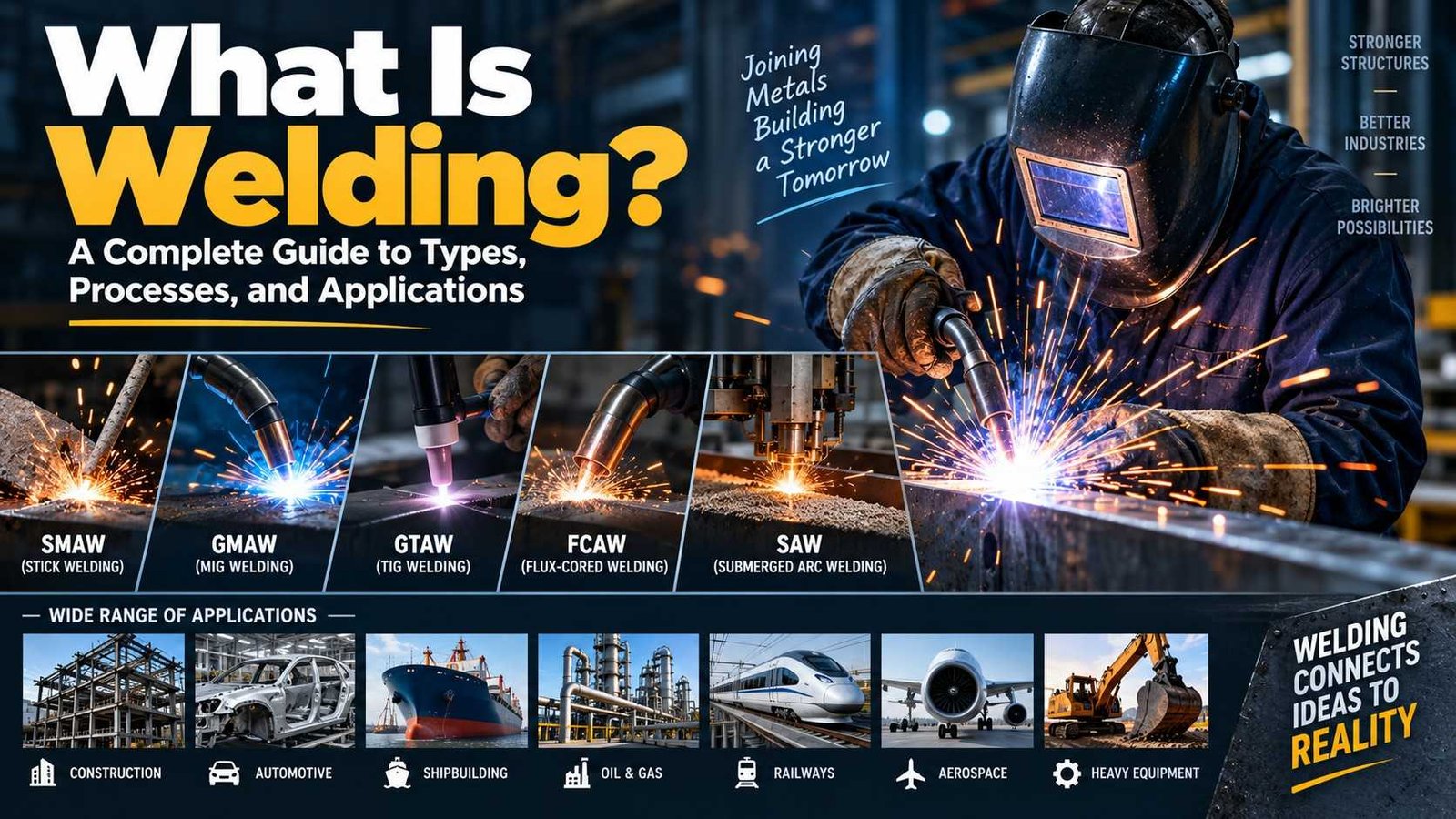
Welding is a manufacturing and fabrication process that permanently joins two or more materials by melting and fusing them together, with or without a filler material. When the molten material cools and solidifies, it forms a joint that is often as strong as – or stronger than – the base materials themselves.
Unlike bolting, riveting, or adhesive bonding, welding creates a metallurgical bond at the atomic level. The atoms of the joined materials intermingle at the weld zone, producing a continuous, unified structure rather than a mechanical connection.
While welding most commonly refers to the joining of metals such as steel, aluminium, and stainless steel, the term also applies to the fusion of thermoplastics used in piping, automotive components, and packaging.
Key Facts About Welding
- Over 30 distinct welding processes are used commercially today.
- Welding is used in the production of nearly every manufactured metal product – from kitchen appliances to spacecraft.
- The global welding industry is valued at over $25 billion and continues to grow with infrastructure investment and advanced manufacturing.
- Welding can be performed manually by a skilled welder, semi-automatically, or fully automatically by robotic systems.
How Does Welding Work?
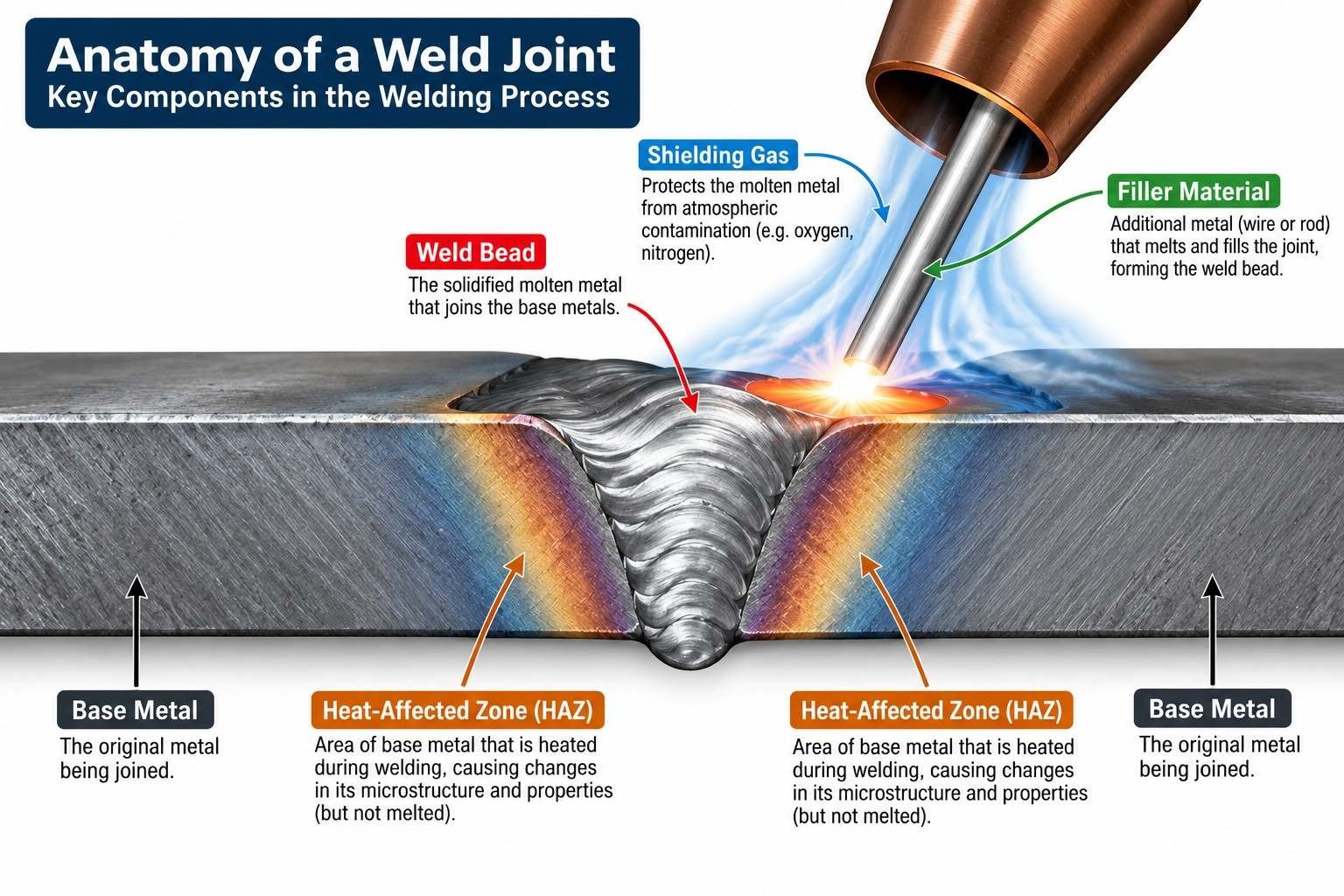
Welding works by supplying enough energy to a localised area of two workpieces to raise the temperature at the joint above the melting point of the base material. The molten pool – called the weld pool – forms where the two pieces meet. A filler material (filler rod or wire) is often added to the pool to bridge gaps and add volume. When the heat source is removed, the weld pool cools and solidifies into a weld bead, permanently fusing the materials.
The Welding Process Step by Step
- Preparation: Clean the base materials to remove rust, oil, paint, or contaminants that would weaken the weld. Cut and fit the pieces to the correct joint geometry (butt joint, lap joint, T-joint, etc.).
- Setup: Select the correct welding process, filler material, shielding gas, and machine settings (voltage, amperage, wire feed speed) for the material type and thickness.
- Tacking: Small tack welds hold the workpieces in position before the full weld run.
- Welding: The welder moves the heat source (electrode, torch, or laser beam) along the joint line, melting the base metal and filler into a unified weld pool.
- Shielding: A shielding gas (argon, CO2, or a mix) or flux coating protects the molten weld pool from atmospheric oxygen and nitrogen, which cause porosity and weakness.
- Cooling and solidification: The weld pool solidifies as it cools, forming the finished weld bead.
- Inspection: The completed weld is inspected visually or using non-destructive testing (NDT) methods such as X-ray, ultrasound, or dye penetrant testing.
What Provides the Heat?
Different welding processes use different energy sources:
- Electric arc (MIG, TIG, Stick welding)
- Gas flame (Oxy-fuel welding)
- Laser beam (Laser beam welding)
- Electron beam (Electron beam welding)
- Friction (Friction stir welding)
- Resistance/electrical current (Spot welding)
- Ultrasound (Ultrasonic welding, used for plastics)
History of Welding
Welding has existed for thousands of years, though modern arc welding as we know it is less than 150 years old.
- 3000 BC: Bronze Age craftsmen used forge welding – hammering heated metals together – to create tools and weapons.
- Middle Ages: Blacksmiths forge-welded iron and steel by heating metal in a furnace and hammering joints together on an anvil.
- 1800: Sir Humphry Davy discovers the electric arc, laying the scientific groundwork for arc welding.
- 1881: Auguste de Meritens uses the carbon arc to join lead plates – the first recorded use of electric arc welding.
- 1890s: Nikolai Slavyanov and C.L. Coffin independently develop metal electrode arc welding.
- World War I (1914-1918): Welding replaces riveting in shipbuilding and munitions manufacturing due to speed and strength advantages.
- 1920s: Automatic welding and the use of shielding gases are introduced.
- World War II (1939-1945): Demand for rapid production of ships, tanks, and aircraft causes explosive growth in welding technology.
- 1950s-1970s: MIG welding (GMAW), TIG welding (GTAW), and plasma arc welding are developed and refined.
- 1991: Friction Stir Welding (FSW) is invented by The Welding Institute (TWI) in the UK – a landmark innovation for joining aluminium.
- 2000s-present: Robotic welding, laser welding, and hybrid processes become mainstream in automotive and aerospace manufacturing.
Types of Welding Processes
There are more than 30 welding processes in commercial use. The following are the most important and widely used.
MIG Welding (GMAW – Gas Metal Arc Welding)
MIG welding (Metal Inert Gas) is the most common welding process in industry and among beginners. A continuous wire electrode is fed automatically through a welding gun, while a shielding gas (usually argon/CO2 mix) protects the weld pool.
- Best for: Steel, stainless steel, aluminium
- Skill level: Beginner to intermediate
- Applications: Automotive bodywork, fabrication, construction, home DIY
- Advantages: Fast, easy to learn, good for thin to medium thickness materials
- Disadvantages: Less precise than TIG; requires shielding gas supply
TIG Welding (GTAW – Gas Tungsten Arc Welding)
TIG welding (Tungsten Inert Gas) uses a non-consumable tungsten electrode to create the arc. Filler metal is added manually by the welder’s free hand. It produces the highest quality, most precise welds of any arc process.
- Best for: Stainless steel, aluminium, titanium, exotic alloys
- Skill level: Advanced
- Applications: Aerospace, food and beverage equipment, motorsport, artistic metalwork
- Advantages: Highest weld quality, precise heat control, clean welds with no spatter
- Disadvantages: Slow, requires high skill level, more expensive
Stick Welding (SMAW – Shielded Metal Arc Welding)
Stick welding uses a consumable flux-coated electrode (the “stick”). The flux coating burns to produce a shielding gas and slag layer, protecting the weld. It is the oldest and most portable arc welding process.
- Best for: Carbon steel, cast iron, stainless steel
- Skill level: Beginner to intermediate
- Applications: Construction, structural steel, pipeline repair, outdoor and site welding
- Advantages: Simple, portable, works outdoors and in wind, no gas cylinder needed
- Disadvantages: Slag must be chipped off; slower than MIG; not ideal for thin materials
Flux-Core Arc Welding (FCAW)
Similar to MIG welding but uses a hollow wire electrode filled with flux instead of (or in addition to) external shielding gas. It is faster than MIG and works well outdoors.
- Best for: Thick steel, structural steel
- Applications: Shipbuilding, heavy fabrication, construction
- Advantages: High deposition rate, works outdoors, penetrates thick material well
- Disadvantages: More spatter than MIG; slag removal required
Oxy-Fuel Welding (OFW)
Uses a mixture of oxygen and a fuel gas (acetylene, propane, or hydrogen) burned through a torch to produce a flame hot enough to melt metal. One of the oldest welding methods, now less common for welding but still widely used for cutting and heating.
- Best for: Thin sheet metal, copper, brass
- Applications: Plumbing, HVAC, artistic metalwork, cutting operations
- Advantages: Portable, no electricity needed, good for small repairs
- Disadvantages: Slow, less precise, fire and explosion risk if mishandled
Spot Welding (Resistance Welding)
Two copper electrodes clamp the workpieces together and pass a high electrical current through them. Resistance to current flow generates heat at the interface, fusing the materials at discrete spots without filler material.
- Best for: Sheet metal (steel, stainless steel, aluminium)
- Applications: Automotive body manufacturing, appliance manufacturing, electronics
- Advantages: Fast, automated, low cost per weld, no filler or shielding gas needed
- Disadvantages: Limited to thin sheets; joint appearance not aesthetically finished
Laser Beam Welding (LBW)
A focused laser beam provides an extremely precise, high-energy heat source. It produces very narrow, deep welds with minimal heat input to the surrounding material.
- Best for: Thin materials, precision components, dissimilar metals
- Applications: Automotive (tailored blanks), electronics, medical devices, jewellery
- Advantages: High speed, precision, minimal distortion, easily automated
- Disadvantages: High equipment cost, requires very tight joint fit-up
Friction Stir Welding (FSW)
A rotating tool is plunged into the joint between two workpieces and moved along the joint line. Frictional heat softens (but does not melt) the material, which is mechanically stirred into a solid-state joint.
- Best for: Aluminium, copper, magnesium
- Applications: Aerospace (fuselage panels), shipbuilding, railway carriages, wind turbines
- Advantages: No melting, low distortion, excellent joint quality, no filler or shielding gas
- Disadvantages: High equipment cost, cannot weld all joint geometries, leaves a keyhole at the end
Welding Process Comparison Table
| Process | Heat Source | Skill Level | Best Materials | Typical Speed | Cost |
| MIG (GMAW) | Electric arc | Beginner | Steel, Al, SS | Fast | Low-Medium |
| TIG (GTAW) | Electric arc | Advanced | All metals | Slow | Medium-High |
| Stick (SMAW) | Electric arc | Beginner | Steel, CI | Medium | Low |
| FCAW | Electric arc | Beginner | Thick steel | Fast | Low-Medium |
| Oxy-Fuel | Gas flame | Intermediate | Thin metals | Slow | Low |
| Spot/Resistance | Electrical resistance | Automated | Sheet metal | Very fast | Medium |
| Laser (LBW) | Laser beam | Automated | Precision parts | Very fast | High |
| Friction Stir | Friction | Automated | Aluminium | Medium | High |
Welding vs Soldering vs Brazing
These three processes all join metals but are fundamentally different in how they work and the strength of joint they produce.
| Feature | Welding | Brazing | Soldering |
| Working temperature | Above base metal melting point | Above 450 degrees C (filler only melts) | Below 450 degrees C |
| Base metal melted? | Yes | No | No |
| Filler used? | Optional | Yes | Yes |
| Joint strength | Highest | Medium-High | Lowest |
| Typical materials | Metals, plastics | Metals, ceramics | Metals, electronics |
| Skill required | High | Medium | Low |
| Common uses | Structural, heavy fabrication | Plumbing, HVAC, jewellery | Electronics, plumbing |
Key distinction: In welding, the base metal itself is melted. In brazing and soldering, only the filler material melts – the base metal stays solid. This is why welded joints are generally the strongest of the three.
Materials That Can Be Welded
Metals
- Carbon steel: The most commonly welded metal. Easy to weld with most processes.
- Stainless steel: Widely welded using TIG and MIG. Requires care to avoid heat distortion and corrosion at the weld zone.
- Aluminium: Lightweight and widely used; requires AC TIG or MIG with argon shielding. More challenging due to oxide layer and high thermal conductivity.
- Cast iron: Weldable but brittle; requires pre-heating and post-weld heat treatment to prevent cracking.
- Copper and brass: Good thermal conductivity makes them challenging; oxy-fuel and TIG commonly used.
- Titanium: High strength-to-weight ratio; TIG welded in a purged argon environment to prevent oxidation.
- Nickel alloys: Used in aerospace and chemical plants; TIG welded with careful heat management.
Plastics (Thermoplastics)
Many thermoplastics can be welded using heat, ultrasound, friction, or hot gas:
- Polyethylene (PE) – used in gas and water pipes
- Polypropylene (PP)
- PVC
- Nylon
Thermosetting plastics (epoxy, polyester) cannot be welded as they do not re-melt.
Materials That Cannot Be Welded
- Dissimilar metals with incompatible metallurgy (e.g., aluminium to steel – requires special processes or adhesive bonding)
- Thermosetting plastics
- Ceramics (except by specialised diffusion bonding)
Welding Equipment and Tools
Core Welding Equipment
- Welding machine / power source: Provides the electrical current (DC or AC) for arc welding. MIG machines include a wire feeder; TIG machines include a high-frequency start unit.
- Electrode / filler wire: The consumable material added to the weld pool. Chosen to match or complement the base metal.
- Welding torch / gun: Directs the arc and, in MIG/TIG, delivers shielding gas to the weld zone.
- Shielding gas and regulator: Argon, CO2, or blended gases protect the weld pool from atmospheric contamination.
- Ground clamp / work lead: Completes the electrical circuit between the machine and workpiece.
- Angle grinder: Used to prepare and clean joints before welding and to clean up weld beads afterwards.
Personal Protective Equipment (PPE)
- Welding helmet with auto-darkening filter (ADF): Protects eyes from the intense UV/IR arc light. Auto-darkening helmets shade automatically when the arc strikes.
- Welding gloves: Heavy leather gloves protect hands from heat, spatter, and UV radiation.
- Welding jacket or apron: Flame-resistant leather or FR cotton protects the body from sparks and spatter.
- Safety boots: Steel-toed boots protect feet from falling metal and hot spatter.
- Respiratory protection: A welding fume respirator or powered air-purifying respirator (PAPR) is essential when welding in confined spaces or with coated/galvanised metals.
Applications of Welding
Welding is fundamental to almost every major industry. Without it, modern infrastructure and manufacturing would not exist in their current form.
| Industry | What Welding Is Used For |
| Construction and civil engineering | Structural steel frames, bridges, pipelines, reinforcement |
| Automotive manufacturing | Car body panels, chassis, exhaust systems, fuel tanks |
| Aerospace | Aircraft fuselage, wing structures, engine components |
| Shipbuilding | Hull plates, decks, bulkheads, offshore platforms |
| Oil and gas | Pipelines, refineries, storage tanks, subsea structures |
| Power generation | Boilers, pressure vessels, wind turbine towers, nuclear plants |
| Railway | Continuous welded rail (CWR), carriage bodies, bogies |
| Robotics and automation | Robotic frames, precision assemblies |
| Medical devices | Surgical instruments, implant components, medical equipment frames |
| Consumer goods | Appliances, furniture, bicycles, cookware |
Welding Safety
Welding is a high-risk activity if performed without proper precautions. Understanding and controlling the hazards is essential for every welder.
Primary Hazards
- Arc flash and UV radiation: The welding arc emits intense ultraviolet and infrared radiation that can cause arc eye (photokeratitis) and skin burns in seconds. Always wear an appropriate welding helmet.
- Welding fumes and gases: Metal fumes (including manganese, hexavalent chromium from stainless steel, and zinc from galvanised metal) are toxic and can cause serious lung disease with long-term exposure. Ensure adequate ventilation or use respiratory protection.
- Fire and explosion: Sparks and spatter travel up to 10 metres. Keep flammable materials away from the work area. Never weld near containers that held flammable liquids without proper purging.
- Electric shock: Arc welding uses high-amperage current. Wet conditions, damaged cables, and poor connections increase electrocution risk. Inspect equipment before use.
- Burns: Heat, spatter, and hot metal cause burns. Wear full PPE at all times.
- Noise: Grinding and some welding processes generate harmful noise levels. Use hearing protection.
Safety Best Practices
- Always weld in a well-ventilated area or use local exhaust ventilation (LEV).
- Inspect cables, connections, and PPE before every session.
- Use a fire watch and keep a fire extinguisher accessible.
- Never weld on containers, drums, or tanks without confirming they are safe.
- Follow employer safety procedures and relevant standards (e.g., OSHA 1910.252 in the US, HSE guidelines in the UK).
Advantages and Disadvantages of Welding
Advantages
- Strong, permanent joints: Welded joints can match or exceed the strength of the base materials.
- Versatility: Works with a wide range of metals, thicknesses, and joint configurations.
- Cost-effective at scale: Automated and robotic welding is extremely fast and economical for high-volume production.
- No fasteners required: Eliminates the weight, cost, and potential failure points of bolts and rivets.
- Airtight and watertight joints: Essential for pressure vessels, pipelines, and fuel tanks.
- Design flexibility: Complex shapes and structures can be fabricated that would be impossible to cast or machine as a single piece.
Disadvantages
- Skilled labour required: Quality welding – especially TIG and structural welding – requires significant training and practice.
- Heat distortion: Localised heating and cooling causes residual stresses and warping, particularly in thin materials.
- Not easily disassembled: Unlike bolted joints, welded connections are permanent. Repair or modification requires cutting.
- Inspection challenges: Weld quality is not always visible on the surface; internal defects require NDT methods.
- Safety hazards: Fumes, UV radiation, fire risk, and electric shock require careful management.
- Material limitations: Not all material combinations can be readily welded.
How to Learn Welding
Welding is a practical skill that requires hands-on training. Here is a clear path from beginner to competent welder.
Step 1: Understand the Basics
Before touching a welding machine, learn the theory: welding processes, metallurgy basics, joint types, and safety. Books, YouTube channels (like Welding Tips and Tricks), and online courses (Lincoln Electric, Miller Welds) provide excellent free resources.
Step 2: Start with MIG Welding
MIG welding is the easiest arc process to learn. Begin on flat mild steel plate, practising straight beads until your travel speed, angle, and distance are consistent.
Step 3: Take a Formal Course
Community colleges, technical colleges, and vocational training providers offer welding programmes ranging from short introductory courses to full-time trade qualifications. Formal training gives you structured feedback and access to equipment.
Step 4: Pursue Certification
Welding certifications validate your skill to employers and clients. Key certifications include:
- AWS (American Welding Society) – Certified Welder (CW), Certified Welding Inspector (CWI)
- ASME – Pressure vessel and piping welders
- EN ISO 9606 – European welder qualification standard
- CSWIP – UK and international welding inspection certification
Step 5: Progress to TIG and Specialised Processes
Once comfortable with MIG and Stick, progress to TIG welding and specialised materials (aluminium, stainless steel) to increase your employability and earning potential.
Conclusion
Welding is one of the most important manufacturing processes in the modern world. From the steel frame of a skyscraper to the aluminium skin of an aircraft, from a city’s water pipelines to the body of the car in your driveway – welding makes it all possible.
Understanding what welding is, how it works, and which process suits which application is the starting point for anyone entering the trade, specifying fabricated components, or simply curious about how the built world is held together.
Whether you are a student choosing a career, an engineer selecting a joining process, or a hobbyist building your first project in the garage, welding offers a powerful, versatile, and deeply satisfying skillset.
12. Frequently Asked Questions (FAQs)
Welding is the process of permanently joining two pieces of metal (or thermoplastic) by melting them together, usually with a filler material. When the molten material cools, it solidifies into a strong, unified joint. Think of it as gluing metal together, but at temperatures of thousands of degrees, with a bond that becomes part of the metal itself.
The four most common welding processes are MIG welding (GMAW), TIG welding (GTAW), Stick welding (SMAW), and Flux-Core welding (FCAW). Other important processes include spot welding, laser welding, oxy-fuel welding, and friction stir welding. The best process depends on the material, thickness, required weld quality, and production environment.
MIG welding can be learned to a basic level in a few days of hands-on practice. Achieving professional-quality welds consistently – especially with TIG welding on aluminium or stainless steel – takes months to years of practice. Welding is a skilled trade and, like most skilled trades, rewards dedicated practice with significant capability and earning potential.
Most metals can be welded, including carbon steel, stainless steel, aluminium, copper, titanium, nickel alloys, and cast iron. Many thermoplastics can also be welded using heat or ultrasound. Some material combinations (such as aluminium to steel) are difficult to weld conventionally and may require specialised processes or alternative joining methods.
The temperature at the weld pool depends on the process and material. A MIG or TIG arc reaches approximately 6,000 to 20,000 degrees Celsius at the arc itself – far hotter than the surface of the sun. The weld pool typically sits at just above the melting point of the base metal: around 1,500 degrees C for steel and around 660 degrees C for aluminium.
MIG welding feeds a wire electrode automatically and is faster and easier to learn, making it ideal for production work and beginners. TIG welding uses a non-consumable tungsten electrode and requires the welder to manually feed filler rod with the other hand, giving finer control. TIG produces cleaner, more precise welds and is preferred for thin materials, stainless steel, aluminium, and any application demanding high visual quality.
Yes. Underwater welding (also known as hyperbaric welding) is performed by commercial diving welders to repair ships, offshore platforms, and pipelines. Wet welding uses waterproof electrodes directly in the water, while dry hyperbaric welding is performed inside a sealed habitat pressurised with gas. It is one of the most demanding and highly paid trades in the world.