
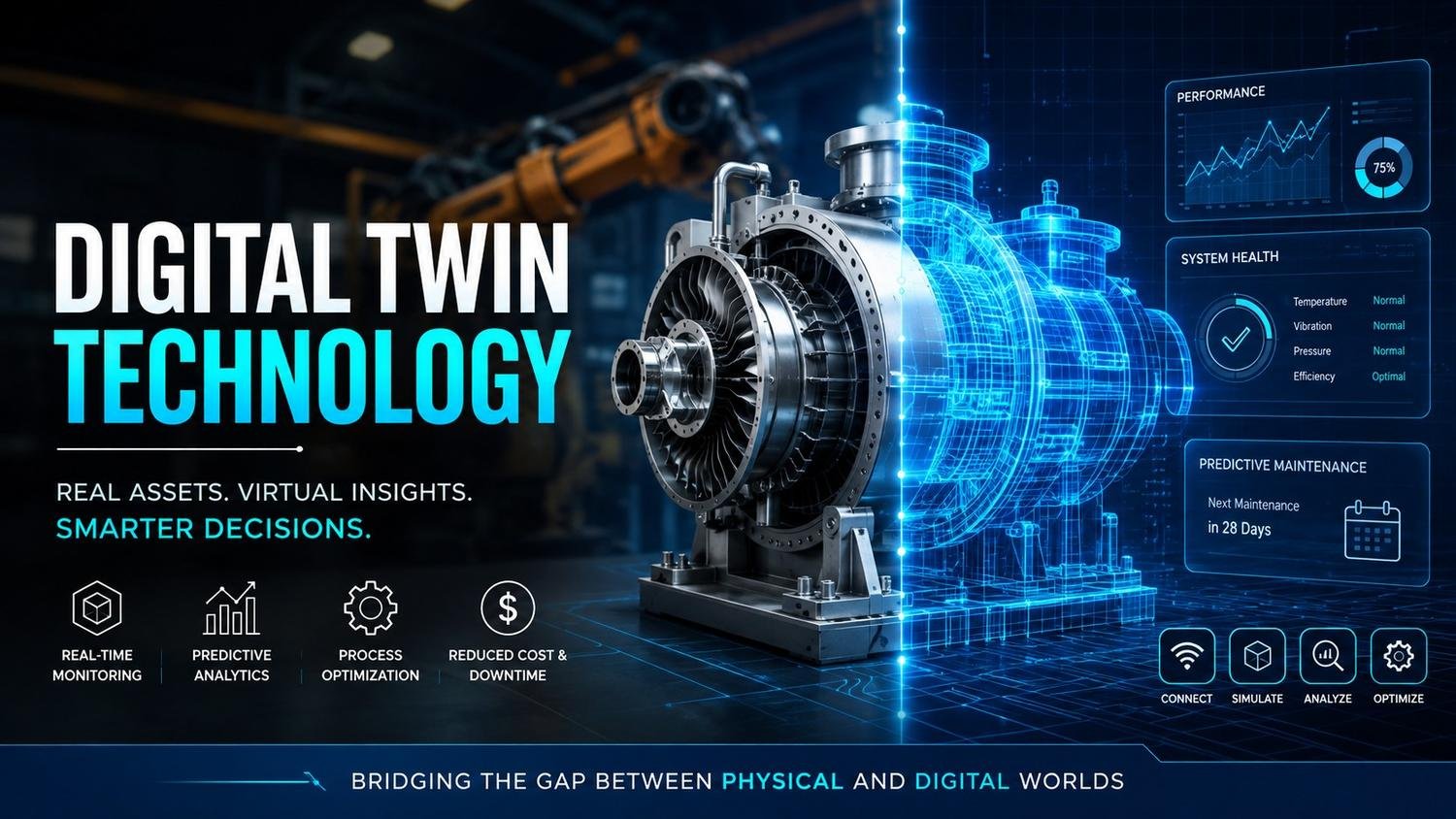
Imagine you could take a jet engine, a factory floor, or an entire wind farm, and shrink it into a living, breathing computer model that updates itself in real time, tells you when a part is about to fail, and lets you test “what if” scenarios without ever touching the real machine.
That’s not science fiction. It’s called a digital twin, and it’s already running inside companies like Siemens, GE, Tesla, NASA, BMW, and Rolls-Royce.
Digital twin technology has quietly become one of the most important tools in modern digital engineering. It’s the backbone of predictive maintenance programs that stop machines from breaking down, the design tool that lets automakers crash-test cars before they’re built, and the operational brain behind smart factories that run themselves through manufacturing automation.
Why does this matter right now? Manufacturing is under pressure to cut downtime, reduce waste, and move faster than ever. According to IBM’s 2026 research, roughly three-quarters of businesses across industries now use digital twins in some form, and a 2025 Hexagon survey found that 92% of companies deploying them report a return on investment above 10%, with more than half reporting returns of at least 20%. Market analysts at firms like Grand View Research and Fortune Business Insights put the global digital twin market at roughly $30–50 billion in 2026, growing at a compound annual rate above 30% through the early 2030s (estimates vary by methodology, but every major report agrees on the direction: fast, sustained growth). If you’re studying mechanical engineering, working on a factory floor, or leading a digital transformation initiative, this is a technology you cannot afford to misunderstand.
In this guide, you’ll learn:
- What a digital twin actually is, explained in plain English
- The exact technologies (sensors, IoT, AI, cloud) that make it work
- The four main types of digital twins and how they differ
- How digital twin architecture is structured, step by step
- Real, sourced case studies from Tesla, GE, NASA, BMW, Siemens, Rolls-Royce, and Amazon, with actual performance numbers
- How a digital twin differs from simulation, IoT, and BIM (a common point of confusion)
- The real challenges companies face when adopting this technology
- Where the industry is headed next
Let’s start from the ground up.
What Is Digital Twin Technology?
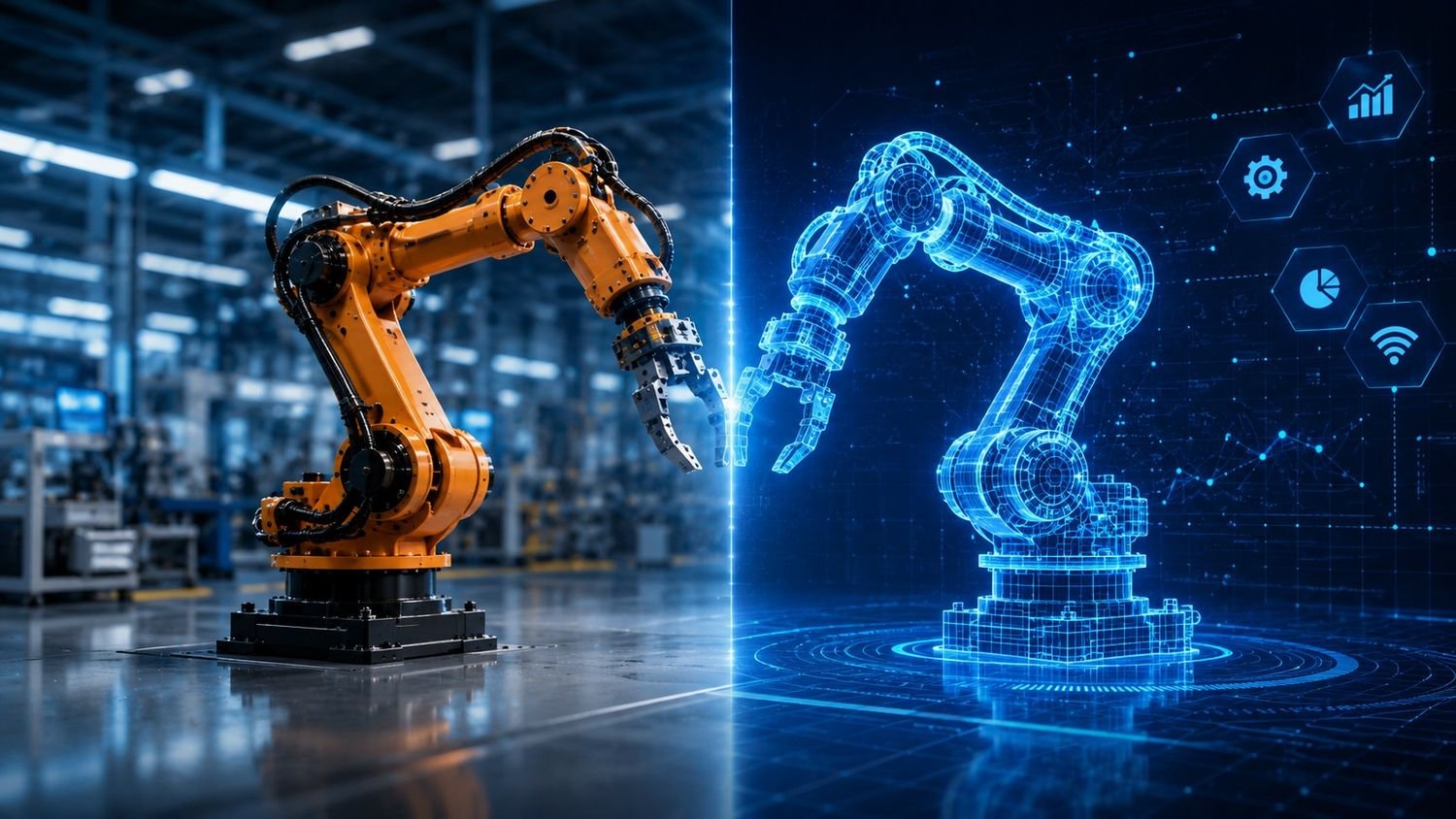
In simple terms: a digital twin is a virtual copy of a real, physical thing (a machine, a building, a vehicle, or even an entire factory) that stays connected to its real-world counterpart through live data.
Think of it like a video game character that mirrors your real body. If you move your arm, the character’s arm moves too, instantly, because sensors track your motion and feed that data into the game engine. A digital twin does the same thing for physical assets: sensors on the real object constantly send data to its digital replica, so the virtual version always reflects what’s actually happening in the physical world, not what happened yesterday, and not what engineers assumed would happen.
This is the key difference between a digital twin and an ordinary 3D model or CAD drawing. A CAD file is static; it shows what something is supposed to look like. A digital twin is dynamic; it shows what something is actually doing, right now, and can even predict what it will do next.
Quick Analogy A CAD model is like a photograph of a car. A digital twin is like a live video call with that car: it can also feel the engine temperature, hear the vibration, and warn you before something breaks.
The concept isn’t brand new. According to NASA’s own documentation, engineers were effectively building digital twins during the Apollo space program in the 1960s, using ground-based replicas of spacecraft to mirror conditions in flight and diagnose problems remotely, famously helping bring the Apollo 13 crew home safely. The term “digital twin” itself was formally coined by Dr. Michael Grieves in 2002 while working on product lifecycle management concepts, and NASA later formalized the modern definition around 2010 for spacecraft and aircraft simulation. What’s changed since then isn’t the idea; it’s the technology. Cheap sensors, fast internet, cloud computing, and AI have finally made real-time digital twins practical and affordable for everyday industry, not just space agencies.
Digital twin technology is also closely related to the broader concept of a cyber-physical system: an engineering discipline that focuses on tightly integrating computation, networking, and physical processes. In fact, most industrial digital twins are a specific, data-rich implementation of cyber-physical systems principles, applied to a single asset, product, or process.
Formal Definition
Digital twin technology is a system that creates and maintains a real-time virtual representation of a physical object, process, or system, using continuous data exchange between the physical and digital versions to enable monitoring, simulation, analysis, and predictive decision-making across the asset’s entire lifecycle.
Break that definition into its core parts and you get four requirements that separate a true digital twin from a regular computer model:
| Requirement | What It Means |
| Real physical counterpart | There must be an actual object or system in the real world |
| Virtual representation | A digital model that mirrors its structure, behavior, or both |
| Live data connection | Sensors and IoT devices feed real-time data into the model |
| Two-way interaction | Insights from the digital twin can influence or control the physical object |
If any one of these four pieces is missing (say, there’s no live data feed), you’re looking at a simulation or a 3D model, not a true digital twin.
How Digital Twin Technology Works
A digital twin isn’t a single piece of software. It’s a pipeline made up of several technologies working together. Here’s how data flows from a physical machine all the way to a decision an engineer can act on.
Step 1: Sensors
Sensors are small devices attached to the physical asset that measure things like temperature, vibration, pressure, speed, humidity, or electrical current. Think of them as the “nervous system” of the digital twin: without sensors, there’s no data, and without data, there’s no twin.
Example: A wind turbine might have sensors measuring blade vibration, rotational speed, wind direction, and gearbox temperature, all at once.
Step 2: IoT (Internet of Things) Connectivity
IoT simply means connecting physical devices to the internet so they can send and receive data automatically. In a digital twin system, IoT is the “delivery truck”: it moves the raw sensor data from the machine floor to wherever it needs to be processed, often continuously and in small packets (a pattern engineers call streaming data). This is why you’ll often see the terms industrial IoT (IIoT) and digital twin used almost interchangeably in manufacturing contexts, even though IIoT is really just the connectivity layer that makes the twin possible.
Step 3: Data Collection and Storage
Raw sensor data is collected, cleaned, and organized so it can be used. This usually involves edge computing (processing data close to the source, like on the factory floor, for speed) combined with centralized storage for historical records.
Step 4: Cloud Computing
Cloud computing means storing and processing data on remote servers instead of local computers. It gives digital twins the computing power to run complex simulations and store years of historical data without needing a supercomputer on-site. This is what allows a company with factories on three continents to monitor them all from one dashboard, and it’s a core reason cloud computing adoption and digital twin adoption tend to rise together.
Step 5: AI and Machine Learning
This is where the digital twin becomes genuinely smart. Machine learning (a branch of AI where software learns patterns from data instead of being explicitly programmed) analyzes historical and live data to detect anomalies, predict failures, and recommend actions. AI in manufacturing increasingly relies on this exact pipeline: for instance, an AI model trained on years of bearing vibration data can learn to recognize the subtle signature that appears weeks before a bearing fails, long before a human would notice.
Step 6: Simulation
The digital twin uses physics-based models (equations that describe how real materials and systems behave) combined with the live data to run engineering simulation scenarios. Engineers can ask questions like, “What happens if we increase this machine’s load by 15%?” and get an answer without ever touching the actual equipment.
Step 7: Analytics and Visualization
Finally, all of this is turned into dashboards, alerts, and reports that a human can actually use: charts showing equipment health, predictive maintenance alerts, or 3D visualizations engineers can rotate and inspect.
Engineer’s Tip If you’re building your first digital twin project, start small. A single-machine “component twin” with basic vibration and temperature sensors will teach your team more about data pipelines than jumping straight into a full factory-wide system twin.
Components of a Digital Twin
Every functioning digital twin system, regardless of industry, is built from the same core building blocks:
- Physical Asset – The real-world object, machine, or process being mirrored
- Sensors and Actuators – Devices that collect data (sensors) and devices that can act on physical systems based on digital instructions (actuators)
- Data Integration Layer – Software that collects, cleans, and standardizes data from multiple sources
- Virtual Model – The digital replica, often built using CAD, physics-based modeling, or 3D geometry
- Simulation Engine – Software that runs “what-if” scenarios using physics and historical data
- AI/Analytics Engine – Machine learning models that detect patterns, predict failures, and generate insights
- Cloud/Edge Infrastructure – The computing backbone that stores data and runs processing
- User Interface (Dashboard) – Where humans view insights, alerts, and visualizations
- Feedback Loop – The connection that allows digital insights to influence the physical asset (e.g., automatically adjusting a machine’s settings)
Types of Digital Twins
Not every digital twin covers an entire factory. In practice, engineers work with digital twins at different scales, often nested inside one another like Russian dolls.
1. Component Twin (Part Twin)
The most basic level: a digital twin of a single part or component, like a bolt, bearing, or turbine blade. Component twins are often used to study material fatigue, stress, and wear at a very granular level.
2. Asset Twin (Product Twin)
An asset twin combines multiple component twins to represent a complete piece of equipment, such as an engine, a pump, or a robotic arm. This is the level most people picture when they hear “digital twin”: a full machine with real-time health monitoring.
3. System Twin (Unit Twin)
A system twin models how multiple assets work together, such as an entire production line or a fleet of vehicles. It reveals interactions between machines that you’d never see by looking at any single asset in isolation, for example, how a slowdown in one machine cascades into a bottleneck three stations down the line.
4. Process Twin
The broadest level. A process twin models an entire operational workflow, such as an end-to-end supply chain, a hospital’s patient flow, or a whole factory’s production process. Process twins are used for high-level strategic decisions like capacity planning and logistics optimization.
| Type | Scope | Example |
| Component Twin | Single part | A turbine blade |
| Asset Twin | Full machine/product | A jet engine |
| System Twin | Multiple connected assets | An entire production line |
| Process Twin | End-to-end workflow | A global supply chain |
Digital Twin Architecture
A digital twin’s architecture is typically described in five layers, moving from the physical world up to the human decision-maker:
- Physical Layer – The real asset and its embedded sensors/actuators
- Connectivity Layer – IoT networks, gateways, and protocols (like MQTT or OPC UA) that transmit data
- Data Layer – Databases, data lakes, and cloud storage where information is organized
- Modeling & Analytics Layer – Simulation engines, digital models, and AI/ML algorithms that process the data
- Application Layer – Dashboards, alerts, APIs, and user interfaces where engineers and managers interact with insights
Crucially, real digital twin architecture includes a closed feedback loop: insights generated in the application layer can flow back down to the physical layer, automatically adjusting machine settings or triggering maintenance workflows, turning the digital twin from a passive dashboard into an active control system. This is what distinguishes a mature industrial digital twin from a read-only monitoring dashboard.
Benefits of Digital Twin Technology
- Predictive Maintenance – Detect equipment problems weeks before failure, based on data patterns rather than fixed maintenance schedules
- Reduced Downtime – Companies using digital twins commonly report significant reductions in unplanned downtime by catching issues early
- Lower Costs – Fewer emergency repairs, less wasted material, and reduced need for physical prototypes
- Faster Product Development – Engineers can test dozens of design variations virtually instead of building physical prototypes for each one
- Improved Quality Control – Real-time monitoring catches defects during production instead of after shipment
- Better Decision-Making – Data-driven “what-if” testing replaces guesswork
- Enhanced Safety – Hazardous scenarios (explosions, structural failure, extreme loads) can be tested virtually instead of physically
- Sustainability Gains – Optimized energy use and material consumption reduce environmental impact
- Lifecycle Visibility – A single digital thread tracks an asset from design through decommissioning
By the Numbers According to IBM’s 2026 digital twin research, roughly 75% of businesses now use digital twins in some capacity, and a 2025 Hexagon survey found 92% of adopters report ROI above 10%, with more than half seeing returns of 20% or higher. In aviation specifically, industry analysts at Deloitte report predictive-maintenance programs can reduce aircraft downtime by around 15%, boost labor productivity by roughly 20%, and cut maintenance costs by 18–25%, while McKinsey estimates aircraft availability can rise by as much as 15%.
Applications Across Industries
Manufacturing
Digital twins power smart factories, where entire production lines are mirrored digitally to optimize throughput, catch defects early, and simulate layout changes before touching the physical floor. This remains the single largest application area for digital twin technology today, and it’s the area where manufacturing automation and digital twins overlap most directly, since automated equipment both generates the sensor data twins rely on and receives the adjustments twins recommend.
Automotive
Automakers use digital twins to crash-test virtual vehicles, simulate battery degradation in EVs, and monitor vehicles remotely once they’re on the road, feeding real driving data back into future design.
Aerospace
Aircraft engines and airframes are twinned to track stress, fatigue, and wear across thousands of flight hours, enabling predictive maintenance that keeps planes safer and reduces unscheduled groundings.
Healthcare
Digital twins of organs, and even entire patients built from imaging and biometric data, help doctors simulate treatment outcomes before committing to surgery or a drug regimen. Surgeons are increasingly using patient-specific digital twins to rehearse complex procedures, including neurosurgery, on virtual anatomy that matches the individual patient before ever touching a scalpel. Hospital-level “process twins” also optimize patient flow and equipment scheduling.
Smart Cities
Urban planners build digital twins of traffic systems, water networks, and power grids to model congestion, plan infrastructure, and respond to emergencies in real time.
Construction
Combined with Building Information Modeling (BIM), digital twins let construction teams monitor a building’s structural health, energy use, and maintenance needs long after the building is complete.
Energy
Power plants, wind farms, and solar installations use digital twins to optimize output, predict equipment failure, and balance load across a grid.
Oil & Gas
Offshore platforms and pipelines, often in hazardous, hard-to-access environments, use digital twins to monitor corrosion, pressure, and structural integrity remotely, reducing the need for dangerous physical inspections.
Supply Chain
Companies model entire logistics networks digitally to predict bottlenecks, optimize inventory, and simulate the impact of disruptions like port closures or supplier delays.
Agriculture
Farms use digital twins of fields and crops, combining soil sensors, weather data, and satellite imagery to optimize irrigation, predict yield, and reduce fertilizer waste.
Real-World Examples and Case Studies
Tesla
Tesla creates a digital twin for every individual vehicle it manufactures. Each car’s twin tracks performance data over its lifetime, and that data feeds back into Tesla’s over-the-air software updates and future design improvements, a feedback loop drawn from millions of vehicles on the road rather than a limited test fleet.
Siemens
Siemens is widely regarded as a market leader in industrial digital twin platforms, and multiple 2025–2026 market reports (including Global Market Insights) rank it as the single largest vendor by market share. Through its Xcelerator and Teamcenter software, Siemens builds digital twins used across manufacturing, energy, and transportation to design and monitor products from concept through operation.
GE Aerospace (formerly GE Aviation)
GE’s Analytics Based Maintenance (ABM) program is one of the most cited digital twin case studies in aerospace. According to GE representatives interviewed by Aerospace Tech Review, digital twins built from aggregated component-level models allowed the company to improve engine monitoring coverage, lead time, and false-positive rates by double-digit percentages. One customer specifically reported a 20% improvement in “time on wing” (the amount of time an engine runs before needing removal) and a one-third reduction in unscheduled engine removals after adopting GE’s digital twin-based ABM approach. Separately, GE has also applied the same digital twin methodology to wind turbine fleets through its “Humble AI” framework, using it to predict downtime and schedule proactive maintenance in the field.
BMW
BMW’s Virtual Factory, built on the NVIDIA Omniverse platform, is one of the most well-documented digital twin deployments in manufacturing. BMW uses it to simulate entire factory layouts, robotics, and logistics across more than 30 production sites worldwide before any physical construction begins. BMW reports the platform is projected to reduce production planning costs by up to 30%, and in one landmark case, the company’s Debrecen, Hungary plant achieved a full “virtual start of production” and was validated entirely through simulation more than two years before real-world operations began, making it one of the first factories in the world planned end-to-end using a digital twin.
NASA
NASA’s use of digital twins traces back to Apollo-era ground simulators, which allowed engineers to mirror the condition of spacecraft they could not physically reach, most famously helping diagnose and resolve the Apollo 13 crisis. NASA continues to apply the same principle today in spacecraft and aircraft programs, where digital twins monitor systems that remain physically unreachable once launched.
Rolls-Royce
Rolls-Royce applies digital twin technology to its aircraft engines through its IntelligentEngine vision and Blue Data Thread strategy, a continuous digital information thread connecting every Rolls-Royce-powered aircraft, airline operation, maintenance shop, and factory. Combined with its TotalCare service, Rolls-Royce uses real-time engine data to update predicted maintenance deadlines automatically for individual life-limited components, rather than relying on fixed, calendar-based service intervals.
Amazon
Amazon uses digital twin and simulation technology, including work built on NVIDIA Omniverse, to design and optimize its fulfillment centers, modeling robot movement, worker paths, and package flow to maximize warehouse efficiency before physical changes are made on the floor.
Case Study Takeaway Notice the pattern across these examples: the highest-value digital twin deployments aren’t just monitoring tools, they close the loop. GE’s twins directly change maintenance schedules. BMW’s twins directly change factory layouts before construction. Rolls-Royce’s twins directly update service deadlines. A digital twin that only displays data without feeding back into a decision is leaving most of its value on the table.
Digital Twin vs. Simulation
People often use these terms interchangeably, but they are not the same thing.
| Aspect | Digital Twin | Traditional Simulation |
| Data Source | Live, real-time data from a real physical asset | Historical or assumed data, no live connection |
| Connection to Reality | Continuously synced (two-way) | One-time or periodic, one-way |
| Lifespan | Exists for the full lifecycle of the asset | Usually built for a single study or project |
| Purpose | Ongoing monitoring, prediction, and control | Answering a specific “what-if” question |
| Example | Live model of a running jet engine | A one-time crash-test simulation of a car design |
In short: every digital twin uses simulation, but not every simulation is a digital twin. A simulation without a live data connection to a real object is just a model.
Digital Twin vs. IoT
| Aspect | Digital Twin | IoT (Internet of Things) |
| What it is | A virtual replica that mirrors a physical object’s behavior | A network of connected sensors and devices |
| Role | The “brain”: analyzes and models data | The “nervous system”: collects and transmits data |
| Output | Predictions, simulations, insights | Raw or lightly processed data |
| Relationship | Cannot function without IoT (usually) | Can exist without a digital twin |
In short: IoT is the data pipeline; the digital twin is what uses that data to build a living virtual model. You can have IoT without a digital twin, but you generally can’t have a real-time digital twin without IoT.
Digital Twin vs. BIM
| Aspect | Digital Twin | BIM (Building Information Modeling) |
| Primary Use | Real-time monitoring and prediction of an operating asset | Design and construction planning of a building |
| Data | Live, continuously updated | Mostly static, updated at project milestones |
| Timeframe | Full operational lifecycle | Primarily design and construction phase |
| Industry Focus | Manufacturing, aerospace, energy, and more | Architecture, engineering, construction (AEC) |
In short: BIM often becomes the starting foundation for a building’s digital twin. A construction team creates a detailed BIM model during design, and after the building is completed, that model can evolve into a digital twin by connecting it to live sensors for ongoing facility management.
Challenges of Digital Twin Technology
Digital twins are powerful, but they are not simple or cheap to implement. Common challenges include:
- High Initial Investment: Sensors, IoT infrastructure, cloud computing, and skilled talent all require significant upfront capital
- Data Quality and Integration: Combining data from legacy machines, modern sensors, and different software systems is often harder than building the model itself
- Cybersecurity Risks: Continuous data streaming from physical assets expands a company’s attack surface, making digital twin pipelines an appealing target for cyberattacks
- Complexity of Physics Modeling: Accurately simulating real-world phenomena like material fatigue, corrosion, or thermal stress requires deep engineering expertise and computationally intensive models
- Skills Gap: Few engineers currently combine mechanical engineering knowledge with data science and AI skills, creating hiring bottlenecks
- Scalability: A digital twin that works for one machine doesn’t always scale cleanly to an entire factory or fleet
- Interoperability: Lack of universal standards means digital twins built on one vendor’s platform can be difficult to connect with another’s
Common Mistake Many first-time digital twin projects fail not because of bad technology, but because of bad data. If your sensor data is inconsistent, delayed, or poorly labeled, even the best AI model will produce unreliable predictions. Data quality should be priority one.
Future Trends
- AI-Native Digital Twins: Generative AI and advanced machine learning are moving digital twins from passive monitoring tools toward autonomous decision-makers that can adjust operations with minimal human input
- Industrial Metaverse Integration: Platforms like NVIDIA Omniverse are enabling immersive, physically accurate virtual environments where engineers can collaborate inside a shared digital twin using AR/VR; NVIDIA reports over 300,000 platform downloads and 250+ enterprise deployments as of 2025
- Edge AI: More processing is moving to the “edge” (on-device, near the sensor) to reduce latency for real-time decisions, especially in safety-critical applications
- 5G and 6G Connectivity: Faster, more reliable wireless networks are enabling denser sensor deployments and near-instant data transmission; telecom companies are now even building digital twins of the networks themselves, such as Nokia’s RAN Digital Twin built on NVIDIA’s Aerial Omniverse platform
- Digital Twins of Entire Systems: Projects are scaling up from single machines to entire cities, power grids, and even climate-scale “digital twin Earth” initiatives aimed at modeling global environmental systems
- Sustainability-Driven Adoption: Regulatory pressure, especially in Europe, is pushing companies to use digital twins to monitor emissions and energy efficiency
- Digital Twins Beyond Industry: The concept is expanding into unexpected areas, including personal productivity tools and AI-driven virtual assistants modeled loosely on an individual’s own working habits
Conclusion
Digital twin technology isn’t a buzzword; it’s a practical engineering tool that’s already reshaping how machines are designed, built, monitored, and maintained. From a single turbine blade to an entire smart city, the core idea stays the same: connect the physical world to a living digital model, and you unlock the ability to predict problems, test changes safely, and make smarter decisions faster than ever before.
For engineering students and manufacturing professionals, understanding digital twins isn’t optional anymore; it’s quickly becoming a core competency for anyone working in Industry 4.0, predictive maintenance, or smart manufacturing. The companies leading this shift (Tesla, Siemens, GE, BMW, NASA, Rolls-Royce, and Amazon) prove it with real, measured results, not just marketing claims: fewer unscheduled engine removals, factories validated entirely before construction, and maintenance deadlines updated automatically from live data. The digital twin is no longer optional infrastructure. It’s the new standard for how the physical and digital worlds work together.
Frequently Asked Questions
It’s a virtual copy of a real object or system that stays updated with live data, so engineers can monitor it, predict problems, and test changes without touching the real thing.
The most common uses are predictive maintenance, product design and testing, operational optimization, and remote monitoring of equipment that’s dangerous, expensive, or physically hard to reach.
Manufacturing currently leads adoption, followed closely by automotive, aerospace, energy, and healthcare.
No. A 3D model is static and shows what something looks like. A digital twin is dynamic, continuously updated with real-time data, and can predict future behavior.
No, though they’re related. The metaverse is generally about shared, persistent virtual spaces for people to interact in. A digital twin is a data-accurate virtual model of one specific physical asset or system. Industrial metaverse platforms (like NVIDIA Omniverse) often host digital twins, but the twin itself is the data-driven model, not the virtual environment around it.
Common platforms include Siemens Xcelerator and Teamcenter, PTC’s ThingWorx, Microsoft Azure Digital Twins, AWS IoT TwinMaker, ANSYS Twin Builder, and NVIDIA Omniverse, often paired with CAD tools like Autodesk or Dassault Systèmes’ 3DEXPERIENCE for the underlying geometry.
Large enterprises currently dominate adoption due to cost, but cloud-based, scalable digital twin platforms are making the technology increasingly accessible to small and mid-sized manufacturers.
A strong foundation in mechanical or industrial engineering, plus familiarity with data analysis, IoT systems, cloud platforms, and basic machine learning concepts, will make you highly competitive in this field.
A: Costs vary enormously depending on scope: a single-machine component twin might cost a few thousand dollars in sensors and software, while a factory-wide system twin can run into the millions once cloud infrastructure, integration, and AI development are included.
Not completely, but they dramatically reduce unplanned failures by identifying early warning signs, giving maintenance teams time to act before a breakdown occurs.
A digital thread is the continuous flow of data connecting a product’s entire lifecycle (design, manufacturing, operation). A digital twin is a specific virtual model that uses that data thread to represent a real asset’s current and predicted state.