
Most car batteries last 3 to 5 years, but the exact number depends on your climate, driving habits, battery type, and how well you maintain it. Some batteries fail at the two-year mark. Others keep starting the engine reliably past year seven. The difference usually comes down to a handful of factors you can actually control.
This guide walks through how long different battery types typically last, what shortens (or extends) that lifespan, the warning signs that tell you a replacement is coming, and how to test your battery before it leaves you stranded.
Average Car Battery Lifespan
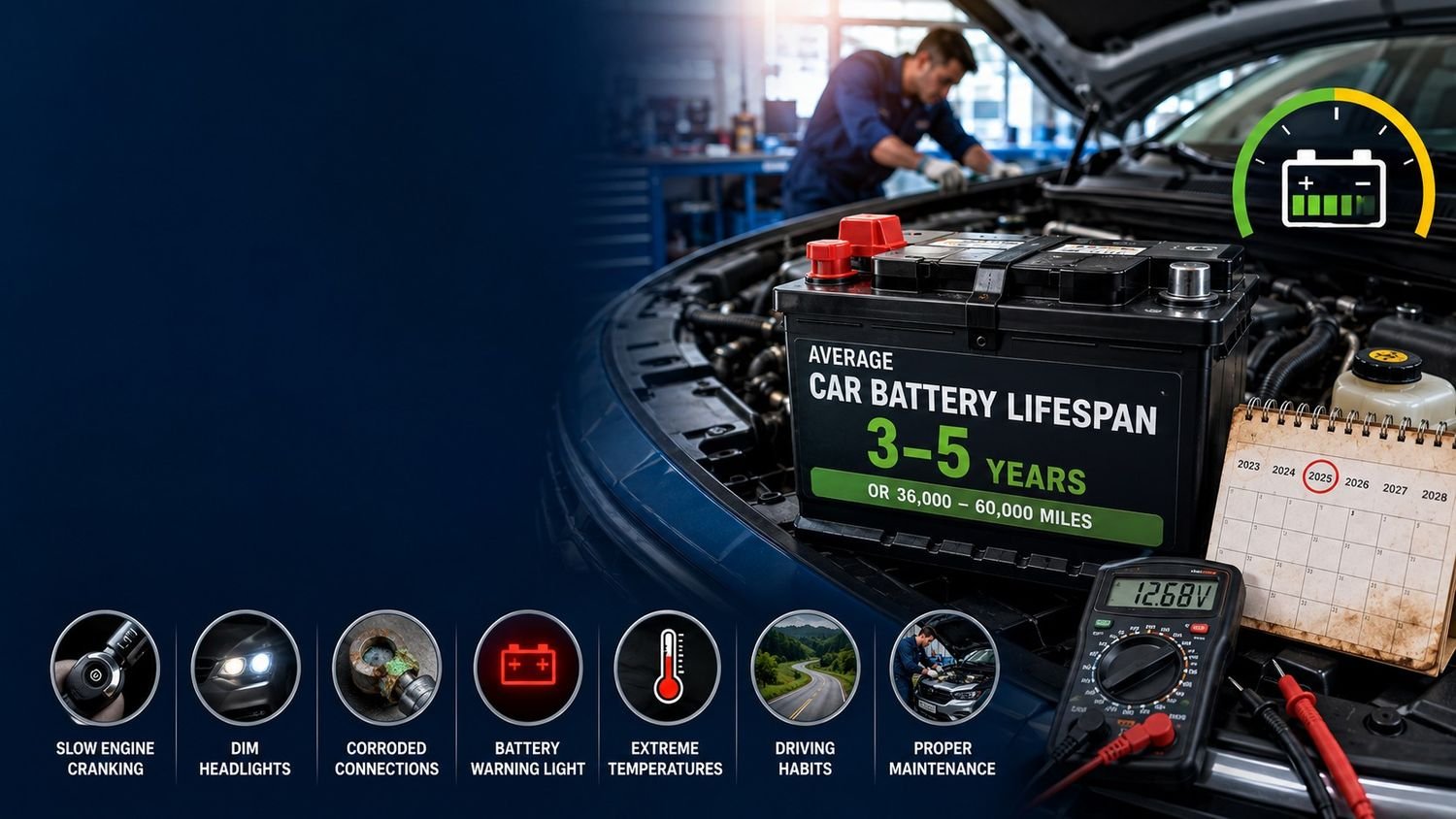
Lifespan varies significantly by battery chemistry and construction. Here’s what to expect from the most common types:
| Battery Type | Average Lifespan | Relative Cost | Maintenance Needs |
| Flooded Lead-Acid | 3–5 years | Low | Moderate |
| AGM (Absorbent Glass Mat) | 4–7 years | Medium | Low |
| Lithium-Ion | 8–10+ years | High | Very Low |
| EV Traction Battery | 8–15+ years (or 100,000+ miles) | Very High | Very Low |
1. Flooded lead-acid batteries
Flooded lead-acid batteries are the standard in most gas-powered vehicles. They’re affordable and reliable but more sensitive to heat, vibration, and deep discharges.
2. AGM batteries
AGM batteries are increasingly common in vehicles with start-stop technology, since they handle frequent cycling better and resist vibration damage.
3. Lithium-ion batteries
Lithium-ion batteries, while still uncommon as a standard 12V starter battery, are gaining ground for their long service life and lighter weight.
4. Electric vehicle batteries
Electric vehicle batteries are a different category entirely: large lithium-ion packs designed for tens of thousands of charge cycles. Most EV manufacturers warranty their battery packs for 8 years or 100,000 miles, and real-world data suggests many last well beyond that, though capacity gradually declines over time.
What Affects Car Battery Life?
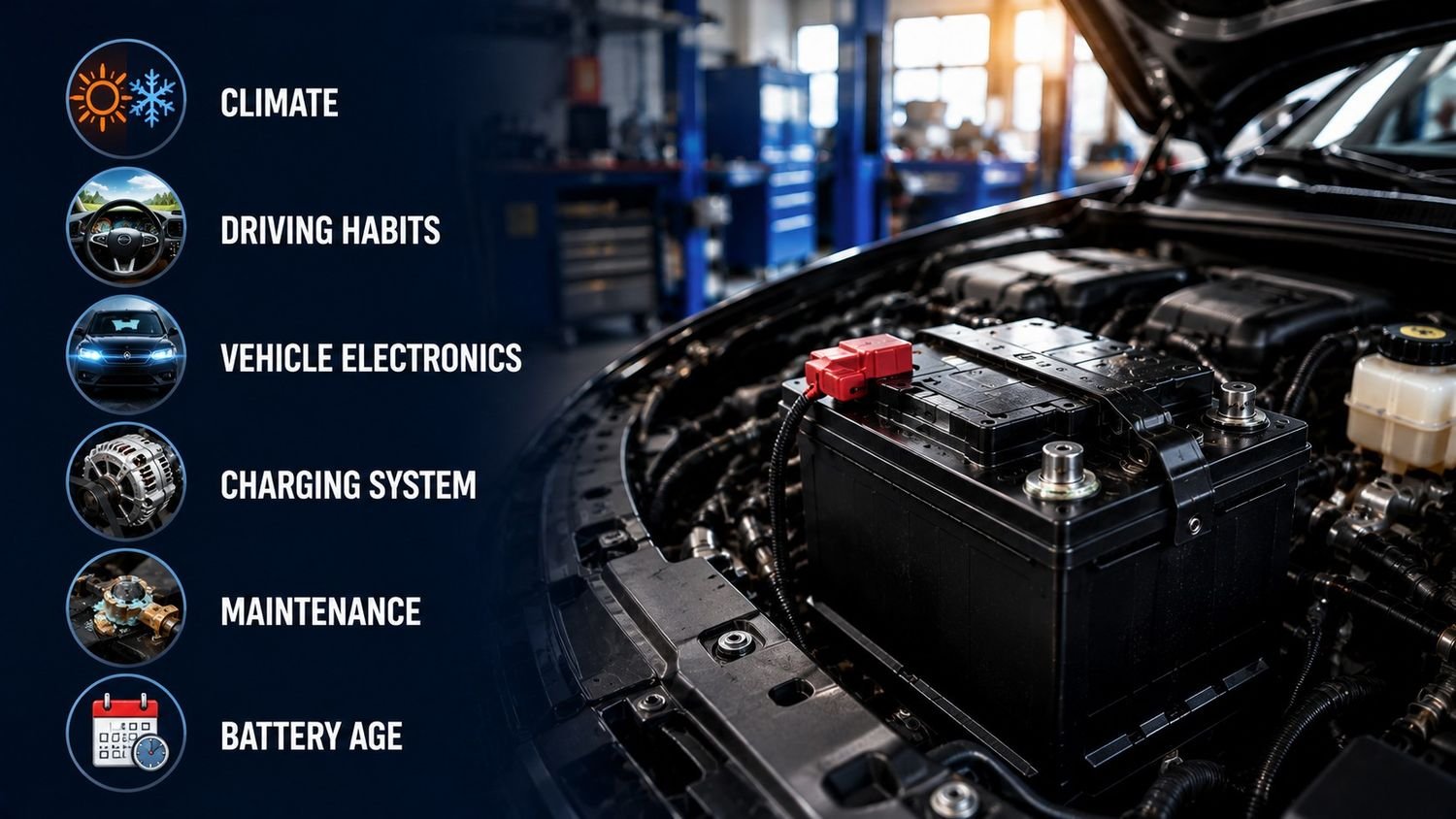
A battery’s rated lifespan is a starting point, not a guarantee. Several everyday factors push that number up or down.
Climate
Heat is the single biggest enemy of a car battery. High temperatures accelerate the chemical reactions inside the battery and evaporate internal fluid, which speeds up corrosion and capacity loss. Batteries in hot climates often need replacement closer to the 3-year mark.
Cold doesn’t damage a battery the way heat does, but it does reduce its ability to deliver power. A battery that’s already weakened by age or heat exposure is far more likely to fail on a freezing morning, since cold temperatures reduce the chemical reaction rate needed to produce cranking power.
Regional differences matter more than most drivers expect. In hot climates, the Southwest and Gulf Coast, for example, batteries often need replacing closer to the 3-year mark because sustained heat accelerates internal corrosion year-round. In cold-weather regions like the Upper Midwest or Northeast, batteries can last closer to 5 years chemically, but winter is when a marginal battery is most likely to actually fail, since cold weather roughly doubles the cranking power an engine needs to start. The practical takeaway: hot-climate drivers should test annually starting at year 2–3; cold-climate drivers should test every fall before the first freeze.
Driving Habits
Short trips prevent the alternator from fully recharging the battery after the high current draw of starting the engine. Repeated short drives leave the battery chronically undercharged, shortening its life.
Long trips and consistent daily driving, by contrast, give the alternator time to keep the battery topped off, which supports a longer lifespan.
How this plays out for real drivers:
- Daily commuters with a 20–30 minute drive each way typically get a battery’s full rated lifespan, since the alternator has time to fully recharge it after each start.
- Infrequent drivers, such as owners of a weekend car or a second vehicle that sits for days at a time, are at higher risk of early failure. Parasitic drains slowly deplete the battery between drives, and it never gets a full recharge cycle. These owners should test twice a year and consider a trickle charger for long idle periods.
- Rideshare and delivery drivers put unusually high demand on the electrical system: frequent short stops, constant phone charging, dash cams, and navigation running continuously. This combination of heavy accessory load and stop-and-go driving tends to shorten battery life, making AGM batteries, which are built to handle frequent cycling, a better fit than standard flooded lead-acid.
Vehicle Electronics
Modern cars carry more electrical load than ever: dash cams, GPS units, security systems, infotainment screens, and always-on modules. Even when the engine is off, some of these draw a small “parasitic” current. Over time, that constant drain can wear down a battery faster, especially if the car sits unused for days at a stretch.
Charging System
A battery is only as good as the system charging it. A failing alternator either undercharges the battery (leaving it perpetually low) or overcharges it (cooking the internal components). If your battery keeps dying despite being relatively new, the alternator, not the battery, may be the real problem.
Maintenance
Corrosion on the battery terminals and loose or dirty connections restrict the flow of current, forcing the battery and charging system to work harder than necessary. Basic upkeep, like keeping terminals clean and connections tight, meaningfully extends service life.
Cleaning corroded terminals takes about 10 minutes:
- Turn off the engine and disconnect the negative (–) terminal first, then the positive (+).
- Mix one tablespoon of baking soda with a cup of water to neutralize the corrosion.
- Dip a wire brush or old toothbrush in the solution and scrub the terminals and cable clamps until the buildup is gone.
- Rinse with a damp cloth and dry thoroughly.
- Reconnect the positive terminal first, then the negative, and tighten both securely.
- Apply a thin layer of dielectric grease or petroleum jelly to the terminals to slow future corrosion.
Doing this once or twice a year, more often in humid or coastal climates, prevents the voltage drop that corrosion causes and reduces strain on the charging system.
Signs Your Car Battery Is Dying
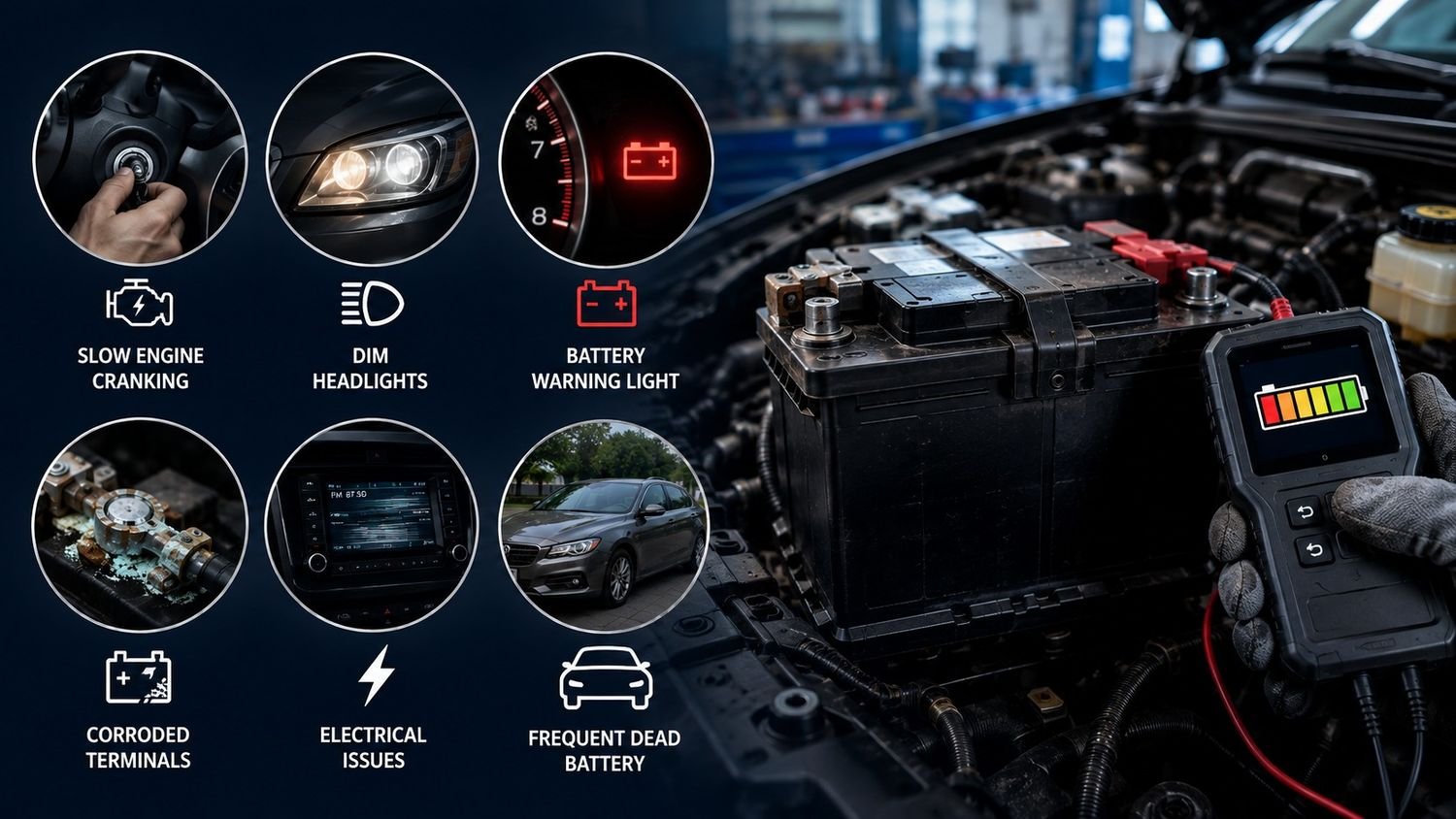
Batteries rarely fail without warning. Watch for these signs:
- Slow engine crank: the engine turns over sluggishly before starting
- Clicking noise when you turn the key, without the engine starting
- Dim headlights or interior lights, especially when idling
- Dashboard battery warning light illuminated
- Electrical problems: power windows, locks, or infotainment acting erratic
- Swollen or bloated battery case, often from heat damage
- Corroded terminals with white or bluish buildup
- Frequent jump starts needed to get the car running
If you notice two or more of these signs, it’s worth testing the battery before it strands you. If your car won’t start at all, see our guide on Car Won’t Start? Common Causes to help narrow down whether the battery, starter, or alternator is at fault, or How to Jump Start a Car if you need to get moving right now.
How to Test a Car Battery
You don’t need to guess whether a battery is failing. You can test it directly.
- Multimeter test. With the engine off, set a multimeter to DC volts and touch the probes to the battery terminals. A fully charged battery should read around 12.6 volts. Anything below 12.4 volts suggests a partial charge, and readings under 12 volts often indicate a battery that needs replacing.
- Battery load tester. A dedicated load tester applies a simulated engine-start load and measures how well the battery holds voltage under stress, giving a more accurate picture than a resting voltage reading alone.
- Auto parts store testing. Most auto parts retailers will test your battery for free using a diagnostic tool, often while it’s still installed in the car.
- Professional inspection. A mechanic can test both the battery and the charging system together, which helps rule out an alternator issue before you replace the battery.
AAA, which conducts annual battery reliability research, recommends testing once a battery is more than three years old, since failure rates climb sharply after that point. It’s a useful rule of thumb even if your battery hasn’t shown any symptoms yet.
How to Make Your Car Battery Last Longer
A few consistent habits can add real years to a battery’s service life:
- Drive regularly. Aim for at least one drive of 20+ minutes weekly to let the alternator fully recharge the battery.
- Keep terminals clean. Remove corrosion with a wire brush and a baking-soda-and-water solution.
- Avoid leaving lights or accessories on when the engine isn’t running.
- Limit short trips where possible, or combine errands into one longer drive.
- Secure the battery in its tray, since excess vibration shortens internal component life.
- Test the battery annually once it passes the 3-year mark.
- Protect it from extreme temperatures with a battery blanket or insulated case in harsh climates.
Helpful tools to have on hand: a basic digital multimeter (under $20) lets you check voltage in seconds, a portable jump starter pack means you’re never dependent on another driver, and a battery maintainer keeps infrequently driven vehicles topped off between drives. None of these are required, but each one either saves a tow-truck call or extends the life of the battery you already have.
When Should You Replace a Car Battery?
There’s no single trigger for replacement. It’s usually a combination of factors:
- Age. Once a battery passes 3–4 years (or 4–6 for AGM), start testing it regularly.
- Test results. A failed load test or a resting voltage consistently below 12.4V is a clear replacement signal.
- Performance symptoms. Slow cranking, dimming lights, or repeated jump starts mean the battery is on borrowed time.
- Manufacturer recommendations. Check your owner’s manual: some manufacturers suggest proactive replacement intervals for specific battery types.
A simple way to think about it: if the battery is old and showing symptoms and testing poorly, replace it now rather than waiting for it to fail on the road.
Cranking amp standards published by SAE International are what battery labels reference when listing cold cranking amps (CCA). Matching your replacement battery’s CCA rating to your owner’s manual specification, not just the size that physically fits, ensures the new battery performs as expected in your climate.
Car Battery Lifespan Comparison
| Battery Type | Average Life | Cost | Maintenance |
| Flooded Lead-Acid | 3–5 years | Low | Moderate |
| AGM | 4–7 years | Medium | Low |
| Lithium | 8–10+ years | High | Very Low |
Key Takeaways
A car battery’s lifespan isn’t fixed. It’s shaped by climate, driving habits, electrical load, and maintenance. Most batteries last 3–5 years, but testing annually after the three-year mark, watching for warning signs, and keeping up with basic maintenance can help you catch a failing battery before it leaves you stranded. When in doubt, get it tested. It only takes a few minutes and can save you an unexpected tow.
Frequently Asked Questions
Most car batteries last 3 to 5 years, though AGM and lithium batteries can last significantly longer with proper care.
It’s possible, particularly with a lithium or high-quality AGM battery and mild climate conditions, but it’s uncommon for standard flooded lead-acid batteries.
Extreme heat, frequent short trips, parasitic electrical drains, and poor maintenance are the leading causes of premature battery failure.
There’s no fixed schedule. Replace it based on age, test results, and performance symptoms rather than a calendar date alone.
Yes. Heat is generally considered the most damaging factor for battery longevity, accelerating internal corrosion and fluid evaporation.
Cold doesn’t directly damage a battery, but it reduces its cranking power, which can reveal weakness in a battery that’s already aging.
Slow cranking, dim lights, a dashboard warning light, clicking sounds, and the need for frequent jump starts are all common warning signs.
A healthy battery can typically sit for two to four weeks before parasitic drain depletes it enough to prevent starting. Connecting a trickle charger or battery maintainer extends that window indefinitely.
Costs vary by battery type and vehicle, generally ranging from budget lead-acid options to significantly higher prices for AGM and lithium batteries.
Most EV battery packs are warrantied for 8 years or 100,000 miles, with many lasting well beyond that before significant capacity loss.