
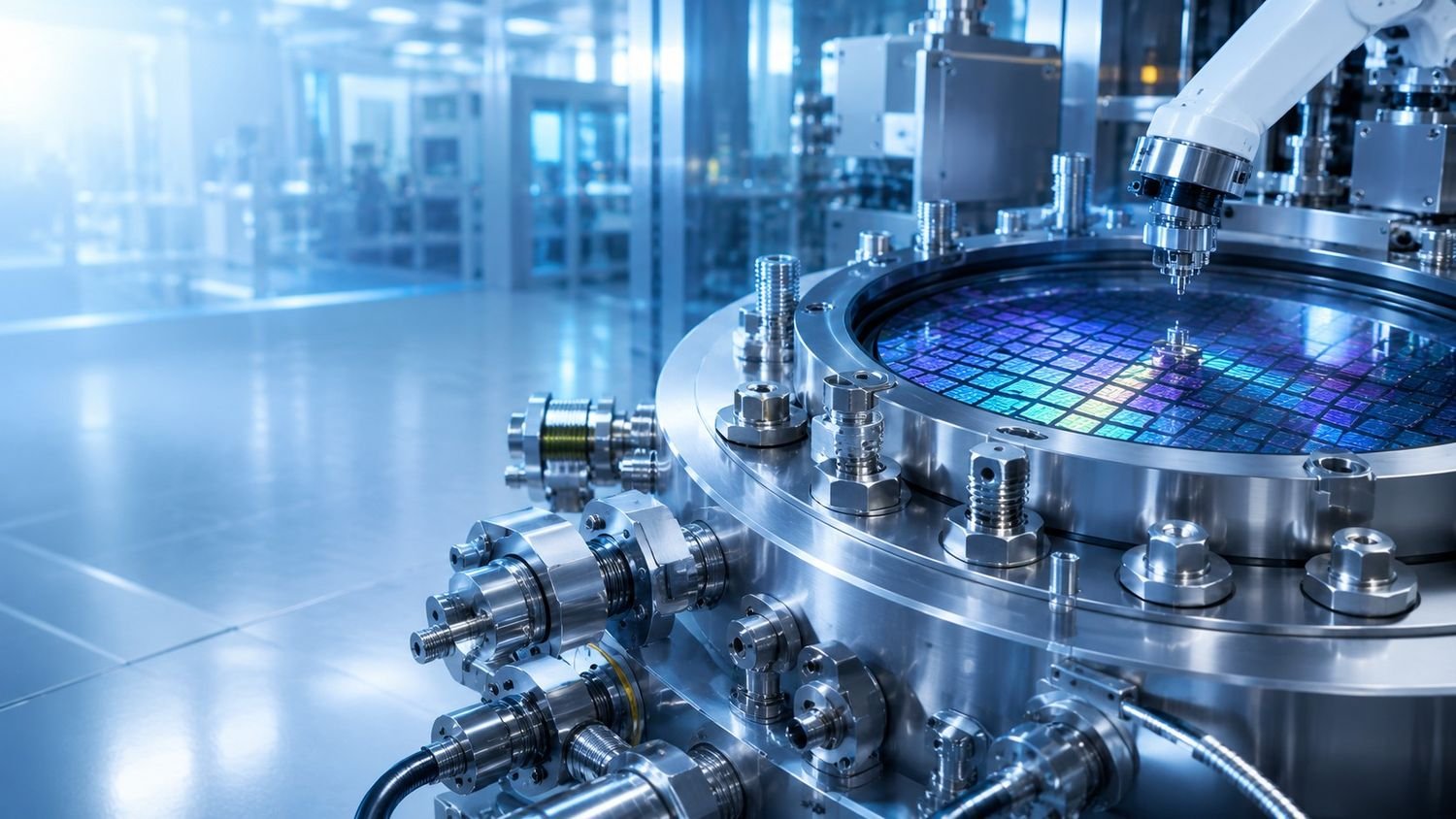
In semiconductor manufacturing, even the tiniest contamination can cost millions in lost yields. Standard fasteners might seem like minor components, but they can introduce particles, leak gases or degrade under intense heat. That’s where semiconductor fasteners made from high-purity exotic alloys come in. These specialized components resist corrosion and handle extreme temperatures while preventing the contamination that can ruin an entire production run.
The Impact of Micro-Contamination on Yield
Manufacturing semiconductors at sub-nanometer nodes requires extraordinary precision. When fasteners in processing equipment fail to meet purity standards, they become contamination sources. Trace impurities from low-grade materials can leach into the fabrication environment, while structural degradation releases microscopic particles directly onto wafer surfaces.
The financial consequences are staggering. Advanced semiconductor production operates on thin margins, where a single percentage point of yield loss can translate to millions in lost revenue. Critical defects caused by contamination may render entire wafers unusable. Equipment that relies on standard fasteners also risks vacuum integrity failures, where trapped gases gradually leak into supposedly sealed chambers. Production then suffers until engineers identify and correct the source.
Airborne molecular contamination is one of the primary sources of defects in modern fabs. Degraded semiconductor fasteners release metallic ions into the cleanroom atmosphere while their deteriorating surfaces shed particles that circulate through ventilation systems. The solution lies in using materials engineered to maintain their integrity under extreme processing conditions.
Choosing High-Performance Semiconductor Fasteners for Maximum ROI
Preventing contamination starts with the right materials. Processes like chemical vapor deposition (CVD) subject fasteners to high temperatures and aggressive chemical environments. Standard alloys can’t uphold structural stability under these conditions. That’s why semiconductor manufacturers increasingly turn to high-nickel-content alloys designed for cleanroom applications.
The shift toward high-purity components shows a broader industry trend as fabrication nodes shrink. Materials that perform adequately at larger scales become liabilities at atomic precision. Nickel Systems offers specialized fastener solutions engineered to meet these demanding requirements. As a true stocking distributor, the company ships hard-to-find specialty components for immediate delivery when downtime costs accumulate rapidly.
“In the realm of electronics, where precision, miniaturization and having the right material properties are essential, fasteners consisting of specialty metals for electronics are integral to meeting design and performance requirements,” says Nickel Systems on its website.
Harsh Chemical Resistance with Hastelloy® Alloys
Semiconductor etching and cleaning processes use highly corrosive chemicals that attack conventional fasteners. These nickel-chromium-molybdenum alloys maintain their integrity even in the harshest chemical environments in semiconductor fabs.
Hastelloy® C276 excels in both oxidizing and reducing media, making it ideal for wet processing equipment exposed to aggressive acids and caustic solutions. Its performance in etching chambers and cleaning stations has made it a preferred choice for operations handling hydrofluoric acid and other aggressive chemistries.
For broader chemical compatibility, Hastelloy® C22 delivers enhanced versatility across a wider range of corrosive media. This alloy handles environments where both oxidizing and reducing conditions may be present, providing reliable protection in multi-chemistry processing tools.
Applications involving nonoxidizing acids, like hydrochloric and sulfuric, benefit from Hastelloy® B2’s specialized protection. Its nickel-molybdenum composition makes it effective in equipment where these specific acid chemistries dominate the process environment.
Hastelloy® X750 brings high strength and oxidation resistance to elevated-temperature applications. This nickel-chromium alloy performs well in semiconductor equipment operating under high-stress conditions that have both thermal and mechanical demands. Its robustness ensures the secure fastening of critical components in advanced processing systems.
By resisting chemical attack, Hastelloy® alloys keep the fabrication environment free from metallic contamination sources that could compromise wafer quality. Their long service life also reduces maintenance frequency and associated cleanroom disruptions.
As Nickel Systems states, “The higher upfront cost of nickel alloy fasteners is offset by a notable return on investment, as their extended service life and reliability result in lower life cycle costs. For example, a chemical plant switching from 316SS to Hastelloy C276 for flange bolts in a hydrochloric acid environment can extend fastener life and eliminate repeated shutdowns.”
High-Temperature Performance with Inconel® Alloys
CVD and other thermal processes subject fasteners to extreme temperature cycling. Repeated thermal stress can cause conventional alloys to warp or lose mechanical properties, leading to alignment issues. When dimensional stability fails across temperature swings, equipment precision may suffer. Thermal expansion mismatches between fasteners and mounting surfaces create additional stress concentrations that can propagate into mechanical failures.
Inconel® 600 maintains its structural integrity across wide temperature ranges thanks to its nickel-chromium-iron composition. This material retains strength at elevated temperatures while resisting oxidation. Its thermal stability ensures secure torque retention and dimensional consistency throughout processing, preventing the micro-vibrations and loosening that can introduce contamination. The alloy’s resistance to high-temperature scaling prevents oxide formation, thus making it suitable for critical mounting applications.
Inconel® 625 delivers versatility where both thermal and chemical challenges converge. This nickel-chromium-molybdenum alloy combines high strength with exceptional resistance to aggressive processing conditions. Equipment exposed to corrosive chemistries at elevated temperatures benefits from its dual protection, keeping reliable performance where either thermal stress or chemical attack alone would degrade lesser materials. Its fabricability also allows for custom fastener configurations.
Long-Term Thermal Stability with Haynes 242
High-temperature processing equipment needs fasteners that maintain consistent performance through extended thermal exposure. Haynes 242, a nickel-molybdenum-chromium alloy, delivers exceptional strength and dimensional stability across sustained high-temperature operation. This material excels in applications where thermal cycling occurs repeatedly over the equipment’s service life.
The alloy’s composition resists thermal degradation that can compromise conventional fasteners in precision manufacturing environments. Its ability to retain mechanical properties under prolonged heat exposure makes it valuable for securing components in CVD reactors and other high-temperature semiconductor processing tools.
Mechanical Strength with Electroless Plated A286
Precise alignment becomes essential while enduring vibration from pumps and process dynamics, yet absolute purity standards cannot be compromised. Component failures lead to equipment misalignment and costly downtime. Clamping force is a balancing act where insufficient pressure allows O-ring seals to leak, while excessive torque can damage delicate surfaces.
Nickel Systems’ Electroless Plated A286 combines high tensile strength with excellent oxidation resistance and surface smoothness. This iron-nickel-chromium alloy delivers the physical robustness needed to prevent mechanical failures while meeting cleanroom purity requirements.
The electroless plating process enhances surface properties without introducing contamination risks, creating a smooth finish that resists particle adhesion. Its consistent mechanical properties across temperature ranges ensure reliable performance in equipment that experiences thermal cycling during operation.
Maximum Purity with Nickel 200
Applications requiring the highest purity standards benefit from Nickel 200’s commercially pure composition. This material offers excellent mechanical properties while maintaining minimal trace element content, making it ideal for fasteners in high-purity water systems and ultrapure processing equipment.
Its resistance to neutral and alkaline environments suits it for applications where even minor metallic contamination could affect sensitive processes. When contamination control takes absolute priority, and the chemical environment remains relatively mild, Nickel 200 provides reliable fastening without introducing unwanted impurities into cleanroom operations.
The Critical Role of Fastener Choice in Semiconductor Manufacturing
The choice of fastener is as important as the specialty metal. More than holding things together, the right fastener is about ensuring electrical connectivity, structural integrity and preventing contamination. Threaded fasteners, such as high-purity screws, bolts and nuts, are the workhorses that secure components in everything from vacuum chambers to CVD tools.
For applications that require ventilation to prevent gas pockets in cleanroom assemblies, specialized options like vented socket screws and custom vented fasteners are critical. These components, along with high-quality washers and standoffs, ensure a secure and stable fit, preventing contamination and protecting yields.
Fastener Choice Does Matter
Advancing semiconductor technology depends on controlling every potential contamination source. Equipment fasteners are precision components whose material properties influence manufacturing success at the atomic level. Choosing high-purity specialty alloys protects the yields that make next-generation chips possible.
Frequently Asked Questions (FAQs) on High-Purity Fasteners
Choosing semiconductor fasteners for critical processing equipment involves understanding how materials perform under specific conditions. These FAQs address the key considerations engineers face when specifying components for cleanroom environments.
Vented fasteners have ventilation channels that release trapped gas in high-vacuum environments, preventing pressure buildup and damage to delicate components. Nickel Systems provides custom vented screws, bolts and studs, all tailored to specific functions.
Material selection depends on process conditions. Hastelloy® C276 and C22 excel in chemically aggressive environments, while Inconel® 625 handles extreme temperatures with superior strength. For neutral environments, Nickel 200 offers high purity. Electroless Plated A286 offers robust mechanical properties and excellent surface characteristics. Temperature ranges, chemical exposure and mechanical stress levels in each application can guide proper selection. Consult with material specialists to match alloy properties to equipment requirements.
Blind-hole applications in vacuum chambers need vented screws to prevent trapped air from compromising chamber integrity. CVD equipment and other high-vacuum processes benefit from this design, as consistent pressure levels are critical to process outcomes. Applications without vacuum requirements or those using through-holes may not need vented designs.
The decision hinges on whether the assembly creates trapped volumes that could outgas during operation. Vented configurations add minimal cost while eliminating a potential source of vacuum performance issues.
Fasteners must have minimal trace element contamination while maintaining structural stability under process conditions. This means using base materials with tightly controlled compositions and manufacturing processes that prevent contamination. Surface finishes must resist particle generation. Minimal outgassing and dimensional stability across temperature cycles ensure these components do not become contamination sources during service. Certification and material traceability help prove that fasteners meet semiconductor industry purity standards.
Components that corrode or generate particles can compromise cleanroom integrity. Low-grade alloys introduce metallic ions and particulates that settle onto wafers, leading to defects. Thermal cycling can also loosen inferior fasteners and create vibration and alignment issues. Proper material selection supports yield targets and process consistency. When fasteners resist degradation, maintenance intervals extend and the frequency of cleanroom interventions decreases.
Nickel Systems offers custom-machined products. Non-standard dimensions, special venting configurations or application-specific material needs can all be addressed through its range of solutions. Working with knowledgeable distributors helps identify whether standard components suffice or if custom designs would better serve specific processing tools. Lead times for custom components vary based on complexity, but stocking distributors can often expedite delivery for urgent applications.