
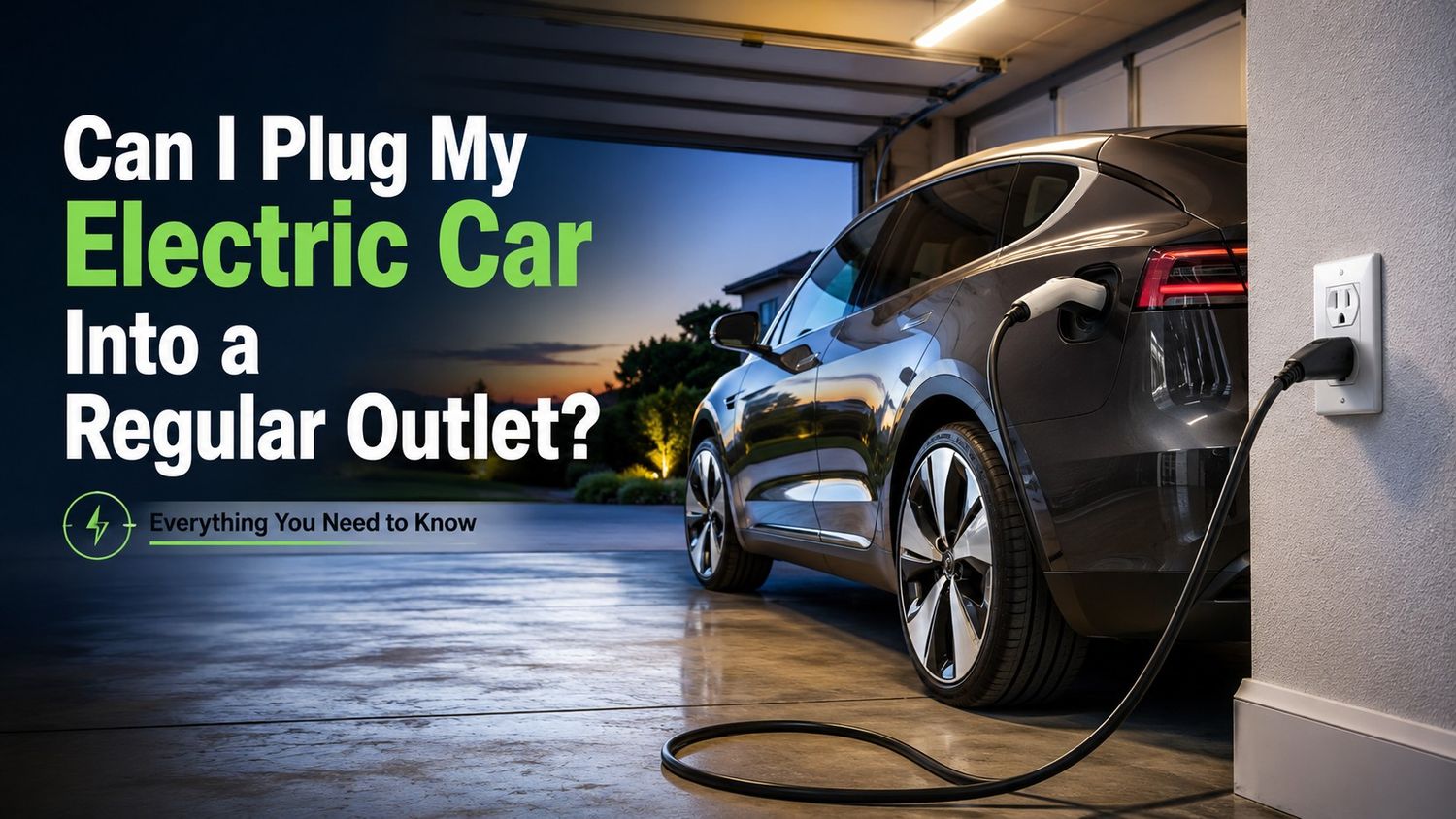
Quick answer: Yes, you can plug most electric cars into a regular household outlet. But there are limitations you should know before you rely on it every day.
If you’ve just brought home an EV, chances are the first question on your mind isn’t range or horsepower, it’s “how do I charge this thing tonight?” The good news is that almost every electric vehicle sold today comes with, or supports, a portable charging cable that plugs into a standard wall outlet. This is called Level 1 charging, and it works in any garage or driveway with an ordinary 120-volt (or 230-volt, depending on your country) outlet.
The catch is speed. A regular outlet delivers power far more slowly than a dedicated Level 2 charger, so it’s best suited to drivers with short daily commutes, plug-in hybrid owners, or anyone who just needs a backup charging option. In this guide, we’ll cover exactly how Level 1 charging works, how long it takes, whether it’s safe, what it costs, and how to decide if, or when, you should upgrade to something faster.
The Short Answer
Yes, you can plug your electric car into a regular household outlet, as long as a few conditions are met:
- Your EV came with (or you’ve purchased) a Level 1 portable charging cable
- The outlet is in good condition, ideally on its own dedicated circuit
- The outlet has GFCI (ground-fault circuit interrupter) protection
- You aren’t using an extension cord or cheap adapter
Level 1 charging is best for people who drive fewer than 40 miles a day, own a plug-in hybrid, live in a home without easy access to Level 2 installation, or simply want a low-cost, no-installation way to top off overnight.
What Is a Regular Household Outlet?
A “regular outlet” refers to the standard electrical socket already installed in most homes:
- 120V outlets: the standard household outlet in North America (the same one your toaster or lamp uses)
- 230V outlets: the standard household outlet in much of Europe, Asia, and Australia
When an EV charges from either of these using its included charging cable, it’s called Level 1 charging. No new wiring, no electrician, no permit: you simply plug in like you would any other appliance.
How Does Level 1 Charging Work?
Level 1 charging relies on a few key components working together:
- The charging cable: a portable unit, often included with your EV, that connects the wall outlet to your car
- The EVSE (Electric Vehicle Supply Equipment): the control box built into the cable that communicates with your car and regulates the flow of electricity for safety
- Power delivery: electricity flows from the outlet, through the EVSE, into the vehicle’s onboard charger, which converts it to a form the battery can store
- The Battery Management System (BMS): your car’s internal system that monitors temperature, voltage, and charge rate to protect battery health
On a standard 120V outlet, most EVs add roughly 3–5 miles of range per hour, though this varies by vehicle, outlet amperage, and ambient temperature. Over a full 8–10 hour overnight charge, that adds up to 25–50 miles, often enough for a typical day of driving.
How Long Does It Take to Charge?
Charging time depends heavily on battery size and the type of charger used. Here’s a general comparison:
| Battery Size | Level 1 (120V) | Level 2 (240V) | DC Fast Charging |
| 40 kWh (small EV) | ~24–30 hours | ~4–6 hours | ~30–40 minutes |
| 60 kWh (mid-size EV) | ~36–48 hours | ~6–8 hours | ~35–45 minutes |
| 100 kWh (long-range EV) | ~60+ hours | ~10–12 hours | ~40–60 minutes |
These figures assume charging from a low state of charge to nearly full. In practice, most drivers don’t fully deplete their battery, so daily “top-off” charging on Level 1 is far more realistic than these full-charge numbers suggest.
Is Charging With a Regular Outlet Safe?
Level 1 charging is generally safe, but only if you follow some basic precautions:
- Use a dedicated circuit: avoid sharing the outlet with other high-draw appliances
- Confirm GFCI protection: GFCI outlets cut power quickly if a fault is detected, reducing shock and fire risk
- Avoid extension cords: they aren’t designed for the sustained current draw of EV charging and can overheat
- Watch for heat buildup: check the outlet, plug, and cable periodically during long charging sessions; warmth is normal, but excessive heat is not
- Have older wiring inspected: homes with outdated electrical panels or worn outlets should be checked by a licensed electrician before regular EV use
- Follow manufacturer recommendations: your EV’s owner’s manual will specify approved charging equipment and outlet requirements
If your outlet is old, flickers, or trips breakers frequently, don’t use it for EV charging until it’s inspected.
Pros of Using a Regular Outlet
- No installation required: plug in and go
- Low upfront cost: no electrician, no equipment purchase beyond what’s included with your EV
- Convenient: works anywhere there’s a standard outlet
- Emergency charging: useful when traveling or visiting friends/family without a Level 2 charger nearby
- Overnight charging: ideal for topping off while you sleep
Cons
- Slow charging: adding only a handful of miles per hour
- Less efficient: more energy can be lost as heat compared to Level 2 charging
- Limited daily range: may not fully replenish a long commute overnight
- Shared circuit issues: running other appliances on the same circuit can trip breakers or slow charging further
Is Level 1 Charging Enough?
Whether Level 1 charging meets your needs comes down to your daily mileage:
| Daily Commute | Level 1 Overnight Charging (8–10 hrs) | Enough? |
| 20 miles/day | Adds ~30–50 miles | Yes, comfortably |
| 40 miles/day | Adds ~30–50 miles | Usually, with some margin |
| 80 miles/day | Adds ~30–50 miles | Often not enough, consider Level 2 |
If you’re consistently driving more miles per day than your overnight charge replenishes, you’ll gradually lose range and eventually need a faster solution.
Level 1 vs Level 2 Charging
| Feature | Level 1 (Regular Outlet) | Level 2 |
| Speed | 3–5 miles of range/hour | 20–30+ miles of range/hour |
| Installation | None | Requires a licensed electrician |
| Cost | Low (often $0 beyond included cable) | $500–$2,000+ including hardware and installation |
| Convenience | High for occasional use | High for daily, high-mileage use |
| Best User | Light drivers, PHEV owners, backup charging | Daily commuters, multi-EV households |
How Much Does It Cost?
Estimating your charging cost is straightforward:
Cost = (kWh added) × (your electricity rate per kWh)
For example, adding 30 miles of range on an EV that uses roughly 0.3 kWh per mile requires about 9 kWh. At a typical residential rate of $0.15 per kWh, that’s roughly $1.35 for the session.
A few things that affect your real-world cost:
- Peak vs. off-peak pricing: many utilities charge less overnight, when most Level 1 charging happens
- Your vehicle’s efficiency: larger, less efficient EVs use more kWh per mile
- Local electricity rates: costs vary significantly by region and provider
For most drivers, charging at home, even slowly, remains cheaper than public charging stations or gasoline.
Does It Hurt Battery Life?
If anything, Level 1 charging is gentler on your battery than fast charging:
- Battery management systems regulate charging speed and temperature regardless of charger type, but slower charging generates less heat overall
- Slow charging advantages: lower heat and lower current stress may support long-term battery health
- Charging to 80%: many manufacturers recommend charging to 80% for daily use and reserving 100% charges for long trips, regardless of charger level
- Charging habits: frequent shallow charges (rather than deep discharges) are generally considered better for lithium-ion battery longevity
Common Mistakes
- Using extension cords: increases fire risk and voltage drop
- Using cheap or uncertified adapters: can overheat or fail to regulate current properly
- Sharing circuits: running the charger alongside other major appliances can overload the circuit
- Charging in wet conditions with damaged connections: inspect cables and connectors before use, especially outdoors
- Ignoring tripped breakers: a recurring trip is a sign of a wiring or circuit issue, not something to simply reset and ignore
When Should You Upgrade to a Level 2 Charger?
Ask yourself:
- Do I regularly drive more than 40–50 miles per day?
- Does my overnight charging session fail to fully replenish what I used?
- Do I own more than one EV that needs to charge at home?
- Am I frustrated by how long a full charge takes?
- Do I have a dedicated parking spot where a Level 2 charger could be installed?
If you answered “yes” to two or more of these, it’s likely time to consult an electrician about installing a Level 2 charging station.
Conclusion
So, can you plug your electric car into a regular outlet? Yes, you can, and for many drivers, it’s a perfectly practical way to charge. It’s safe when done correctly, ideal for light daily drivers and plug-in hybrid owners, and requires no installation or upfront investment. But if your daily mileage starts outpacing what an overnight Level 1 charge can replenish, it’s a sign that a Level 2 charger could save you time, hassle, and range anxiety.
Not sure which option is right for you? Talk to a licensed electrician about your home’s wiring, or explore Level 2 charger installation if your daily driving calls for faster charging.
Explore More:
- What are Advantages of Electric Vehicle?
- How Much Does It Cost to Charge an Electric Vehicle?
- Are Electric Cars Better for the Environment?
Frequently Asked Questions
Most EVs can charge from a regular outlet using their included or an approved portable Level 1 charging cable, though charging speed varies by vehicle.
Many manufacturers include a portable Level 1 cable, but some have moved to selling it separately, so check your vehicle’s documentation.
An 8–10 hour overnight session on Level 1 typically adds around 25–50 miles of range, depending on the vehicle.
No, extension cords aren’t rated for the sustained current EV charging requires and can pose a fire risk.
Yes, but usually modestly; charging overnight during off-peak hours can help minimize the cost increase.
Yes, when using a dedicated, GFCI-protected outlet in good condition and following manufacturer guidance.
It may help reduce heat-related battery stress compared to fast charging, though overall battery health depends on many factors.
EV charging equipment is designed to handle outdoor exposure, but always inspect cables and connections for damage before use.
It’s strongly recommended to avoid overloading shared circuits and reduce fire risk.
If your daily driving exceeds what overnight Level 1 charging can replenish, a Level 2 charger is worth considering.
Typically 25–50 miles on a standard 120V outlet over 8–10 hours, depending on the vehicle.
It’s less efficient than Level 2 charging, with slightly more energy lost as heat during the process.
240V (Level 2) delivers power roughly 3–10 times faster than a standard 120V outlet.
Generally yes, especially when charging overnight during off-peak electricity rates.