
NUE tubing has non-upset ends; EUE tubing has externally upset ends. That difference in the pipe end that receives the thread reaches the coupling, the external clearance and the checks behind every selection. EUE gives a locally enlarged end, but its connection must still be verified for loads, sealing performance and clearance — and neither designation alone proves a tubing string suits a well.
NUE and EUE are familiar terms in oilfield tubing specifications, yet they are often treated as interchangeable labels for threaded pipe. The distinction becomes clearer when the pipe body, threaded end and coupling are viewed as separate components.
This article compares those components and explains which checks change when selecting between the two configurations. It focuses on standard coupled tubing, not casing threads or proprietary premium connections.
Key Takeaways
- NUE and EUE describe the pipe end, not the whole joint. A coupled NUE connection still has its own coupling outside diameter.
- The external upset is local to the end region. It is not a strength rating and does not make the tube thicker along its length.
- Outside clearance and inside passage are separate checks: use the connection envelope for the first and drift data for the second.
- Specify the full connection, not just “threaded tubing”, and review clearance, accessories and assembly whenever the end configuration changes.
NUE Tubing: Non-upset End and a Separate Coupling
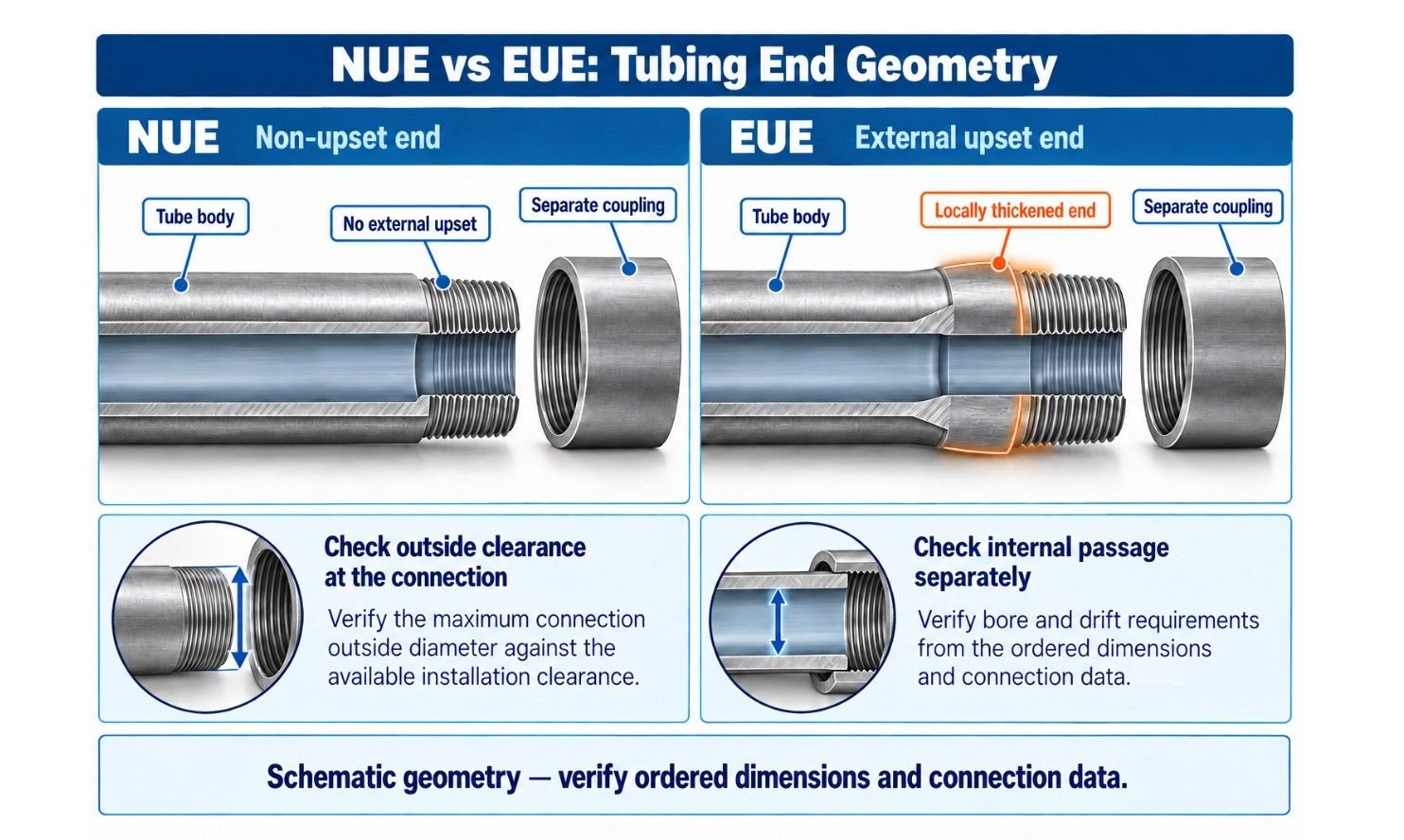
NUE means non-upset end. The tubing end is not intentionally enlarged by upsetting before the external thread is formed. A separate internally threaded coupling connects matching threaded ends.
“Non-upset” does not mean that the assembled connection is flush with the tubing body. The coupling has its own outside diameter. An engineer checking clearance must therefore use the connection envelope, not just the nominal tubing OD.
NUE is one of the standard connection options associated with API 5CT tubing pipe. The complete item description still needs the selected tubing size, weight designation, grade and connection requirements.
EUE Tubing: What the External Upset Changes
EUE means external-upset end. The end region is formed with additional material on the outside before threading. This changes the geometry supporting the threaded connection without making the full tube a uniformly thicker pipe.
The extra end material is relevant to connection design, but “upset” is not a universal strength rating. Joint performance must be established for the particular size, grade and connection. It should not be inferred from a photograph of a thicker end.
For standard configurations of the same tubing size, the EUE coupling generally has a larger external envelope than the NUE coupling. That difference can matter where tubing passes through a restricted space. Confirm the controlled drawing, including any special-clearance option, before making the comparison.
NUE vs EUE: Side-by-Side Comparison
| Feature | NUE | EUE |
|---|---|---|
| End configuration | Non-upset pipe end | Externally upset pipe end |
| Local end geometry | No intentional external upset | Locally enlarged outside profile |
| Connection components | Matching threaded ends and coupling | Matching upset threaded ends and coupling |
| External clearance | Check coupling OD as well as tubing OD | Check upset and coupling envelope as well as tubing OD |
| Performance review | Use the applicable connection data | Use the applicable connection data; do not assume a rating from the upset alone |
| Interchangeability | Requires the specified mating geometry | Requires the specified mating geometry |
The table describes configuration differences, not a ranking. “EUE is always better” and “NUE is always sufficient” both skip the engineering review that makes the choice meaningful.
Coupling Envelope: Why Tubing OD is Not the Clearance
Tubing OD describes the pipe body. It does not describe the largest external dimension along an assembled string. Couplings and other completion components may govern the space needed to run the assembly.
Imagine two otherwise comparable tubing options for a restricted completion. One option offers a larger connection envelope. That option cannot be accepted solely because its pipe body has the correct nominal OD; the connection must also fit the approved clearance arrangement. This is a conceptual example, not a recommendation for a particular well.
The API 5CT tubing dimensions, weight and drift database places tubing-body and NUE/EUE coupling dimensions alongside one another. Use the selected row as a reference, then verify the actual connection drawing and project requirements. Special-clearance or proprietary designs need their own identified data.
Outside Clearance vs Inside Passage: Two Separate Checks
Outside clearance concerns the space occupied by the tubing and its connections. Inside passage concerns the space available for the intended tools or flow path. They are related to the same assembly but are different checks.
Nominal ID is a reference dimension. Drift testing verifies passage of a specified gauge under defined conditions. Neither a nominal ID calculation nor the word “EUE” establishes passage through every component in a completion.
| Design question | Information to compare | Shortcut to avoid |
|---|---|---|
| Will the string fit externally | Tubing, upset and coupling envelopes against available space | Comparing tubing-body OD alone |
| Will the intended tool pass | Required passage, drift and local restrictions | Treating nominal ID as a complete passage guarantee |
| Will the connection carry the loads | Applicable connection performance and approved load cases | Selecting by the appearance of the upset |
| Will it meet sealing requirements | Connection qualification and service requirements | Assuming every threaded connection is equivalent |
| Will accessories mate correctly | Exact thread and accessory designations | Matching only nominal size |
Thread Standards and Make-up: Performance Depends on Assembly
A correct connection designation does not remove the need for correct handling and make-up. Thread condition, compatible accessories, the specified compound and the applicable assembly procedure remain relevant to both NUE and EUE.
Tenaris’s API 8 Round Connections running guidance includes NUE and EUE within its scope and addresses cleaning, inspection, accessory compatibility, thread compound and make-up. These are connection-specific operating topics; a general comparison article should not replace them with a universal torque value.
API Spec 5B provides the standard framework for threading, gauging and inspecting relevant API threads. The API explanation of Spec 5B describes that role. For an order, identify the applicable edition and required connection rather than relying on the phrase “standard thread.”
How to Choose Between NUE and EUE Tubing
Begin with the completion’s specified connection and performance requirements. If both configurations remain candidates, compare their actual connection data and external envelopes, then check compatibility with the planned accessories and passage requirements.
Where a project requires a named premium connection or a qualified performance envelope, do not replace it with NUE or EUE on the assumption that a standard API thread is equivalent. Conversely, the need for a premium connection should follow the project’s requirements rather than a general claim that one label is more advanced.
The resulting selection should name the full connection, not merely say “threaded tubing.” Any change to the selected end configuration should trigger a review of the affected coupling, accessories, clearance and assembly information.
FAQ: NUE and EUE Tubing
Not necessarily. A standard coupled NUE connection includes a coupling with its own outside diameter. Non-upset describes the pipe end, not the entire joint envelope.
No. The external upset is local to the end region. Specify the pipe-body wall or weight designation separately.
Do not assume interchangeability. Matching nominal tubing size does not establish matching thread and coupling geometry. Use the exact approved connection and accessories.
No. The designation describes the end configuration. Required sealing performance must be established for the actual connection and service.
Conclusion: A Local Difference, A System-Wide Review
NUE and EUE differ at the tubing end, yet that difference affects more than the end profile. A sound comparison follows the connection outward to clearance and accessories, and inward to passage requirements. That is more useful than choosing a connection by its abbreviation alone.