
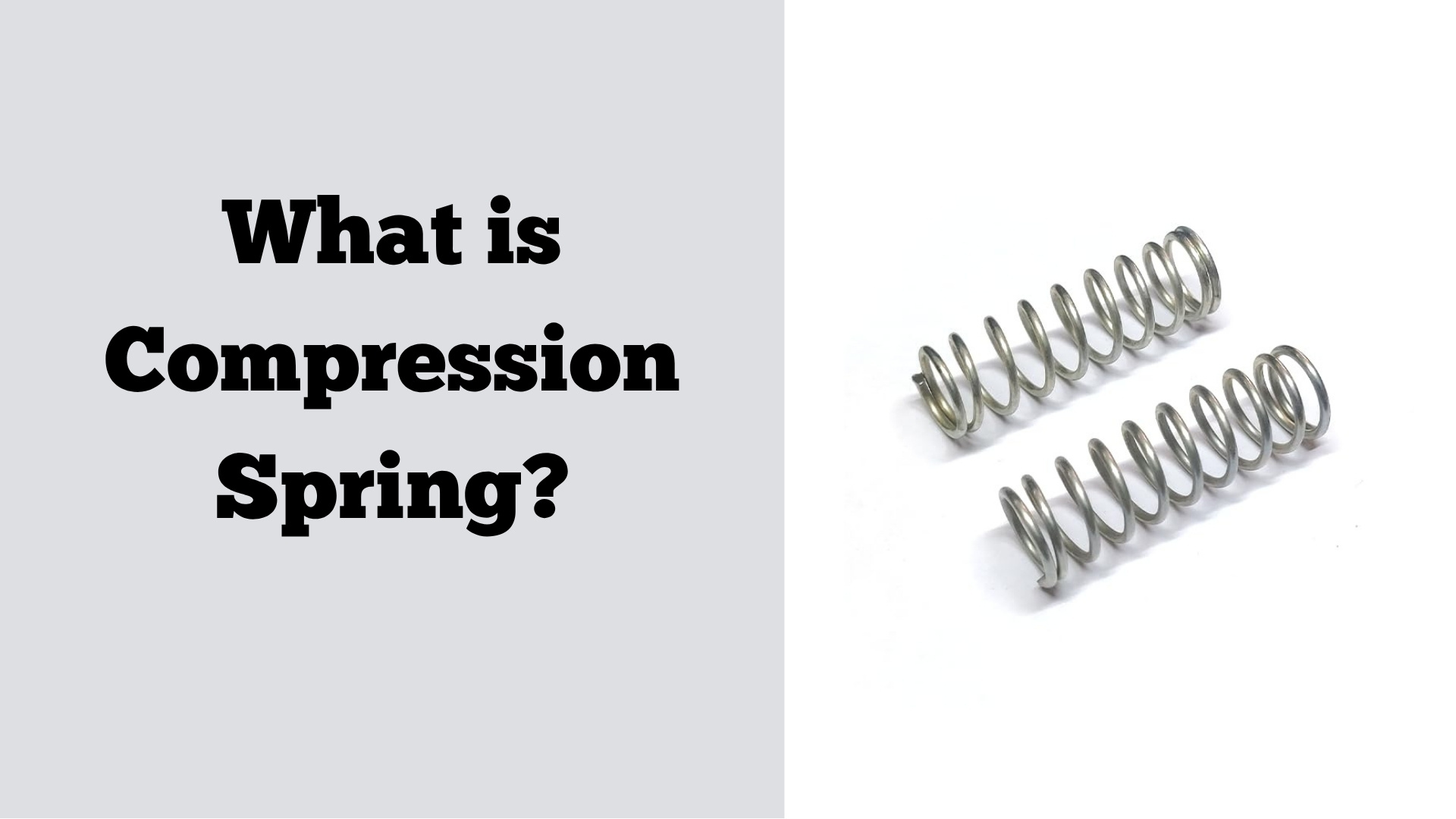
You’ve seen thousands of compression springs in your life – inside ballpoint pens, car suspensions, push-button switches, and mattresses – but most people never stop to think about what makes these deceptively simple components so indispensable. If you’re an engineer sourcing a replacement spring, a designer specifying hardware, or just curious about how they work, this guide covers everything you need to know.
What Is a Compression Spring?
A compression spring is a mechanical component made from coiled wire or bar stock that stores and releases energy by resisting compressive force. In its natural, unloaded state, the spring is fully extended – its coils spaced apart so they don’t touch. Push the two ends toward each other, and the coils compress, storing torsional energy that pushes back the moment you release the load.
Compression springs are sometimes called coil springs or helical compression springs, and they represent the most recognizable spring type in mechanical engineering. Unlike extension springs (which pull) or torsion springs (which twist), compression springs always push outward – they want to return to their resting height.
How Does a Compression Spring Work?
The physics behind compression springs is rooted in Hooke’s Law: the force a spring exerts is directly proportional to how far it’s been compressed from its natural length. In formula form:
F = k × x
Where:
- F = force exerted (in pounds or Newtons)
- k = spring rate (stiffness, in lb/in or N/mm)
- x = distance compressed from free length
This relationship stays linear throughout most of a spring’s working range. Double the compression, double the force. That predictability is exactly why engineers rely on compression springs for precise force and motion control in everything from fuel injectors to surgical instruments.
When a spring is compressed all the way until every coil touches, it has reached its solid height – the absolute minimum compressed length. Designing an application so the spring never bottoms out at solid height is critical for longevity and safety.
Types of Compression Springs
Not all compression springs are shaped the same. The coil geometry determines how the spring performs under load, how much space it takes up, and whether it can resist buckling.
1. Cylindrical (Straight) Springs
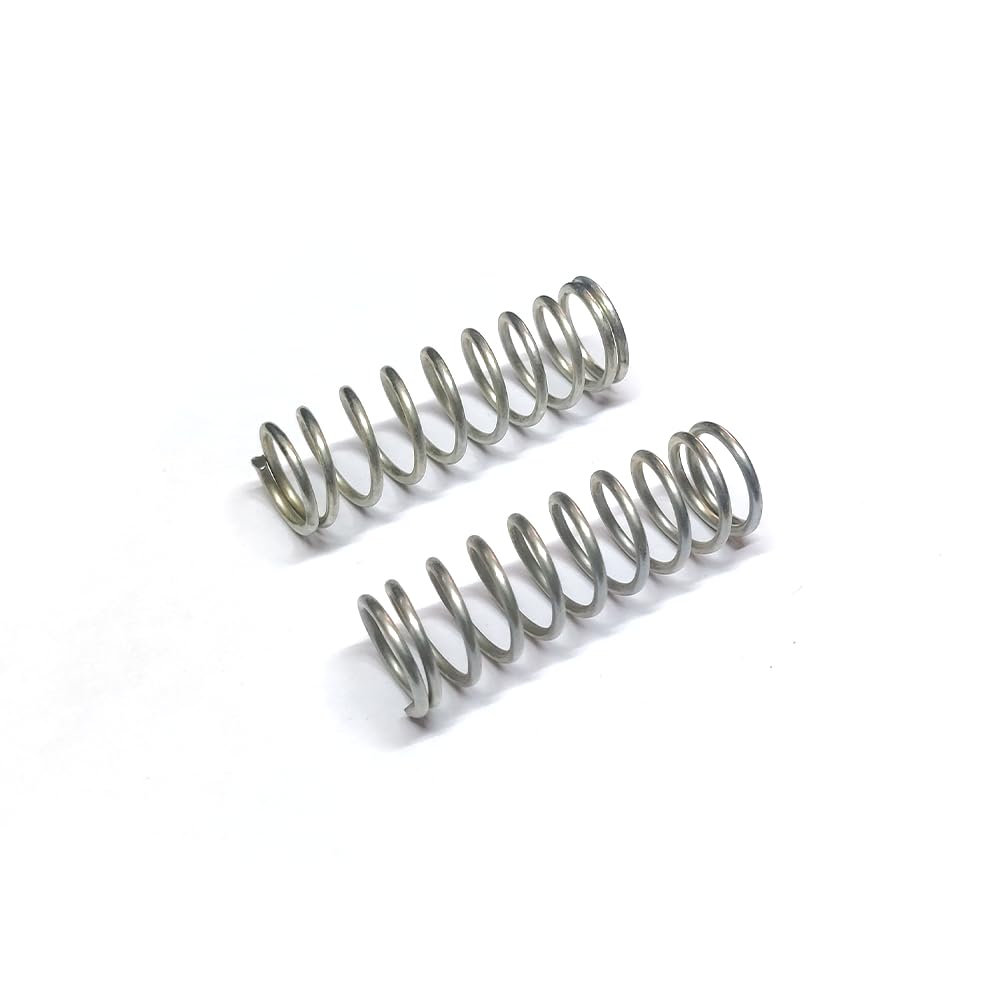
The most common type. Consistent coil diameter from top to bottom, predictable linear spring rate, and easy to manufacture in large quantities. These are what most people picture when they think of a spring and what you’ll find in the vast majority of industrial and consumer applications.
2. Conical (Tapered) Springs
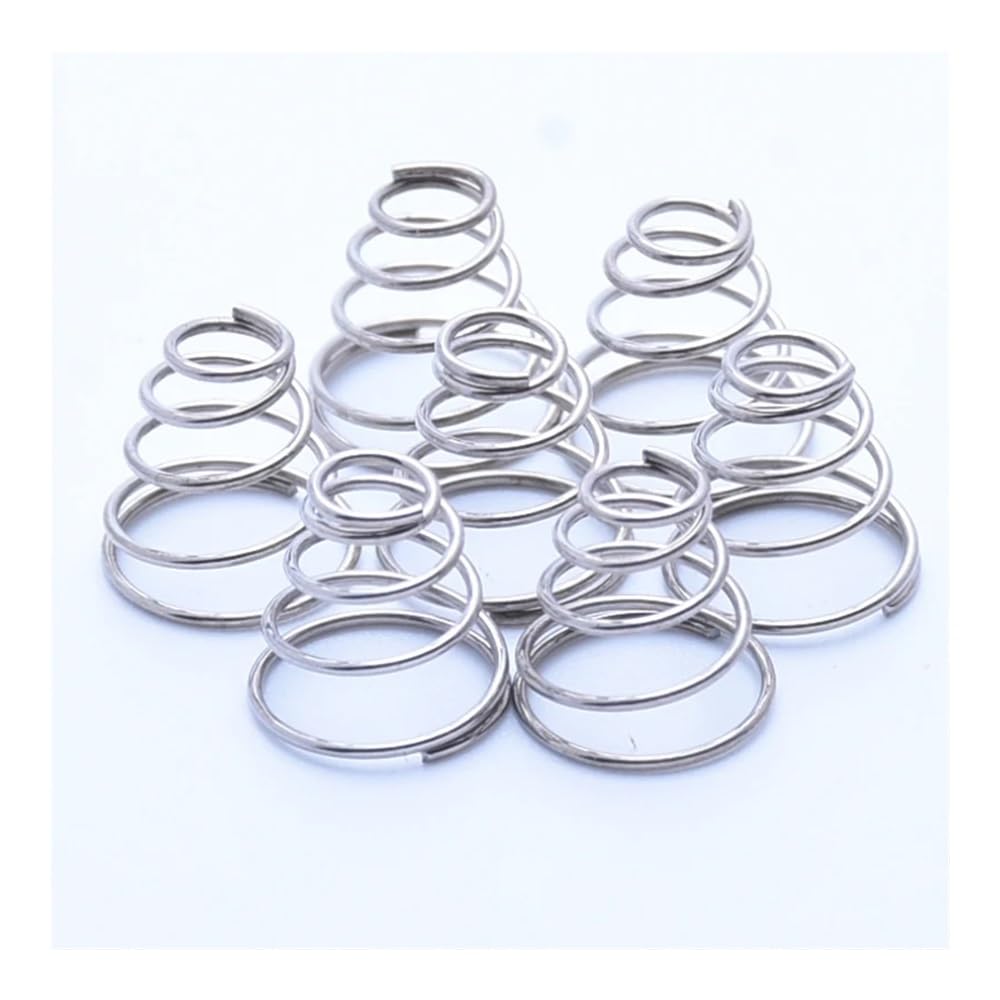
Shaped like a cone, with the diameter graduating from wide at one end to narrow at the other. When compressed, the smaller coils nest inside the larger ones, achieving an extremely low solid height – sometimes as thin as a single wire diameter. This makes conical springs ideal for applications with tight space constraints, like valve seats, battery contacts, and circuit breakers. They also resist buckling better than straight cylindrical springs.
3. Barrel (Convex) Springs
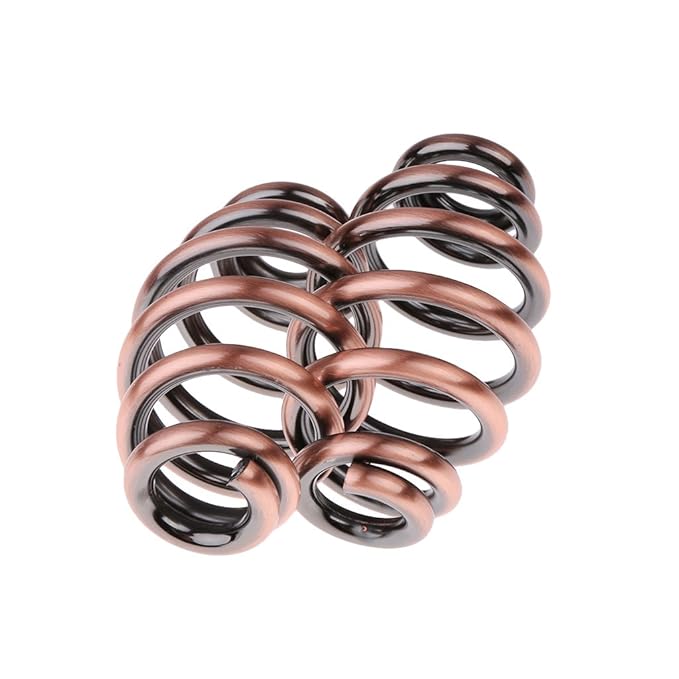
Widest in the middle, narrowing toward both ends. The geometry provides inherent anti-buckling stability, making them suitable for vehicle seats, mattresses, and applications where a guide rod isn’t practical. They also offer a progressive spring rate – they stiffen as they compress, since the outer (larger) coils close off first.
4. Hourglass (Concave) Springs
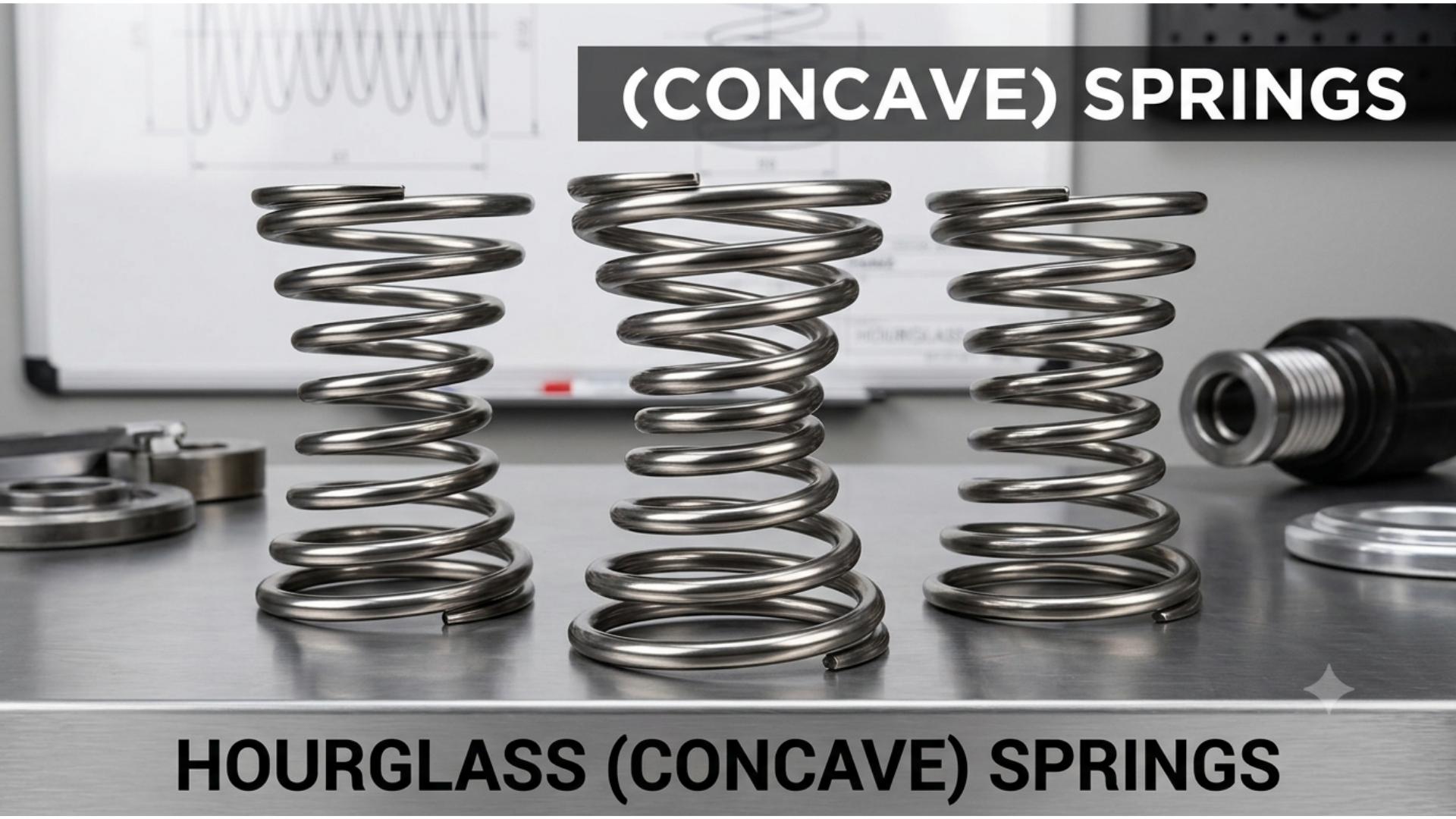
The inverse of a barrel spring – smallest in the middle, wider at both ends. Like conical springs, their nested geometry allows a very low solid height, and their shape provides excellent lateral stability.
5. Variable Pitch Springs
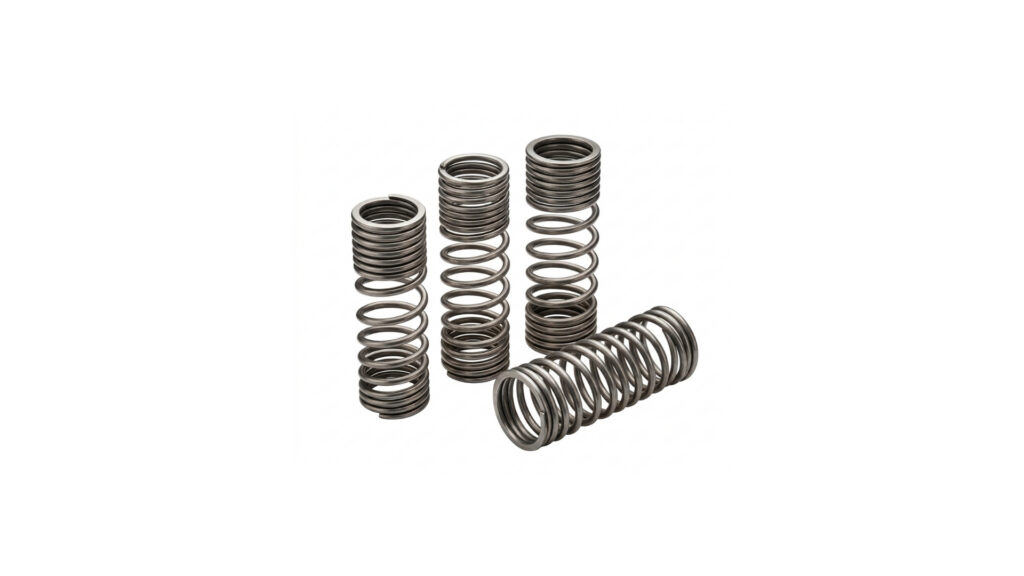
Standard cylindrical springs have uniform spacing (pitch) between coils. Variable pitch springs intentionally vary that spacing, producing a non-linear force-deflection curve. When lightly loaded, the widely spaced coils compress easily; as load increases, the closely spaced coils engage, stiffening the spring. They’re widely used in shock absorbers and performance suspension systems where progressive resistance is needed.
Also Read:
- Types of Gauges in Metrology – Complete Explanation
- Types of Screwdrivers and Their Uses (Complete Guide)
- Different Types of Screws Heads – That You Must Know
Common Materials and When to Use Them
Material selection directly affects a compression spring’s strength, corrosion resistance, temperature rating, and cost.
| Material | Best For | Key Property |
| Music Wire (ASTM A228) | General indoor use, high-cycle applications | Highest tensile strength of common spring steels |
| Hard-Drawn MB Wire | Low-cost, static-load applications | Good value, moderate strength |
| Oil-Tempered Wire | Larger diameter springs, precision forming | Consistent tensile strength, excellent straightness |
| Stainless Steel 302/316 | Outdoor, corrosive, or food-contact environments | Corrosion and heat resistance |
| Chrome Silicon | High-temperature or high-stress applications | Superior fatigue life, resists relaxation |
| Phosphor Bronze / Brass | Electronics, marine environments, cold climates | Electrical conductivity, corrosion resistance |
| Inconel / Nickel Alloys | Extreme heat, aerospace, and chemical environments | Performance at 600°F+ |
For most everyday repairs and general industrial use, music wire or stainless steel 302 will cover 90% of your needs. When in doubt, stainless is the safer choice if there’s any chance of moisture exposure.
Key Dimensions and Design Parameters
To specify or measure a compression spring, you need to know these core dimensions:
- Free Length (FL): The total length when unloaded – the spring’s natural resting height.
- Outer Diameter (OD): The widest measurement across the spring. Critical when the spring fits inside a bore or housing.
- Inner Diameter (ID): The opening through the center. Critical when the spring fits over a rod or shaft. Allow 0.5–1.0 mm clearance for deflection.
- Wire Diameter (d): The thickness of the wire itself. This single measurement has the most influence on spring rate – it appears to the fourth power in the spring rate formula.
- Number of Active Coils (N): The coils that actually flex under load. Closed and ground end springs have 1.5–2 inactive (dead) coils at each end.
- Solid Height (SH): The length when all coils are touching. The spring must never reach solid height in normal operation.
- Spring Rate (k): How stiff the spring is, expressed in lb/in or N/mm.
End Types affect how the spring seats and loads:
- Open End: No closure at the end coil. Spring must be mounted on a rod for stability.
- Closed End: Last coil wound tightly against the adjacent coil, creating a more stable base.
- Closed and Ground: Closed end that’s machined flat. The most stable option, ideal for precision applications where squareness under load matters.
How to Calculate Spring Rate
There are two practical ways to calculate spring rate.
Method 1 – By Load and Travel (Hooke’s Law):
k = F ÷ x
If you need a spring to support 50 lbs with 1.5 inches of compression, you need a spring rate of 50 ÷ 1.5 ≈ 33 lb/in. This is the fastest approach when you already know your force and travel requirements.
Method 2 – By Physical Dimensions:
k = (G × d⁴) ÷ (8 × D³ × N)
Where:
- G = Shear modulus of the material (music wire ≈ 11.5 × 10⁶ psi; stainless ≈ 11.2 × 10⁶ psi)
- d = Wire diameter (inches)
- D = Mean coil diameter (OD minus one wire diameter, in inches)
- N = Number of active coils
This formula is how engineers design a spring from scratch to hit a specific stiffness target. Because wire diameter is raised to the fourth power, even a 10% increase in wire thickness can nearly double the spring rate. That’s why measuring wire diameter with calipers – not a ruler – is essential when sourcing a replacement spring.
Quick practical tip: When replacing a spring and you don’t know the rate, compress the old spring fully by hand and measure its solid height. Any replacement must have a solid height shorter than the minimum installed gap in your assembly, or it will bottom out and fail.
Compression Spring vs. Extension Spring: Key Differences
| Feature | Compression Spring | Extension Spring |
| Resting state | Coils open/spaced apart | Coils touching (pre-loaded tension) |
| Force direction | Pushes outward (repels) | Pulls inward (attracts) |
| End type | Flat or open ends | Hooks or loops |
| Common use | Push-back mechanisms, shock absorption | Return mechanisms, tension-loading |
| Example | Car suspension, door latch | Garage door, trampoline |
The simplest distinction: compression springs push, extension springs pull.
Top Industries and Applications
Compression springs show up in almost every manufactured product. Here’s where they do the most important work:
Automotive:
Suspension coil springs absorb road impacts and maintain ride height. Valve springs in internal combustion engines operate at high speed and temperature thousands of times per minute. Clutch, brake, and gear-shift mechanisms all rely on compression spring return forces.
Medical Devices:
Surgical instruments, infusion pumps, diagnostic equipment, and implantable devices like pacemakers use precision compression springs where reliability is literally life-critical. These applications typically specify stainless steel or superalloys.
Consumer Electronics:
Battery contacts in remotes, toys, and portable devices use small compression springs to maintain consistent electrical contact. Keyboard switches, retractable pens, and push-button mechanisms all depend on them.
Industrial Machinery:
Stamping presses, conveyor systems, CNC machines, lathes, and assembly equipment use compression springs for everything from die cushioning to part ejection.
Aerospace:
Landing gear, flight control actuators, fuel system valves, and engine components require springs that maintain performance under extreme temperature, pressure, and vibration conditions.
How to Choose the Right Compression Spring
Follow this four-step selection process:
- Define your force and travel requirements. How much force does the spring need to exert, and at what compressed length? Use k = F ÷ x to determine the spring rate you need.
- Measure your space constraints. What’s the maximum outer diameter, inner diameter clearance, and free length that fits in your assembly? Know whether your constraint is OD (fitting inside a bore) or ID (fitting over a rod).
- Select the right material. Indoor and dry environment? Music wire or hard-drawn. Outdoor or chemical exposure? Stainless steel 302. High-temperature? Chrome silicon or Inconel. Electrical conductivity needed? Phosphor bronze.
- Verify solid height. Confirm that the spring’s solid height is less than the minimum compressed gap in your application. If it isn’t, the spring will bottom out and eventually fail – or cause damage.
If you can’t find a stock spring that matches all your requirements within ±10% tolerance, contact a custom spring manufacturer. Most offer quick-turn prototypes, and the cost difference between a standard and custom spring is often smaller than you’d expect for production quantities.
Key Takeaways
- A compression spring stores energy when compressed and releases it as a push-back force – always following Hooke’s Law (F = k × x).
- The five main types are cylindrical, conical, barrel (convex), hourglass (concave), and variable pitch – each suited to different space, load, and stability requirements.
- Wire diameter has the greatest influence on spring rate, because it’s raised to the fourth power in the design formula.
- Material selection comes down to environment and performance: music wire for general use, stainless for corrosion resistance, chrome silicon for high stress or high temperature, Inconel for extreme conditions.
- To choose the right spring: define force + travel → determine rate → check space constraints → verify solid height clearance.
- When a stock spring won’t meet your specs, custom springs are more accessible and affordable than most buyers expect.
Conclusion
Compression springs may look simple, but the engineering behind them is precise and consequential. Whether you’re replacing a worn spring in a piece of equipment, designing a new mechanism from scratch, or simply trying to understand why your ballpoint pen clicks, the principles are the same: understand your load, know your space, pick the right material, and always leave room before solid height. Get those four things right, and you’ll have a spring that works reliably for the full life of your application.
FAQs
A compression spring absorbs compressive forces, stores mechanical energy, and returns to its original shape when the load is removed. It is commonly used to absorb shocks, reduce vibration, maintain pressure, and control movement in automotive suspension systems, industrial machinery, valves, medical devices, and many everyday products.
A compression spring works by resisting a pushing (compressive) force, while a tension spring, also called an extension spring, works by resisting a pulling (tensile) force. Compression springs have open coils that compress under load, whereas tension springs typically have tightly wound coils with hooks or loops at each end that stretch when force is applied.
No. Compression springs are designed to be pushed together. Using one in tension – stretching it – would cause the coils to separate unevenly and the spring to fail quickly. Use an extension spring for tension applications instead.
The most common causes are: bottoming out (reaching solid height repeatedly), exceeding the spring’s maximum stress limits, corrosion from environmental exposure, and fatigue from high-cycle applications without appropriate material selection (e.g., using music wire where chrome silicon is needed).
Place the spring on a scale, then apply a known weight. Measure how much the spring compressed under that weight. Divide the load (in pounds) by the compression distance (in inches): k = F ÷ x. For example, a 5 lb weight that compresses your spring 0.5 inches means your spring rate is 10 lb/in.
The maximum compression of a spring is measured in units of length, such as meters (m) in the SI system or inches (in) in the U.S. customary system. It represents the greatest distance the spring is compressed from its free (unloaded) length before reaching its design limit or solid height.
A compressed spring stores elastic potential energy. When a spring is compressed, work is done against its restoring force, and that energy is stored within the spring. Once the compressive force is removed, the spring releases the stored energy and returns to its original shape, converting the potential energy into kinetic energy or mechanical work.